Minimalist Makeover: Lea Ann’s Closet

A few weeks ago, I wrote about Beth’s closet and kitchen makeover. Shortly thereafter, I heard from Lea Ann, who had just finished a closet makeover of her own. I was amazed by the “before” and “after” photos:

Lea Ann's Closet

Lea Ann's Closet

What a difference! I asked her to share with us exactly *how* she accomplished this transformation. She wrote:

Background: I lived in San Francisco where space was tight. Moved to Wisconsin and am suddenly in a 770 s.f. apartment that has more space and closets than I was used to. To leave San Francisco, I’d given away all but a car load of items and road tripped to Wisconsin. Thus I didn’t have that much to move into an apartment and certainly didn’t devise a system for anything. My “system” was to toss things on shelves and in drawers and be done with it.
.
Real Life: I’ve lived in the apartment over three years and have accumulated “stuff” and stored the “stuff” by making a couple trips annually to IKEA to stock up on all kinds of containers to contain my “stuff”. I have this incredible walk in closet that I’d lined with shelving units and hanging organizers…so much so that I felt closed in when entering the closet. So I began tossing things INTO the closet and shutting the door. Was never happy with this, of course, but it kept the clutter out of my apartment and in that closet.
.
August, 2010: I’m informed by my coworker who is also a neighbor that there are water leaks and the owner and an HVAC guy will need access to every upper units attic access – which happens to be in the master bedroom closet. PANIC. I panicked. Then thought this is the time to conquer the closet once and for all. Sort of. Life is ongoing and so is the closet maintenance.
.
Closet:
  • I began by taking everything out of the closet and placing it into my living room.
  • Each item was put in a category:  clothing/shoes, linens or “stuff”.
  • When the closet floor and back shelves  were empty (amazingly large and clean!), I vacuumed it out and stood back, proud of my progress.
  • I tackled each category from the living room, keeping only what I loved and needed, and gave away the rest. Linens were tucked into the bathroom closet. Current size/season clothes were hung up or put into a shelving unit while “out of season” and “out of size” clothing items were put in boxes labeled as such.
  • The “stuff” on the coffee table was sorted through, one container at a time, and homes were found for items.
  • When I needed a container to house an item from the living room, I pulled from my Outbox.* I’d pick a container that was the appropriate size and then contained the items and put them away in the closet.
*The Outbox is the area in my office nook off the living room that I designated for items that I’m not sure yet what to do with. Having the Outbox helps me have a place for those “I just don’t know” items and lets me decide when I have more time what to do with the items. I also used the Outbox to store all the pretty, empty containers and empty banker boxes that I have available in which to store items. When I’m done around the apartment, I will gather up the extra containers and give them away to my highly organized sister-in-law Maya or donate them to the thrift store.
.
What helped me during this makeover were these things:
  • I decided on some key words and kept those in mind the whole time. My words for the project were quick, organized and pretty.
  • I put like with like in my first quick sort with items from the closet to the living room, then when I sorted items to be put away in the closet, I kept like with like.
  • It wouldn’t have gone as smoothly if I hadn’t pulled everything out of the closet and started with a blank slate.
  • When looking at a category/pile of items, I pulled out only what I knew I wanted to keep, THEN for the remainder of the items, they were to be tossed or given away.
  • Honesty was key. I pulled out a dress I love but its wearable life is over. So I put it in the garbage.  I knew which items I loved and which items I’ve been hemming and hawing about for a long time. I let those items go to the thrift shop! Something I’ve been hesitating on may be a delight to someone else!
  • Ongoing Process: I don’t feel “done” and imagine I never will be. So it’ll be a challenge to maintain the closet and not let it get back to how it was. But I do know I don’t want it to get back to the mess it was when a friend saw the closet and went “oh.  my.”
  • Confidence Building. Completing this project has me smile each day. I smile when I see the closet AND am encouraged that I can do anything – it just takes babysteps.

I’m thrilled that Lea Ann was kind enough to share her makeover with us, and provide us with such wonderful inspiration. If you’d like to see more of her closet pics, please visit her blog, Just Daisy.

Note: I’d love to make “Minimalist Makeover” a regular feature! So if you’ve recently decluttered, please email me your “before” and “after” pics, and a few words about your inspiration, motivation, or techniques:

ct09 AT missminimalist.com (remove the spaces and replace the AT with @, of course!)

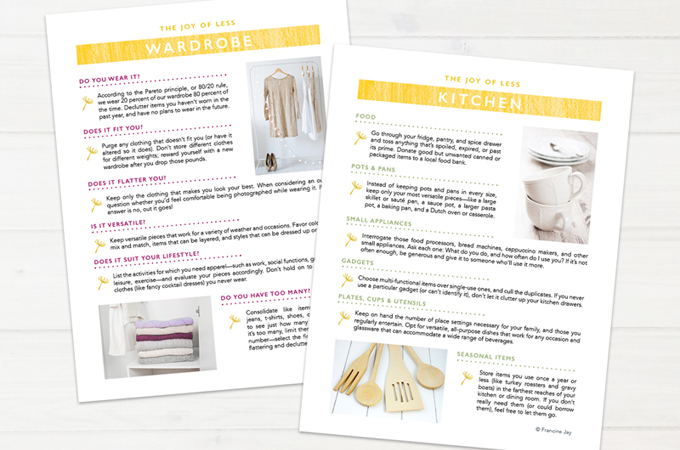
{If you’d like to read more about minimalist living, please consider buying my book, The Joy of Less, A Minimalist Living Guide, or subscribing to my RSS feed.}

Minimalist Makeover: Beth’s Closet and Kitchen

Last week, Beth left the following lovely comment on my post about The Joy of Less:

Thank you! I read your book last week and loved it! There is so much valuable information in it! I started today with my bedroom closet. I kept remembering your words and kept going. I did it and the bedroom (which I am going to use as a yoga room too–don’t have a mattress and box spring–just a futon) is next! My closet looks so good! I can’t believe it but I am only using half of the rods to hang clothes on. I feel like a real minimalist–ok maybe a beginner but I’m into it now. ( :

I was immediately intrigued by her closet makeover (what minimalist wouldn’t be?), and invited her to send me some “before” and “after” photos. I also asked her which advice from my book she found to be most valuable, or inspirational, in her decluttering process. Here was her reply:

What really helped me:

Your advice to take everything out, everything! I didn’t want to do it at first–just as you wrote–there were some things I thought I’d be putting back anyway, why take them out? I did as you suggested though and you know what, many of those items never made it back into the closet!

Also your suggestion about using modules for projects or like items. This really helped me. I make jewelry and knit. Now I have jewelry supply, knitting supply and even technology supply modules instead of having these things all over the table surface or on the closet floor! That box on the shelf with the bike helmet is my jewelry making supply module.

For the kitchen–your strong advice (I love it) to have a place for everything. I realized if my drawers and cabinets were not cluttered then I’d have room for the kitchen items I use but don’t need to have cluttering the counter.

Also–invaluable–your idea of Trash, Treasure or Transfer. This made it fun and easy to do the initial sort through the stuff. I would always get stuck right at the beginning obsessing over items or paperwork and just quitting. This time I just made piles. In trash I had recycle or shred. I’m shredding some of it myself but am going to a community shredding event for the bulk of it. That gave me the idea to post links on my blog to shredding events.

So without further ado, here are the photos of Beth’s closet transformation (before on the left, after on the right):

bethscloset-m

Beth's closet

Notice the clear floor, the nice amount of breathing room between clothes, and the color coding of the bottom rack. She also removed the jumble of boxes from her top shelf, leaving just one box and her bike helmet (what a difference!). I’m sure this serene and streamlined space makes it a pleasure to get dressed each morning!

Beth was also kind enough to send me a snap of her gorgeous, decluttered kitchen:

Beth's kitchen

Beth's kitchen

Those empty countertops are a minimalist’s dream! Keeping all surfaces clear is an important step in my STREAMLINE method (my strategy for achieving, and maintaining, a decluttered home). As I mentioned to Beth, this photo would have made a great illustration for my book. :-)

Many thanks to Beth for sharing these inspirational photos! If you’d like to learn more about her minimalist journey (and see more of her decluttering pics), please visit her blog, Staying True. You can also read her full review of my book while you’re there.

I really enjoyed this, and would love to make “Minimalist Makeovers” a regular feature on the blog. If you have one to share (whether it’s your garage, your living room, or simply your sock drawer), email it to me at:

ct09 AT missminimalist.com (remove the spaces and replace the AT with @, of course!)

Please include a photo of your newly-decluttered space (and a “before” pic, if you have one!). Also, let me know what decluttering advice (from my book, or otherwise) inspired you most.

{If you’d like to read more about minimalist living, please consider buying my book, The Joy of Less, A Minimalist Living Guide, or subscribing to my RSS feed.}

Declutter Your Jewelry Box

Let’s face it—we all have clutter in our jewelry boxes: broken chains, gifts from old flames, grandma’s wedding ring, an uncle’s old watch. Jewelry, however, can be especially difficult to purge. Unlike most clutter, gold and gemstones have intrinsic value—tossing them in the trash is like throwing money away.

Good news: the price of gold is near its all-time high, and jewelers everywhere are buying it from people like you and me. (It may seem contradictory that jewelers would want to buy gold at such a high price, but they make a profit by selling it to a refiner.)

Here’s how it works: clean out your jewelry box of all the bits and bobs you no longer want. Take the pile down to your local jeweler. The jeweler will separate out the gold from the costume (not gold) pieces. You can facilitate this process by looking for 10K, 14K or 18K stamps on your items; in the absence of such markings, the jeweler will use acid, or an electronic tester, to determine the gold content. The jeweler will then weigh your pieces on a scale, and use a multiplier to calculate the gold (“scrap”) value in dollars.

It’s a great way to get rid of (and get cash for!) broken, common, or unattractive jewelry that has little antique value or artistic merit. Finer pieces, or those with quality diamonds and gemstones, will command a higher price than this “scrap” value, and should be taken to an estate jeweler for evaluation.

And if you don’t need the cash, consider gifting sentimental pieces to someone in the family; Uncle Ed’s pocket watch may not be your cup of tea, but it might be a treasure for a nephew or grandson!

The Top Ten Ways to Declutter Heirlooms

I was recently cleaning out some bookmarks (digital decluttering!), and ran across this oldie-but-goodie from the New York Times:

The Tyranny of the Heirloom

In the article, the writer interviews several people who feel compelled to keep the things they’ve inherited — a Victorian settee, an ugly painting, a massive sideboard — despite their dislike for them. Some do it out of guilt, some to hang onto memories, others to preserve their family “history.”

I can relate, as I inherited my grandmother’s twelve place settings of china right after I graduated from college. I dragged them around with me for years, carefully packing and unpacking them during moves across three states. (Perhaps one of the reasons I became a minimalist!) Fortunately, I was finally able to unload them on give them to another family member.

Want to avoid the tyranny of the heirloom? Here’s ten ways to declutter them — with less guilt than simply throwing them away:

1. Be generous, and give them to another family member. (I could never understand why heirs fight over material things — I say, let ‘em take it all!)

2. Donate them to a charitable organization, and let them do some good rather than gathering dust in your basement.

3. Sell them, and donate the money “in memoriam” to your loved one’s favorite charity.

4. Sell them, and use the money for something you really want.

5. Donate historical items to a museum or university.

6. Save a piece of the heirloom (like a swatch of your grandmother’s handmade quilt or wedding dress).

7. Save one item from the collection (like a single plate or tea cup from a set of china).

8. Photograph them, and save the photos (instead of the items) for memories.

9. Re-make the heirloom into something more useful. Have a jeweler set the stones of a gaudy old brooch into a pretty necklace, or use the yarn from your grandpa’s sweater to knit a nice scarf.

10. Avoid them in the first place. Tell family members (gently and politely, of course) that you don’t want them to “save” anything for you, and encourage them to find alternate homes for their treasures.

Has anyone else ever felt “shackled” to an unwanted heirloom? Or does anyone have other creative strategies for getting rid of them?

Minimalist Strategy: Don’t Organize Your Clutter

storagebinI used to be a big fan of organizational items. Although I wasn’t much of a shopper, a trip to The Container Store or Organized Living never failed to excite me.

The idea of corralling hundreds of loose bits and bobs into sleek, perfectly-matched containers had great appeal.  I truly thought that by putting all my stuff into various bins, I could maintain a sense of order in my life.

But while the containers made my house look shelter magazine-tidy, they didn’t bring me the serenity I’d hoped for. Even though everything was arranged neatly in pretty boxes (cloth-covered, wooden, wicker, plastic, etc.), it was still there.

In reality, all those lovely boxes, bins, and drawers served no higher purpose than to hide my junk. At some point I realized that I wasn’t organizing my life; I was organizing my clutter.

That’s when I changed strategies: I went from world-class organizer to world-class declutterer. Instead of arranging and containing things, I got rid of them. I decluttered on the weekends; I decluttered in the evening; I decluttered in the morning; I decluttered in my dreams (really!). When I wasn’t actually decluttering, I was thinking about what I could declutter next.  :-)

And it worked. As my house became emptier, I became happier. With the weight of my stuff lifted from my shoulders, I felt more spontaneous, energetic, and carefree.

The big payoff came when I was able to declutter the containers themselves. There’s something very satisfying about not needing any more storage! Even so, when we completed our ultimate decluttering to move to the UK (see My Minimalist Story, Part 2: The Great Unraveling), I’m embarrassed about how many containers we left on the curb. (Don’t worry, they didn’t go to a landfill; they were snapped up within minutes!)

My advice to anyone who feels they need to get organized: declutter first. If you have to, declutter for a year before you start buying fancy boxes and squirreling things away.

Then think long and hard before you put something into a container (especially if it’s not something you use regularly). Because once you give something a warm, cozy abode, it can be hard to get it to leave.

Minimalist Living: One In, One Out

a(Photo: Moe_)

One in, one out: it’s a simple rule that works wonders in keeping clutter under control.

When trying to lead a minimalist lifestyle, it’s important to monitor the “stuff level” in your home. Imagine it as a bucket full of water. Your decluttering efforts are a hole in the bottom…drip…drip…drip…as you slowly rid your household of unwanted things. But if you continue to pour water in the top, it’ll never empty—and may, in fact, overflow!

To keep your stuff level from rising, live by the following rule: every time a new item comes into your home, a similar item must leave. For every drip into the bucket, there must be one drip out; this ensures that your household won’t flood, and threaten the progress you’re making.

For best results, pair like-with-like items. For example: for every new shirt that goes in the closet, an old one comes out; new handbag in, old handbag out; new pair of shoes in, old pair of shoes out. If you need to rebalance, you can mix it up; for example, if you have too many pants and not enough shirts, feel free to decrease the former, while increasing the latter. But no fair tossing a pair of socks for a new coat!

The system takes a lot of discipline; it’s tempting to cheat, and tell yourself you’ll get rid of something “later.” In fact, it’s essential to commit to “one out” immediately, or it’ll likely never happen. I’ve gone so far as to keep new items, still packaged, in the trunk of my car until I was able to purge something similar.

When you start the process of minimizing your stuff, “one in, one out” is a good stopgap measure. It puts a lid on your number of possessions, and ensures you don’t accumulate more than you purge.

But to really make progress, the flow out the bottom has to exceed the flow in the top. In other words, it’s necessary to increase the decluttering “drips” from a trickle to a steady flow–while “shutting off the tap” to prevent new things from coming into your home (mainly by buying much, much less).

You’ll then see a significant, and rewarding, drop in the water/stuff level–which you can maintain by continuing to practice “one in, one out.”

Ditch the Prints – Digital Photos are More Fun!

photothumbnailsTo be honest, I’ve never really enjoyed spending hours looking through someone else’s family photo albums—and I get the feeling I’m not the only one! On the other hand, receiving a snapshot by email always makes me smile. :-)

I stopped printing digital photos many years ago, and I recently paid a service to scan my shoeboxes of old pictures. Not only has this eliminated a lot of clutter from my life, but I actually look at my photos much more often. I can access them more easily, and more quickly, now that they’re on my laptop. If on a whim I want to view pics of my trip to Paris, the office Christmas party, or even my high school prom, they’re right there at my fingertips; if I had to dig through a closet or shoebox to find them, I likely wouldn’t bother.

Furthermore, in this day and age, digital photos are a lot easier to share than paper ones. Most of us don’t get to see our friends and relatives as often as we’d like—so when we finally visit, we may end up browsing through prints from months (or years!) ago. It’s much more fun to receive a recent pic of a friend’s new baby or relative’s vacation by email, than to slog through a pile of outdated photos later on.

Another point to consider: paper photos can easily be destroyed in a fire, flood, or other disaster (or slowly deteriorate with age). Since digital photos can be “stored” in multiple ways (on a hard drive, online, and on DVDs in different locations), you’re much less likely to suffer a loss of your irreplaceable images.

So kick the print habit, and if you have albums or shoeboxes stuffed with old photos, consider scanning them (or paying a service to do so). You can share your snaps with friends and family by creating online albums through services like Flickr and Shutterfly. Be sure, of course, to burn backup copies of your digital photos onto archival DVDs.

Going digital not only frees up space, and eliminates the need to store, move, and worry about physical photographs; it also enables you (and your loved ones) to derive much more enjoyment from them!

Ebay Reality Check – The True Value of Your Treasures

a(Photo: PetitPoulailler)

Are you holding onto certain items because they might be “worth something?” If so, it’s time to take the Ebay Reality Check. Just about everything imaginable has been sold on Ebay.com—which makes it a great reference with which to value your items.

Unless you are dealing with some true rarities, why pay for an expensive appraisal when you have all that Ebay info at your fingertips? Chances are, if you want to sell an item, that’s where you’ll end up; and no matter what valuation an appraiser gives it, you can only sell it for what someone is willing to pay.

Tired of dusting around that vase you inherited? Don’t know what to do with that old turntable in the basement? No longer interested in the figurines, paperweights, or sports memorabilia you once avidly collected? Take a few minutes, surf over to Ebay, and see what it’s going for!

Chances are, most of your clutter is not fetching a fortune—and in my opinion, any item unlikely to sell for more than $10 is hardly worth the time and effort to photograph it, list it, and ship it.

But that doesn’t mean you have to hold onto it… Feel free to let it go! If you ever have the need for such an item in the future, look how inexpensively you can acquire it!

And for those few treasures for which you can pocket some serious cash—why not go for it? If you don’t need it, and don’t love it, take some snaps and put it up for auction. You’ll have the photographs for memories, and some extra space in your house. And don’t you think Aunt Edna would be pleased if her old silverware helped finance a kitchen makeover?

Minimizing Magazines

The Internet is such a wonderful source of information, that I no longer feel the need to subscribe to any magazines. In fact, many publications make the same content available on their websites, rendering paper copies largely unnecessary.

That said, I know many people prefer to kick back with their favorite glossy rather than stare at a computer screen. Fair enough! As long as you keep current with your incoming subscriptions, you can keep magazine clutter under control. Commit to reading each one the month it arrives. When the new one appears in your mailbox, out goes the old!

If you have a backlog of unread issues, limit the number of publications to which you subscribe. Once you’ve fallen behind two months or so, you’re unlikely to catch up—and the magazine piles will grow and grow. Remember, it’s only possible to read and absorb so much information; anything beyond that only leads to mental clutter. It’s important to keep your mind as clear as your space.

And by all means, do not keep an entire magazine for one interesting article. Tear out the article and file it; or better yet, scan it into your computer. The less paper clutter the better, and the information will be at your fingertips when you need it.

One more thing: if you are going to receive paper subscriptions, please don’t let them pile up in a landfill. Recycle them, or donate them to your local library, physician’s or dentist’s office. And when you’re feeling “greener,” think about giving up the paper copies altogether—you’ll not only save money, but a whole lot of trees!

Goodbye, Stuff

a(Photo: sflovestory)

Dear Stuff,

I’m not sure how to break this to you…but the time has come for us to part ways. Sure, we have a long history, but we simply can’t go on pretending that we’re still happy together.

It seems that after all these years, our relationship has lost its spark. I recall the magic of when we first met: how your shiny newness caught my eye, how I vowed to have you at any price, how excited I was to bring you home.

It didn’t take long, however, for the novelty to wear away. Maybe it was the thrill of the hunt, but once you were mine, you no longer seemed quite so attractive. In fact, much of the time, you just seemed to be in the way.

What’s more, you never really lived up to your promises or expectations: owning you didn’t make me any smarter, happier, cooler, or sexier. Instead, our relationship drained my energy and my wallet. I’ve spent untold hours (and dollars) keeping you looking nice and in good repair, protecting you from theft, and moving you around when I’ve had to relocate.

To be honest, though, your presence in my living room, bedroom, kitchen, and closets is stifling me. I can’t help but wonder how you’ve expanded so much over the years. I’m getting tired of stepping over you, cleaning around you, and generally wondering what to do with you. I need some space, some serenity, some room to breathe.

Of course, you’re not entirely to blame; I was no angel, either. Though I kept a roof over your head, I never really lavished you with attention. I shoved you away in boxes and closets, sometimes neglected to maintain you, and all too often simply ignored you.

Therefore, I think you’ll also be better off without me. You’ll have a happier life with someone else—someone who wants you, needs you, and appreciates you for what you are. And don’t worry, I won’t be so cruel as to leave you out on the curb. I’ll post flattering photos of you on Craigslist, sing your praises on Freecycle, and contact charitable organizations to find you that special someone.

So I guess this is goodbye…Let’s part without regrets, and look on this as a new beginning. I already feel like a weight has been lifted off my shoulders, and I’m ready to embark on a new life—unencumbered, footloose, and full of possibility!

Yours Truly,

Miss M.