From the time I was young, I’ve had mixed feelings about the holidays. While I love the excitement, the festivity, and the gatherings with family and friends, I’ve always dreaded the “stuff” that seems to come along with it.
When I was a child, I couldn’t articulate just what it was that made me so uncomfortable about Christmas. I enjoyed the anticipation, and how the spirit of the season made the everyday world seem more magical (I’ve always had a thing for fairy lights.) But the day after opening my mountain of presents, I’d tuck them away as quickly as possible, unsure of how to handle the sudden barrage of new possessions.
I began to understand my problem as a young adult. Immediately after Thanksgiving, I’d go into defensive mode. I knew stuff would soon be flying at me from all directions (from family, relatives, friends, colleagues). I’d try my best to get out of gift exchanges, and dodged social calls that might involve presents (“let’s get together after the holidays instead”), but I felt like I was fighting a losing battle. In the end, I’d graciously accept what was given to me, and then return, regift, or donate what I could.
Fortunately, as my minimalist lifestyle became more understood and accepted, things changed. At first, people despaired about what to get me. “You’re so hard to shop for!” was a common refrain. Eventually, though, there came a point where I could rest easy; the vast majority of gifts I received were of a consumable nature (food, wine, homemade cookies). Better yet, many friends were happy to get together for a holiday lunch or dinner in lieu of exchanging presents.
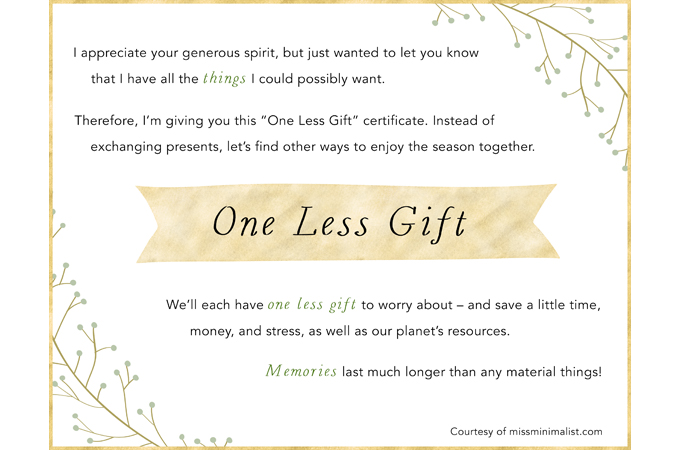
In fact, as awkward as the topic often was to address, it seemed that the end of a gift exchange brought a sense of relief all around. I honestly think that a lot fewer presents would change hands if people had an easy way to say “Let’s stop.” While I’ve never personally used one, I like the idea of a gift exemption certificate, as shown here and here.
If you’d like to join me in making this holiday a minimalist one, here are some ideas to consider:
Gifts. Try to limit gift exchanges as much as possible. Propose alternatives (like a get-together instead of presents) to friends and family. At the very least, express a preference for consumables; it’ll dramatically decrease your post-Christmas clutter. For those with children, consider following Heather’s example in her comment to my Born Minimalist? post. She gives her young son four gifts for Christmas, and asks him to donate one to Toys for Tots. (I just love this idea!)
Cards. The vast majority of holiday cards wind up in the trash by January, so consider emailing a holiday greeting instead. You’ll save time, money, and the environment. If you feel you must send a card, consider recycling an old one—cut off the picture on the front, and send as a postcard.
Decorations. Give yourself permission to enjoy other people’s decorations, instead of feeling obligated to display your own. I haven’t had a Christmas tree, or decorated my home with lights, in years; I much prefer walking around neighborhoods and downtown streets, and admiring everyone else’s efforts.
If anything, opt for natural décor (greenery, berries, and pine cones) instead of mass-produced, store-bought items.
Just because you’re a minimalist doesn’t mean you can’t enjoy the holidays. In fact, you may even enjoy them more! The key is focusing on the experience of the holidays, rather than the stuff.
Even though my husband and I won’t be sending cards, exchanging gifts, or putting up any decorations, we’re looking forward to the season with the same anticipation we had as children. We love seeing the streets of London turn into Dickensian scenes of twinkling lights. We’ve also booked a trip to the Christmas markets in Cologne, Germany—not to buy anything, but rather to nibble stollen and sip hot chocolate while taking in the festive atmosphere around us.
I’d love to hear how others plan to celebrate the holidays. Are you taking any steps to simplify your Christmas (or Hanukkah, Kwanzaa, winter solstice, etc.)?