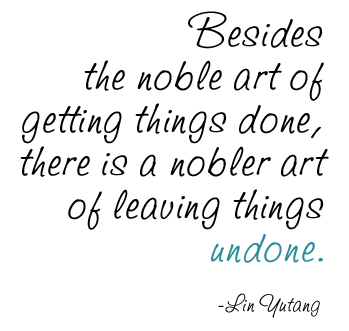
Without All This Ado

(Photo: mctroutman)

Yesterday, the property manager of my current sublet told me she’d be showing the place to potential tenants that afternoon. (We’re only here for the summer, as we don’t want to sign the required one-year lease.) I feel awkward hanging around during showings, so I planned to take my iPod Touch to the park for some reading. As I headed out the door, I realized I forgot to charge it—so I grabbed the book by my husband’s side of the bed (Hard Scrabble by John Graves) and took that instead.

What a fortuitous choice! For on the very first page was the following passage (from Thomas Traherne’s The Centuries):

It is storied of that prince, that having conceived a purpose to invade Italy, he sent for Cineas, a philosopher and the King’s friend: to whom he communicated his design, and desired his counsel. Cineas asked him to what purpose he invaded Italy? He said, to conquer it. And what will you do when you, have conquered it? Go into France, said the King, and conquer that. And,what will you do when you have conquered France? Conquer Germany. And what then? said the philosopher. Conquer Spain. I perceive, said Cineas, you mean to conquer all the World. What will you do when you have conquered all? Why then said the King we will return, and enjoy ourselves at quiet in our own land. So you may now, said the philosopher, without all this ado.

Granted, most of us don’t entertain notions of world domination—but I think it’s a wonderful metaphor for the insatiable wants that can consume our lives.

How often have you thought, “Life will be better when {fill in the blank}.” You get that bigger house, nicer car, newer gadget, or hipper clothes. The better job, fancier title, or more advanced degree. More money, more power, more fame, more respect.

In our winner-take-all society, we’re conditioned to keep striving, and striving, and striving for more. But where does more end? What exactly are we striving for? Is it possible to have everything—and if so, what happens then?

Wouldn’t it be easier to just sit back and enjoy things as they are?

Let’s forget the luxury cars, and simply celebrate the auto, bike, train, bus, or legs that currently provide us mobility. When it’s rainy and cold, let’s be overjoyed to have any roof over our head. Instead of working ourselves into the ground for that promotion or corner office, let’s feel lucky that our current job provides for our needs. Let’s stop browsing shops, websites, catalogs, and magazines looking for things to want, and be satisfied with what we already have.

Okay, so no one will ever praise my ambition or invite me to speak at a motivational seminar. My idea of achievement has nothing to do with money, status, or lofty goals, but rather redefining achievement to be not-so-lofty. In other words, instead of expending great effort to get more, I find it infinitely easier to want less.

Because even if we made a fortune, shot to fame, or conquered the world, who guarantees we’d be happy? Perhaps we’d wish for the simple, quiet, humble life we’d left behind.

I have nothing against reaching for the stars, except when it blinds us to what’s in our grasp. If we re-focus, we may see that contentment, happiness, and fulfillment are sitting right in front of us, there for the taking.

To me, that’s the beauty of minimalism: setting our sights on what’s enough, and enjoying life without all this ado.

{If you’d like to learn more about minimalist living, please consider reading my book, The Joy of Less, A Minimalist Living Guide, or subscribing to my RSS feed.}

Drifting

Drifter {definition}: a person who goes from place to place, job to job, etc., remaining in each for a short period.

Two years ago, when I moved to the UK, I thought it was pretty impressive that I lived out of a duffel bag for six weeks.

Ha! I’ve been doing it now for over three months.

My husband and I gave up our flat in February, and decided we didn’t want to commit to any long-term housing options. Therefore, we’ve been in and out of hotels, sublets, and extended stays ever since.

In two weeks, we’ll be moving into our fifth “home” in less than a year (“home” being somewhere we’ve stayed longer than a month).

Last summer, my home was an 800-square-foot two-bedroom flat. That’s where I started this blog, and wrote my book.

Last fall, my home was a 390-square-foot one-bedroom with high ceilings and enormous windows. That was my first taste of tiny living.

Earlier this year, my home was an extended stay studio with yellow walls, green carpeting, a red sofa, and a small kitchenette. That’s where I filed my tax return.

Right now, my home is a 1200-square-foot apartment in a grand old Victorian mansion. Architecturally, it’s one of the most stunning places I’ve ever lived, but is filled top to bottom with someone else’s stuff. (I fantasize at least once a day about emptying it out and painting it white!) That’s where I’m writing this post.

Next month, my home will be a small one-bedroom in a converted warehouse, in close proximity to a lovely park.

I know it sounds like a royal pain to be always on the move, and hunting for new digs. Fortunately, though, we’ve been lucky enough to find nice accommodations; and moving day has been reduced to stuffing our bags in a cab and taking it across town. To be honest, this nomadic life has been quite easy and carefree—and dare I say, it’s begun to feel “normal.”

I remember when my husband and I bought our house back in 2003. It took about a month before it really felt comfortable to me, before I could walk around in the middle of the night without bumping into things.

Since then, my adjustment period has drastically decreased. Now it takes me all of a few hours, from the time I first plop down my duffel bag, to think of a new place as home—even if it’s furnished with stuff I’d never choose, or the closets are packed with someone else’s clothes.

I’ve become accustomed to (and quite fond of) the fact that the sum total of my possessions are in packing cubes in my duffel bag, a toiletry case in the bathroom, and a handful of cooking implements on the kitchen counter.

I’ve almost forgotten what it’s like to put my clothing in a closet, my books on a shelf, my spices in a drawer, or my lotions and potions in a medicine cabinet. It feels like ages since I’ve slept in my own bed, or received mail at a regular address. I’ve become adept at tracking things down on an as-needed basis: I’ve borrowed office supplies from hotel reception desks, cleaning supplies from housekeeping, and kitchen supplies from various landlords.

Furthermore, I now analyze the portability of every potential possession. I buy shampoo, laundry detergent, and olive oil in the smallest bottles possible. I calculate whether I have room in a packing cube for a new shirt or pair of socks. And yesterday, I passed on buying a bag of flour because I didn’t want the hassle of moving it in two weeks.

Most importantly, though, drifting from place to place has changed my way of thinking. Lately, I’ve been contemplating, do we ever really own anything? Whether it’s books, clothing, tchotchkes, cars, or even houses, things feel radically less permanent to me. In the grand scheme of things, it seems they’re all on temporary loan until we can’t (or don’t want to) use them anymore—at which point we pass them along, or they get passed along for us.

As such, I think material things deserve far less attention than we tend to give them. I’ve become more and more enamored with the notion of the itinerant monk, wandering with only what he can carry and meeting his needs on the go. Sure, I’ll never reach that level, but I like it all the same. :)

I’ve become acutely aware of how possessions can needlessly complicate things. If I were carting around a houseful of stuff, this past year would have been nothing short of a nightmare. However, it’s been just the opposite: minimalism has made this experience surprisingly pleasant and enjoyable. As someone who thrives on change, I love the novelty of trying out a variety of neighborhoods and living arrangements. I like the idea of not knowing where I’ll be three months down the road.

I can certainly see the value of having roots, a community, a permanent address. But given our current situation, it’s just not in the cards right now. We’ll likely be drifting for the foreseeable future, and to tell you the truth, I don’t mind a bit.

{If you’d like to learn more about minimalist living, please consider reading my book, The Joy of Less, A Minimalist Living Guide, or subscribing to my RSS feed.}

Messages from Japan

Kaori, a reader from Tokyo, left a very thought-provoking comment on last week’s Real Life Minimalist post. I know that many of you don’t subscribe to the RSS Comments feed; therefore, I thought I’d share it in today’s post in case you missed it:

hi. I’m writing from Tokyo, Japan where as a city we’re having to rethink our priorities in terms of stuff, power and fuel. As you may know, this country is in the midst of the greatest national crisis (earthquake, tsunami, nuclear plant meltdown) since WWII and as I write, tens of thousands of people are stuck in evac shelters with no cash, no home, no job and a dark, uncertain future. Those of us in Tokyo send money and supplies and go out on weekends to volunteer. It’s nowhere near enough, however and it seems like we go from day to day clinging to a bizaare hope that tomorrow or sooner, things are bound to get better.

What’s crushing for myself and many others in Tokyo is that we had let ourselves be lulled into an unforgivable state of complacency. We had convinced ourselves that to work 14 hour days and shop like crazy was the norm and prerequisite, for living in one of the wealthiest, glitziest and convenient cities on the planet. The reality is that there are 10 – count ‘em -10 nuclear power plants in the northeastern region of Japan, mainly to feed and fuel this one, particular city. Nationwide, there are 53 nuclear power units, any one of which could be seriously damaged and leaking radiation in the event of another major quake.

How did we let this happen? The Japanese are natural minimalists; living on less and the desire not to own stuff is embedded in our DNA – borne of a long history of constant civil strife and the knowledge that in a country with zero natural fuel sources, the best option was to live with nature instead of against it. Yet, in the pursuit of wealth and convenience and the need to become a global contender, Japan ditched a lot of hard-won wisdom for short-term gratification. Tokyo has a lot to answer for, but at this point in time we don’t even know where to start. Individually, people are trying to save on power. Individually, many are abstaining from spending and excess. But we’re told that to do so will wreak havoc on an already wilting economy. Ironically, the more we work to try to survive, the more we use fuel which gives the electric company and the government more of an excuse to keep those nuke plants operative which tips the scale that much further to trigger another catastrophe.

Personally, I want off the grid. For me, the first step to real minimalism is to let go of worries over what other people think and to liberate myself from the dictations of the status quo. I’m hoping that the majority of the city will come around to the same conclusion – causing us all to turn off the main switch, open all the windows and see what happens.

I also received a poignant email from Mitsuko, who was affected directly by the disaster:

I am a minimalist in japan. On March 11th, we had huge earthquake in our country. Many many people died, lost their houses, their things, and lost their loved family. Now, we had still rolling blackout, so we can’t use enough electrics. And we have strong fear about broken nuclear plant.
Now, among Japanese, there are many change of the way of thinking. Though we had worked hard, and had bought a lot of stuff, these stuff actually useless when we met such a disaster.
We had latest TV, DVD, New huge houses, but now, everything had gone.
Of course, many people are  overwhelmed by  this situation now.
They can’t stand up to take care of themselves now.
But, many Japanese people found that their prosperity are depend on those people life who live near the nuclear plant.
We try not to use extra electronics, eat less, and buy less.
My house has broken because of this earthquake, and our family had to move new house. We lost many chinas, furniture, my favorite plants. But I can start over, because I am a minimalist.
I hope it will be a chance that many japanese will reborn as minimalists.

First of all, my heart goes out to Kaori, Mitsuko, and the Japanese people—they’ve experienced unimaginable losses, and continue to struggle with the aftermath of this terrible tragedy. Let’s remember that they still need our help.

I think we all have something to learn from their words. In our pursuit of wealth, of stuff, of status symbols, what have we lost sight of? How many hours have we given up with our families by working overtime? How much of nature’s resources have we squandered away on trendy clothes, new tech gadgets, or tchotchkes to decorate our homes? How much time and resources have we wasted consuming goods and entertainment, instead of enjoying nature or participating in our communities?

I only hope that such an event brings us all a new mindfulness—of our lifestyles, our actions, our principles, our priorities.

I truly believe that minimalism can lead us down the right path. Each time we decide against a frivolous purchase, make do with something we already have, or engage in other acts of consumer disobedience, we give a little gift to the planet. Each little action may seem inconsequential, but our efforts ripple out to effect positive change in the world.

Minimalist living isn’t a trend or blog-flavor-du-jour; it’s a conversation we need to keep going. Because the less we “need” (and the more we talk about it), the better our chance of changing the current paradigm: from one of rampant consumerism and resource depletion, to one of conservation and sustainable growth. Let’s stop the mindless work-and-spend cycle, and start to appreciate the beautiful, symbiotic relationship we have with each other and our planet.

Let’s put buying on the backburner, and focus on being instead; or, in Kaori’s words, “turn off the main switch, open all the windows and see what happens.”

Thank you, Kaori and Mitsuko, for your wonderful messages.

Minimalist Philosophy: Sophrosyne

(Photo: phocks)

A few weeks ago, while researching my post on areté, I tripped across another interesting concept from classical Greece: sophrosyne.

Sophrosyne (pronounced suh-FROSS-uh-nee, if you’d like to impress your friends) is an ancient ideal involving healthy-mindedness, balance, and moderation. As you can imagine, I was immediately intrigued. :)

According to Wikipedia, sophrosyne “is perhaps best expressed by the two most famous sayings of the oracle at Delphi: ‘Nothing in excess’ and ‘Know thyself.’ The term suggests a life-long happiness obtained when one’s philosophical needs are satisfied, resembling the idea of enlightenment through harmonious living.”

Unfortunately, the word has no direct counterpart in English, and an in-depth understanding requires a reading of Plato’s Charmides, The Symposium, and The Republic. But if you don’t mind a little armchair philosophy, I’ll give you my interpretation of the term, and how it relates to our minimalist journey.

As I see it, there are three main facets to sophrosyne:

  1. Self-knowledge
  2. Self-restraint
  3. Harmony

Or, in my minimalist interpretation:

  1. Knowing what’s enough for you
  2. Choosing enough over excess
  3. Finding joy in enough

Sophrosyne, then, isn’t about self-denial. Rather, it’s avoiding overindulgence (like doing, buying, owning, or eating “too much”) because it truly makes you happier to do so.

Some examples:

Sophrosyne isn’t skipping the Doritos or a second helping, and feeling miserable about it; it’s eating healthy foods, in healthy proportions, because it makes your body feel better.

Sophrosyne isn’t denying yourself that new handbag/gadget/car, while continuing to yearn for it; it’s being excited to preserve some of the Earth’s resources, or put that money into your child’s college fund instead.

Sophrosyne isn’t giving up your TV because it’s “a minimalist thing,” but because it gives you more time to pursue the activities you love.

Sophrosyne isn’t throwing all your stuff away in a no-holds-barred decluttering session; it’s questioning whether each item you own adds value to your life, or if you’d be happier without it.

Sophrosyne isn’t about choosing moderation because you think you should, but because it feels right and delights your soul.

A common misconception about minimalists is that we ditch our material possessions in some bizarre attempt to deny ourselves the “pleasures” of consumerism. I think what critics don’t get is this concept of sophrosyne: that we reject overconsumption because we get more pleasure from not owning three closets of clothes or a houseful of knickknacks. We derive more happiness from saving our space, time, money, or the planet, than acquiring more possessions.

Sophrosyne isn’t about self-restraint for its own sake, but rather the joy it brings us. It’s living a wise, graceful, and balanced life because we wouldn’t have it any other way.

In the time of Aristotle and Plato, sophrosyne was of supreme importance, a virtue to which people aspired. Unfortunately, it’s been lost in our modern age. Today, our society rewards the big, the loud, the radical, the extreme; sophrosyne, in contrast, is all about quiet elegance. I hope, however, that the growing popularity of minimalism—living beautiful lives with less—will spark a new interest in the concept.

Having sophrosyne is like being a finely-tuned instrument, with all our thoughts, values, and actions in harmony. But it goes beyond that: mastering our desires, and avoiding extremes in consumption, attitudes, and behavior, doesn’t benefit only ourselves. Like the melodious note from a plucked string, sophrosyne radiates out to the rest of the world, helping us live in harmony with nature and each other.

I hope I’ve been able to explain this wonderful concept with some coherence. Is anyone else as enamored with sophrosyne as I am?

{If you’d like to learn more about minimalist living, please consider reading my book, The Joy of Less, A Minimalist Living Guide, or subscribing to my RSS feed.}

Chopping Wood and Carrying Water

I’ve been interviewed countless times over the past year, and frequently asked “What is minimalism?” More often than not, the reporter is looking for something dramatic, something newsworthy, something extreme. And more often than not, my answer disappoints them.

Why? Because in my opinion, minimalism is not about being radical or awesome or extraordinary.

It’s not about reducing your entire life to a hard drive, or interacting with the world through your iPhone.

It’s not about quitting your day job, traveling the world, or selling ebooks from a tropical beach.

It’s not about living in a sleek loft with three pieces of designer furniture.

It’s not daring, nor dramatic, nor even all that difficult.

What is minimalism then?

It’s eliminating the excess.

It’s asking “why” before you buy.

It’s embracing the concept of enough.

It’s living lightly and gracefully on the Earth.

It’s uncovering who you are when all of the logos, brand names, and clutter are stripped away.

It’s simple, it’s ordinary, and it’s accessible to everyone – even those whose lives are filled with kids, pets, laundry, and junk mail.

I’m reminded of the saying, “Zen is chopping wood and carrying water.” In other words, the world of enlightenment is none other than our everyday world.

In the same way, minimalism is chopping wood and carrying water. It’s cooking dinner, doing the dishes, paying the bills, and playing with our kids – no radical lifestyle changes necessary.

It’s simply going about our daily lives with a new clarity, and awareness, and appreciation. It’s cherishing the experiences that fill our days, rather than the stuff.

That’s not an answer that makes national headlines or the evening news. But it makes for happier, kinder, and more contented souls.

What’s your one-sentence definition of minimalism? Please share it with us in the Comments.

{If you’d like to learn more about minimalist living, please consider reading my book, The Joy of Less, A Minimalist Living Guide, or subscribing to my RSS feed.}

Arete: Minimalism and the Pursuit of Excellence

disc-m150Back in college, I had a thing for Greek philosophers. While my peers were obtaining more practical knowledge in business, engineering, and the like, I was reading Plato and Aristotle and pondering the meaning of life.

My fling with these ancient thinkers was pushed to the backburner when I graduated, however; after all, I had more pressing concerns – like paying the rent and making a living.

Occasionally, though, something sparks that flame anew; most recently, a reader named Anna. In her email, she reminded me of the concept of areté, and how it relates to minimalism.

Areté, in the most general sense, means excellence – particularly with regards to fulfilling a purpose or function.

The areté of a knife is to cut well. The areté of an ear is to hear well. The areté of a lamp is to illuminate well.

So what does this have to do with minimalism?

When we’re trying to declutter, areté is a call to quality over quantity. Choose one pen that writes superbly over a drawerful of mediocre ones. Choose one gadget that functions flawlessly, rather than a slew of sub-par ones. Choose a small wardrobe of excellent clothes instead of a closetful of  inferior ones.

Considering areté makes us mindful of every object we own – and encourages us to question whether it’s performing its function to the best of its ability.

The vase that elegantly showcases your garden’s flowers? That’s living up to its areté. The broken printer in the corner of your office? Not so much.

A minimalist household, then, is one in which the areté of every item shines forth.

But there’s more to it than that – there’s our own areté to consider. And here’s where minimalism really lives up to the hype. By stripping away all the clutter, the excess, and the non-essentials in our lives, we can uncover our own particular excellence. It’s a process of peeling away the layers, to see what’s at our core.

When I moved overseas, I had the rare opportunity to do this in one fell swoop. I arrived in the UK stripped of my possessions, my home, my family, my friends, my career. And as I sat in an empty room with little more than a laptop, I was forced to ponder what was left. Who was I after all the stuff, all the expectations, all the trappings of the life I knew were taken away?

And that’s when I found my areté: to write well, and do some good in the process.

My areté won’t be the same as your areté, and your areté won’t be the same as your neighbor’s. Whether it’s excelling in business, as a parent, as a poet or a humanitarian, your areté as an individual is unique.

Becoming minimalists not only helps us discover our areté, it helps us achieve it. For areté doesn’t come without hard work and discipline: according to Hesiod, “between us and Goodness [his term for areté] the gods have placed the sweat of our brows: long and steep is the path that leads to her…”

Minimalism eliminates all those things that distract us from our areté – like clutter, debt, and concern about keeping up with the Joneses. Each unnecessary thing we purge (or choose not to buy) is one less thing to fuss over, clean, repair, maintain, and pay for. Each unfulfilling task we toss from our schedules is one less hassle in the course of our day.

In paring down to the essentials, a myriad of worries fall to the wayside. And what are we left with? More space, more minutes, more attention for what’s important.

We regain the time, clarity, and energy to discover our true purpose in life, and fulfill our highest potential. In short – the chance to realize our areté.

Have you found your areté? Please share with us in the Comments!

é

The Year of the Butterfly

bluebutterfly-m125

.

The small butterfly
moves as though unburdened by
the world of desire

-Haiku by Kobayashi Issa


Today marks the first day of the Chinese New Year, which according to their lunar calendar is the Year of the Rabbit.

Well, I’d like to propose a special New Year for us minimalists: let’s make this the Year of the Butterfly.

Why? Let me explain with an excerpt from my book, The Joy of Less, A Minimalist Living Guide:

When we overconsume, we’re like bulls running through a china shop—leaving a destructive path of downed forests, dirty waterways, and overflowing landfills in our wake. In our quest for more goods and unfettered growth, we break the Earth’s fragile ecosystems, shatter the lives of indigenous peoples, and leave future generations to clean up the mess.

As minsumers, we want to do the opposite. Instead of being bulls, we strive to be butterflies—living as lightly, gracefully, and beautifully as possible. We want to flit through life with little baggage, unencumbered by excess stuff. We want to leave the Earth and its resources whole and intact, as if we alighted just for a moment and barely touched them.

The Earth has a finite number of resources for a growing number of people; and as more countries become industrialized, the greater the pressure on the system. When we act like bulls, we grab more than our fair share. We feel entitled to support our consumptive lifestyles at any cost, and worry little about the effects on the environment. We don’t give a second thought to what’s left over for others, or whether we’ll have enough land, food, water, and energy to go around. What’s worse: in a “growth at all costs” economy, such behavior becomes the norm. Imagine hundreds, thousands, even millions of bulls stomping through the world and stripping it bare of its bounty.

When we act like butterflies, on the other hand, we’re satisfied with the barest of essentials. We consume as little as possible, conscious of the fact that resources are limited. We celebrate the gifts of nature—a spring breeze, a clear stream, a fragrant flower—rather than trampling them. We’re aware that we’re stewards of the Earth, and have a responsibility to nourish and nurture it for future generations. We exist harmoniously with each other, and within the ecosystem.

With that in mind, here’s 10 ways we can live more like butterflies this year:

1. Buy less. Resolve to purchase only the essentials, and refrain from acquiring new clothes, décor, electronics, and other unnecessary items.

2. Be content with what you have. To a butterfly, more is only a burden.

3. Act gracefully. Do what you do, and say what you say, with poise and elegance. Brash language and aggressive attitudes just aren’t cool (or particularly pleasant).

4. Appreciate nature. Seek entertainment in parks and forests, instead of movie theaters and malls. Enjoy the latest blooms instead of the latest releases.

5. Eat fresh and light. Like a butterfly, get your nourishment from the natural world—chemical-, preservative-, and hormone-free. Consume only what’s enough, instead of indulging in excess.

6. Preserve the Earth’s resources. Be a minsumer, and consider the effect of every purchase on the environment. Buy used, buy local, and recycle whenever possible.

7. Inspire others with your actions. Instead of preaching, let the beauty of your ways be an example to others.

8. Lighten your burden. Donate your excess to others: Goodwill, the Salvation Army, and local thrift shops can help distribute your castoffs to those who need them most.

9. Live in the moment. A butterfly doesn’t pine for the past, or fret about the future; rather, every moment is its eternity.

10. Love unconditionally. Understand that you’re connected to every person, plant, and animal on this planet, and treat them all with love, kindness, and respect.

I’d love to hear your ideas for living lightly, gracefully, and beautifully this year. How will you make this the Year of the Butterfly?

The small butterfly

moves as though unburdened by

the world of desire

108 Bells: Decluttering for the Soul

japanbell-m3

In Japan, at the stroke of midnight on New Year’s Eve, temple bells across the country toll 108 times. According to Buddhist teaching, we have 108 earthly desires that cause us suffering – and by listening to the bells toll, we can dispel each desire, one by one.

For example: first ring – goodbye, greed. Second ring – goodbye, jealousy. Third ring – goodbye, vanity. And so on…

If you’re curious, here’s a list of the 108 “defilements,” courtesy of virtuescience.com:

Ostentatiousness, grudge, gambling, ingratitude, dipsomania, ambition, dominance, faithlessness, manipulation, stinginess, pessimism, hostility, abuse, debasement, sexual lust, sarcasm, humiliation, jealousy, gluttony, unruliness, hurt, cruelty, unkindness, obstinacy, envy, indifference, negativity, furtiveness, sadism, enviousness, derision, falseness, high-handedness, know-it-all, rage, aggression, rapacity, effrontery, disrespectfulness, hard-heartedness, eagerness for power, lying, insidiousness, self-denial, inattentiveness, contempt, wrath, haughtiness, greed for money, seducement, vindictiveness, insatiability, voluptuousness, excessiveness, censoriousness, dissatisfaction, egoism, ignorance, hatred, greed, impudence, imposture, cursing, imperiousness, lecherousness, callousness, malignancy, torment, intolerance, blasphemy, shamelessness, irresponsibility, obsession, prejudice, arrogance, violent temper, garrulity, dogmatism, presumption, intransigence, oppression, prodigality, lack of comprehension, obstinacy, pride, conceitedness, delusion, quarrelsomeness, self-hatred, violence, vanity, hypocrisy, stubbornness, baseness, pretence, mercilessness, disrespect, ridicule, masochism, tyranny, capriciousness, deceit, anger, discord, calculation, unyielding, desire for fame, deception. (I imagine that some of the repetition is due to translation.)

This ritual, called Joya-no-Kane, is a beautiful purification rite that encourages a spiritual fresh start for the coming year – and one that I believe has particular relevance for us as minimalists.

When we pursue a minimalist lifestyle, we often begin by focusing on our stuff. We clean out our closets, pare down our wardrobes, and purge the tchotchkes from our living room shelves.

Some of us then unleash our decluttering prowess on our schedules: we set priorities, learn to say no, and streamline our commitments to free up our time.

This year, I propose we go one step further: let’s declutter our souls. Let’s purge all those negative habits, attitudes, and traits that keep us from being the best people we can be.

Take a few moments, and consider what “defilements” you’d like to cast off (the list above provides plenty of inspiration!). For each one, ring a bell (literally or figuratively), and resolve to eliminate it from your life.

We can declutter until the day is long, but clean closets alone won’t make us better people. To be sure, creating a calm and serene environment is important – but it’s just the first step. Once we’ve eliminated the outer clutter and chaos, it’s time to turn our attention inwards. It’s time to do a clean sweep of our souls, so that we can uncover the beauty within – and truly become the change we want to see in the world.

{If you’d like to learn more about minimalist living, please consider reading my book, The Joy of Less, A Minimalist Living Guide, or subscribing to my RSS feed.}

How Minimalism Can Change the World

A few days ago, long-time reader Jens sent me a wonderful article from the BBC News Magazine. It details the inspirational story of Toby Ord, a 31-year-old British university researcher who’s pledged to give away £1 million to charity over his lifetime. The truly inspirational part: he plans to do this while living on little more than the average salary.

In the past year, he’s given away £10,000 – a figure that represents more than a third of his earnings. Going forward, he’s vowed to donate all his annual earnings above £20,000 to help those living in the poorest countries.

What I love about Toby’s story (besides his amazing generosity) is his methodology: he determined exactly how much money was enough for him, then decided to give away the excess.

He realized that spending that money on more stuff wouldn’t make him happier; and instead, feels much more fulfilled using it to help others.

In his words:

“What’s really important in our lives is spending time together, chatting with our close friends and reading beautiful books and listening to beautiful music, and we’re really lucky to live in a beautiful place and there are lots of stimulating cultural activities around. With all that you can’t really ask for much more.

“I’ve also changed the way I look at the world. I don’t want more stuff. If someone said to me ‘Here’s one thousand pounds’ and I had to spend it on myself I would feel anxious about that because I just want to help people more and it would be a very frustrating time.”

Toby doesn’t consider his pledge to be a big sacrifice, explaining that he and his wife live a perfectly comfortable, middle-class existence in their one-bedroom flat:

“It’s not that amazing. I’m not that impressed by this, but I’m glad that people feel it’s a good story. The median income is £18,000 so I’m not living off anything less than the median person in the UK.

“It’s quite possible to present this as a very positive thing. You can help people so much without impacting on your own life. We can still live a middle-class life on this kind of money.”

You can read the whole article here:

Toby Ord: Why I’m giving £1m to charity

Toby Ord has also set up a website, Giving What We Can, to inspire and help others perform their own acts of generosity. Two pages are particularly illuminating: How Rich You Are, which calculates your wealth relative to the rest of the world; and What You Can Achieve, which tells you how many lives you can save, years of health you can add, and years of school attendance you can produce by donating a portion of your income. The message: we’re millionaires compared to those living on a dollar a day, and the smallest sacrifice on our part can prevent untold suffering.

So what does this have to do with minimalist living?

Over the past year, I’ve heard many a critique of minimalism – mainly by people who think it’s nothing more than counting items, decluttering closets, or living out of a backpack.

My answer: minimalism is so much more than that. Minimalism is determining when you have enough, so you can do something extraordinary with the excess.

That may mean working fewer hours so you can spend more time with your kids; buying less stuff to preserve more of the Earth’s resources; or, like Toby Ord, spending less money on material goods and donating more to those in need.

In short, living with less means you have more to give.

That’s the beauty of enough – and that’s how minimalism can change the world.

The Quick and Easy Guide to Coming Out as a Minimalist

a(Photo: John Loo)

“So, I hear you’re a minimalist. Not that there’s anything wrong with that.”

Last week, a reader emailed me for advice on how to “come out” as a minimalist. She wanted to explain to friends and family her desire to live simply—in a way they would understand, and without sounding judgmental of their lifestyles.

I think it’s a fabulous question, and imagine she’s not the only one struggling with this issue. For outside the cozy confines of the blogosphere, a declaration of “I’m a minimalist” may very well be met with, “You’re a minima-WHAT?” Smirks, raised eyebrows, and quizzical looks are not out of the realm of possibility, either.

I’m lucky—I eased my way into minimalism long before it was a popular Google search. As I decluttered slowly and methodically, year in and year out, my friends and family had plenty of time to assimilate my lifestyle. Though they may have found my empty rooms, bare walls, and sparse wardrobe quirky, they simply accepted it as who I was.

Those of you on a faster track to freedom-from-stuff, however, may find things a bit more challenging on the friends-and-family front. Never fear – I’ve written this Quick and Easy Guide to Coming Out as a Minimalist, just for you:

1. Tell the truth. Be honest about why you’re embracing a minimalist lifestyle. For example: you’d like to be more mobile, you’re concerned about the environment, or you’d like to be able to find things in your home without mounting a search expedition.

2. Focus on the positive. Explain the benefits you’ll experience from adopting a minimalist lifestyle, rather than the negatives associated with a non-minimalist lifestyle. For example: instead of saying you gave up your TV because it’s a soul-sucking time-waster, explain how you’ve found more time to read, write, and pursue your hobbies without it.

3. Give concrete examples. Many people have a hard time relating to “minimalism” as an abstract concept. However, if you tell them exactly *why* having less stuff makes you happier, they’re much more likely to understand. For example: you’re striving to declutter your home so you’ll have more space to work on your art, play with your kids, or do yoga.

4. Make it about you. “I don’t want to end up like you” is not the way to tell your debt-ridden, shopaholic sister-in-law that you’ve decided to consume less. Concentrate the attention on your finances, your clutter, and your closet space.

5. Don’t preach. Banish the phrase “you should” from your minimalist vocabulary, and don’t in any way suggest that your lifestyle is superior to someone else’s. If you put people on the defensive, they’re much less likely to understand or embrace your choices.

6. Show instead of tell. Here, as in many aspects of life, actions speak louder than words. Invite people over to your newly-decluttered space, so they can see your calm, spacious, and serene environment. The sight of an elegantly-spare room is much more powerful, and compelling, than a vague concept like “minimalism.”

7. Ask for help. Recruit a friend to help you declutter your wardrobe, or destash your hobby supplies. It’ll give them a first-hand look at how and why you’re paring down your possessions. Not only will it help them understand your choices; it may also inspire them to do the same!

8. Have a sense of humor. If someone pokes fun at your mattress on the floor, or teases you about your empty cabinets, smile and take it in stride. Appreciate the lighter side of living outside the status quo.

9. Steal my words (and those of other minimalist bloggers). If you’re not feeling eloquent enough to explain your decision to others, let us say it for you. Whether you’re struggling to explain your lack of a couch, your limited number of shoes, or your desire to downsize to a tiny home, you’re sure to find a relevant blog post you can forward along. At the very least, they’ll know you’re not the only “crazy minimalist” out there. ;-)

10. Don’t assume a negative reaction. In fact, you may be surprised how many others share your desire to declutter. Mention offhand to your colleague or neighbor that you’re “downsizing your possessions,” and you’ll likely be met with a knowing sigh, and a comment to the effect of “I’d like to do that, too.”

It’s never easy to make a dramatic lifestyle change, let alone explain that choice to those around you. However, with a little tact, grace, and charm, you can help others understand the joys you find in a minimalist lifestyle—and perhaps even inspire them to join you on your journey!

Does anyone else have tips or experiences to share on “coming out”? Let us know in the Comments!

{If you’d like to learn more about minimalist living, please consider reading my book, The Joy of Less, A Minimalist Living Guide, or subscribing to my RSS feed.}