Real Life Minimalists: Deirdre

Every Monday I post Real Life Minimalists, a profile of one of my readers in their own words. If you’d like to participate, click here for details. (Note: the schedule is now full until December — but if you don’t mind waiting, feel free to send me your submission!)

This week, it’s my pleasure to introduce you to Deirdre. In her story, she chronicles how her clutter accumulated, and how she was able to purge it from her life. Please visit her blog for more inspiration on living life simply and slowly.

Deirdre writes:

Like many of the readers and contributors I found my way to consciously minimizing my stuff as an adult (though I do remember as a kid trying hard to have a messy room like my friends, but it was against my inner nature and I could never pull it off…my mother had it easy in that regard!) I moved around a lot as a child and in my teens and then some more in my twenties and as result items would have to be pared down for convenience and often a box or two would get lost in the shuffle. When I moved in with the man who would become my husband, we shared a very small apartment and again as part of my nature, I tried not to fill it up with too much stuff so we could move around comfortably.

Later our daughter was born and with three, we outgrew that tiny space and moved into a house. We joked about how much room we had. Ultimately, we filled it up with our child’s things and after being settled for several years we did begin to accumulate stuff. By the time our second child was born we decided we needed more space. We more than doubled our living area in the new house. This too started filling up with the artifacts of four people, pets and years of birthday, Christmas and miscellaneous gifts from our well-meaning and generous families.

Then something began to shift. I started to feel overwhelmed, claustrophobic. The overwhelming desire to move struck me (was this related to my early life moving around so often and not gathering too much?) Then I began to downsize, slowly…I had a tag sale and unloaded a fair amount of our things. It was hard at first, my head brimming with thoughts like, “what if we need this someday?” I started to sort through my children’s toys and clothes and give away (to friends or donation centers) things that no longer fit or they had outgrown/become disinterested in. Another round of holidays added to what I surmised was an already ridiculous amount of toys and just things. Then I found this blog and others that pointed me to another way of living; one more suited to my inner nature and intended to relieve the pressure of all the clutter.

Last winter I took on the project of going from room to room, pulling everything out of each cabinet, drawer, closet, etc. and did the infamous, three pile strategy: keep, toss, donate. Nothing escaped my scrutiny. My husband joked that one of these days he was going to come home to an empty house…empty of stuff that is. I felt so liberated, years of dust covered, unused things could now be enjoyed by someone who may actually make use of them. We ended up with bags for donation and an entire trailer full to capacity of stuff for another tag sale. This also meant that as a parent and keeper of the house there was less to pick up, clean and organize. Liberated indeed! I got my hands on some books about feng shui and really began to delight in my home with its new found clear counters, tidy closets, entryways, the energy flowing freely through all corners of our home.

This summer, with some time on my hands I began to look for things to sort through with the intention of getting rid of/minimizing more. While that is possible (we could still downsize more) I began to wonder if I had become addicted? (Like Gretchen Rubin jokes about in her book, The Happiness Project- I could relate!) I contemplated this in the comfort of my spacious, airy and simple home. What was the underlying drive behind reducing the number of things we owned? I had more or less accomplished my goals of simplifying and minimizing, what was I missing, what else was there? It dawned on my that not only was it necessary for me to unload the actual, physical baggage I accumulated and carried with me for years, but it was time I also went room to room in my mental house and keep, toss or donate the old memories, guilt and baggage I carried around upstairs. That is my current project, you can take a peek at how I am transforming myself and my life at www.theslowlifeblog.com.

{If you’d like to read more about minimalist living, please consider buying my book, The Joy of Less, A Minimalist Living Guide, or subscribing to my RSS feed.}

100 Ways to Simplify Your Life (and Make Yourself Happier)

I’ve been striving to simplify my life for many years now, and have recently (through my writing) been advising others how to do the same. In the process, I’ve learned that making little changes in our attitudes, habits, and environment can have a big impact. So today, I thought I’d compile a list of 100 ways to simplify your life – from the practical to the philosophical, and everything in between.

Of course, not every item on the list will work for every person reading it. However, I hope that you’ll find at least a little something that speaks to you, helps you save some time, space, and energy — and perhaps even increases your serenity and happiness!

AROUND THE HOUSE
1. Ditch the TV (or at least turn if off). If you’re an average viewer, you’ll save over a hundred precious hours each month. An added bonus: less exposure to commercials means less desire to buy stuff, and more money in your pocket.
2. Cancel magazine subscriptions. Read the content online instead, and avoid accumulating a pile of reading material.
3. Read news online, instead of on paper. You’ll save plenty of time, and plenty of trees, by reading only the articles that interest you.
4. Get rid of excessive furniture, so there’s less to walk around, trip over, or move when you have to clean.
5. Opt for multi-functional furniture, so you can satisfy your needs with fewer pieces.
6. Get rid of excessive décor, so you’ll spend less time and effort cleaning around stuff.
7. Digitize your music. You’ll eliminate the clutter of CDs, and have easier access to your music library.
8. Download movies instead of renting DVDs. You’ll avoid the hassle of picking them up, dropping them off, or mailing them back.
9. Put items away immediately after use. It takes a lot less effort than cleaning up piles of stuff later on.
10. Have a place for everything. It makes it much easier to find things, and put them away.
11. Clean as you go. Wipe up spills, and take care of little messes before they become big ones.
12. Devise a cleaning routine. Streamline your chores into an ordered set of tasks for maximum efficiency.
13. Do laundry in large batches, instead of small ones. It’ll save you time, and reduce your energy (and water) consumption.
14. Buy enough socks and underwear to make it through a full laundry cycle, to avoid doing small “emergency” loads.
15. Wash towels less often. They don’t need laundering on a daily basis; you’re clean when you use them, after all!
16. Consolidate hobby items in designated containers. That way, all your supplies will be on hand when you need them.
17. If you start a new hobby, drop an out-of-favor one (along with its equipment and supplies).
18. Adopt the “one in, one out” rule: when you purchase something new, get rid of something old.
19. Don’t start collections. Avoid the clutter, and save your money, by channeling your energy and creativity into something more productive.
20. Get rid of one item every day. At the end of the year, you’ll have 365 less things to worry about!

WARDROBE AND STYLE
21. Hang up clothes, or put them in a hamper, as soon as you take them off. Avoid starting a “floordrobe” or piling them on a chair, and you’ll have less straightening up to do later.
22. Organize your clothes by category. For example, hang all your pants, skirts, or shirts together so you can quickly find what you need.
23. Use containers to corral accessories like jewelry, watches, or scarves, instead of scattering them about.
24. Choose versatile clothing. The more ways you can wear something, the fewer items you’ll need.
25. Don’t be a fashion victim. Chasing trends is a waste of time and money.
26. Know what flatters you. You’ll avoid accumulating a closet full of wardrobe “mistakes.”
27. Don’t buy “fantasy” clothes. In other words, if you’re not a social diva, skip the cocktail dresses – reserve your closet space for the stuff you’ll actually wear.
28. Get a simple, no-fuss haircut; it’ll save tons of time in the morning.
29. Embrace your natural hair. Don’t make it straight if it’s curly, curly if it’s straight, or brown if it’s gray.
30. Keep makeup as minimal as possible, or go without. Most of us don’t need to look like supermodels on a daily basis!
31. Use multi-purpose products (like a shampoo/body wash, or moisturizer plus sunscreen) to save time and eliminate bathroom clutter.
32. Standardize your grooming routine, so you can get ready each morning with a minimum amount of fuss.
33. Don’t buy hope in a bottle, and clutter your cabinets with half-used “miracle” lotions and potions.
34. Avoid unhealthy habits, like smoking, drugs, or drinking in excess. You’ll look better now, and avoid a boatload of health problems down the road.
35. Let your inner beauty shine. A pleasant countenance and radiant smile will make you more beautiful than any cosmetics.

KITCHEN AND DINING
36. Love those leftovers. Cook extra for dinner, and have it for lunch the next day.
37. Cook a week’s worth of meals at a time, and freeze for later (Google “batch cooking” for recipes and instructions).
38. Plan your meals in advance. You’ll spend less time staring into your refrigerator, wondering what to make.
39. Shop with a grocery list. You’ll avoid making extra trips for forgotten items.
40. Make one-pot meals, and drastically reduce your after-dinner cleanup.
41. Pare down your dishes, cups, and utensils to what you regularly use. It’ll limit the amount of dishwashing that piles up in the sink.
42. Purge unnecessary gadgets and seldom-used equipment. A large variety of meals can be made with basic pots and implements.
43. Eat healthy foods (like whole grains, fruits, and vegetables), and you’ll avoid a wide variety of medical problems.
44. Keep your countertops clutter-free. Cooking is so much easier when you’re not moving stuff out of the way to do it.
45. Develop a set of standard dishes (like a pasta, chicken, or tofu dish), and vary the sauces. That way, you won’t have to reinvent the wheel each night.

OFFICE AND TECH
46. Stop as much incoming paperwork as possible. Get off mailing lists, cancel catalogs, and sign up for online billing and statements. The less physical mail you have to deal with, the better!
47. Print as little as possible. Don’t give yourself more stuff to file. Instead, print to a PDF file using free software like cutePDF or pdf995.
48. Digitize your paperwork. It’ll take up less space, and give you easier access to it.
49. Backup to the cloud. Use an online storage service, as an alternative to DVDs or an external hard drive.
50. Pay bills online. It takes much less time than writing and mailing a check, and you won’t need to buy envelopes and stamps.
51. Bank online. Transfer money without going to the bank, or standing in line waiting for a teller.
52. Automate recurring transactions. It’s a great way to pay your rent, mortgage, or insurance payments without lifting a finger.
53. Automate investments. Set up your brokerage account to buy a fixed dollar amount of a certain investment (like an index fund) on a regular schedule. It’ll smooth out the effects of market volatility on your portfolio, and keep you from making emotional decisions.
54. Stay out of debt. Life is much simpler when you don’t have to worry about interest charges and minimum payments.
55. Purchase bundled services. Buying telephone, tv, and internet services from the same company reduces your number of bills (and likely the amount you have to pay).
56. Telecommute. Arrange to work from home at least once or twice a week, to save time and commuting costs.
57. Don’t let junk mail enter your office. Keep a recycling bin by your front door, and dump junk mail and solicitations (without personal information) straight in.
58. Sort incoming paperwork immediately. Separate it into “file,” “act on,” and “dispose of” piles for efficient handling.
59. Organize your digital files. Develop a logical system of folders, so you won’t have to wade through hundreds of random files to find what you’re looking for.
60. Purge your bookmarks regularly. The stuff you found interesting last month, or last week, may be of no use to you today. Don’t waste time scrolling through irrelevant stuff.
61. Quit Facebook (or don’t join). It can be a huge digital commitment, and a major time sink. At the very least, limit the time you spend on it.
62. Limit the number of blogs you read. When you subscribe to a new one, drop an old one, so as not to increase your time commitment.
63. Reduce your Twitter time. Constant digital “chatter” can significantly reduce your productivity.
64. Check and answer email during defined periods. When you’re distracted by constant incoming messages, it takes longer to complete the task at hand.
65. Take digital sabbaticals. Disconnecting for a period of time – be it an hour, a day, or a weekend – can be quite liberating!

TIME MANAGEMENT
66. Learn to say no. It can be difficult, but will ensure you have enough time and energy for the stuff that really matters.
67. Delegate. Give up trying to do everything yourself; get employees to help with projects, and children to help with chores.
68. Limit your commitments. Don’t increase your number of obligations; drop old ones to make way for the new.
69. Right-size your expectations. When you expect too much of yourself and others, disappointment and stress are often the result.
70. Choose your battles. There are thousands of little things that just aren’t worth fighting for – let them go.
71. Go with the flow. Instead of trying to control things, let them happen as they may.
72. Be flexible. Adapt to the situation at hand, rather than insisting on doing things “your way.”
73. Forget about perfection. For the vast majority of tasks, good enough is good enough.
74. Fix little problems before they become big ones. A little effort now can save a lot of headaches later.
75. Consolidate your tasks. It’s more efficient to do your ironing, pay your bills, and answer your emails in one sitting than in bits and pieces.
76. Consolidate your errands. Plan your visits to the grocery store, dry cleaners, post office, etc., so you can take care of all of it in one trip.
77. Declutter your To Do list. Purge any unimportant, unnecessary, or unfulfilling activities.
78. Ask for help or advice. Reaching out to someone with more expertise can often save you hours (or days) of muddling through on your own.
79. Share your expertise with others. An open exchange of information makes things easier for everyone.
80. Make it a goal to do less, not more. Increase your productivity to free up your schedule, rather than jam more stuff into it.

ATTITUDE
81. Keep an open mind. Life is infinitely more interesting and pleasant when you’re willing to consider opinions and viewpoints that differ from your own.
82. Accept others for who they are. Live and let live, and you’ll have much less to worry about.
83. Live in the present. Don’t spend excessive hours pining for the past, or fretting about the future. Be here now.
84. Don’t meddle in other people’s business. Concentrate on keeping your own life in order, and don’t worry about everyone else’s.
85. Forget about the Joneses. Conspicuous consumption benefits nobody but the companies selling the goods. We’d be happier, more relaxed, and more satisfied if we disengaged from it entirely.
86. March to your own drummer. Don’t feel obligated to follow the crowd, or live according to others’ expectations.
87. Think before you act. We can often save ourselves a lot of trouble if we think about the consequences before acting on impulse.
88. Think before you speak. Once you let some ill-considered words out of your mouth, you can’t get them back. Better to hold your tongue than have to deal with the fallout.
89. Don’t be overly sensitive. Sometimes others don’t think before they speak. Let careless remarks roll off your back, not ruin your day.
90. Don’t hold grudges. Forgiveness eases your stress and tension, and frees up your time and energy for more positive pursuits.
91. Don’t be a drama queen. Making mountains out of molehills unduly complicates life.
92. Have an attitude of gratitude. Be grateful for what you do have, instead of stressing over what you don’t.
93. Realize that you’re not living in the spotlight. Most people are too wrapped up in their own lives to care (or notice) what you own, what you’re wearing, or how you look.
94. Embrace the concept of enough. Once our needs are met, there’s usually little utility (or happiness) in acquiring more – by contrast, it often leads to cluttered homes and empty bank accounts.
95. Enjoy without owning. Admire the objects in a shop window, the art in a gallery, the plants in a garden, without acquiring them for yourself. You’ll often get more pleasure from things when you don’t have the responsibility of ownership.

MISCELLANEOUS
96. Downsize your digs. A smaller home means less to maintain, less to clean, and less to pay in mortgage, utilities, and rent.
97. Go car-free. If you can walk, bike, or take public transit where you need to go, consider ditching your car. If you’re in a multi-car household, consider whether you can get by with one less car.
98. Avoid advertising like the plague. When you don’t know an item exists, you won’t stress over desiring, acquiring, or paying for it.
99. Don’t shop unless you need something. In other words, don’t browse stores, catalogs, or websites looking for something to need.
100. Make your own definition of “success.” Raising a happy family or excelling at your job are better measures of success than status symbols and material accumulation.

{If you’d like to read more about minimalist living, please consider buying my book, The Joy of Less, A Minimalist Living Guide, or subscribing to my RSS feed.}

Some Minimalist Humor

Jack, one of my readers, recently emailed me a link to this “Absolutely Fabulous” clip on YouTube — and I just had to share it with the rest of you! It’s a wonderfully-humorous take on ultraminimalism, and a great reminder not to take ourselves too seriously. :-)   I can only imagine what Edina and Patsy would think of my spare, white apartment!

Edited to add: my favorite part is when Max (after careful consideration) places the wine on the floor, and Bettina ever-so-slightly shakes her head “no” — mainly because I can totally see myself doing the same. :-)

Extreme Minimalist Travel: No Luggage

suitcase-no(Photo: stacy michelle)

If you’ve been reading this blog for awhile, you know I like to travel light. I take a small carry-on bag for long trips, and nothing but a large purse for anything under a week.

Author and “vagabonder” Rolf Potts, however, has me beat. He’s traveling the world for six weeks without a single piece of luggage: no suitcase, no day bag, not even a fanny pack!

The only items he’s taking are those that fit in the pockets of his Scott eVest: a handful of toiletries, a few electronic devices, and a couple of miscellaneous items like earplugs, sunglasses, safety pins, and a notebook. He’s also managed to fit some spare socks, t-shirts, and underwear in there. You can see his complete packing list here.

The funny thing is, my husband, brother, and I (all extremely light travelers) have been joking about doing this for years. Of course, our “no luggage” plans are usually hatched late at night in a bar, after one too many beers – and quickly dismissed the following morning. :-)

Nevertheless, I’m pretty sure I could do this. The Scott eVest has 18 generous pockets that could easily accommodate my toiletries, cell phone, iPod touch, and an extra pair of socks and underwear. The large, zippered pocket across the back of the jacket looks roomy enough for one or two articles of clothing, as well as a few maps.

I think it would be fun to do once, just for the sake of doing it. However, I probably wouldn’t travel this way on a regular basis, for the following reasons:

1. Comfort. It’s too hot to wear a jacket or vest in the summer, or in overheated museums, stores, restaurants, planes, and trains in the winter. I’d end up carrying it, which would be more awkward than carrying a bag.

2. Security. When/if I do take it off, I’m almost certain to leave it on the back of a chair or a bus. In contrast, my cross-body bag is attached to me at all times (even when sitting).

3. Vanity. At the risk of sounding too vain, I’d rather not add excessive lumps or bulges to my figure. ;-) To be fair, the Scott eVest website says that the pockets are specially constructed so as not to bulge – but I’d have to see this to believe it!

4. Convenience. I like to carry some emergency items (like Advil, Imodium, etc) to avoid hunting down their equivalents in a foreign country (been there, done that). It’s easy to buy toothpaste in Tokyo or Thailand, but securing medications can be more of a hassle. Also, while I don’t mind doing laundry a few times during a trip, I’m not sure I want to do it everyday.

5. Hydration. When I’m traveling, I usually carry a water bottle with me. By filling it up in the hotel room each morning, I avoid buying drinks (or using dodgy water fountains) while out and about. While this slips easily into my bag, I’m not sure if it would fit comfortably into the eVest. It does have a bottle holder (an elastic band) in one of the pockets, but I’d have to see about the weight/bulge factor.

That said, while the jacket may not replace my travel bag, I think it might be well-suited to my everyday needs (at least in cooler weather, as I’m not really a vest person). It holds much more than my current coat, and would certainly eliminate the need for a purse.

I applaud Rolf for pushing the boundaries of light travel, and look forward to following his journey. I can’t wait to pick up some new tips (and inspiration) for lightening my load even more!

{If you’d like to read more about minimalist living, please consider buying my book, The Joy of Less, A Minimalist Living Guide, or subscribing to my RSS feed.}

Real Life Minimalists: Leslie

Every Monday I post Real Life Minimalists, a profile of one of my readers in their own words. If you’d like to participate, click here for details.

I can’t tell you how excited I was to receive this submission from Leslie. At fifteen years old, she’s the youngest minimalist I’ve heard from yet — and wise beyond her years! Don’t forget to check out her blog; her posts are informative, insightful, and a delight to read.

Leslie writes:

Leslie

Leslie

So, I decided to go to sleep away camp last year and stopped by a goodwill on the way there. I picked out The Seven Habits of Highly Effective People from the shelf because my cousin had the teen version and I was interested to see what this one was about. Plus it was only $1. My week at summer camp turned out to be a transformative experience. I came back home with a renewed sense of self.

Somehow I stumbled across personal development sites and started digesting lots of information rapidly. Minimalism became very popular recently so it was inevitable for me to find minimalism sites mixed in. They totally changed my thinking forever. I’d guesstimate I began my minimalist journey around the beginning of this year, I don’t remember.

I started by quitting shopping and then randomly bringing personal items to school (I’m 15) to give away to my friends. Hair spray, gel, nail polish, pens, a paper mache duck, miniature bowling pins(just to clarify, I’m not joking), just a LOT of stuff. I even had 11 micro Christmas gift bags I’d asked for from Bath and Body Works when I was younger so I filled those up and gave them away. Mostly little things.

I even brought in some really old scar creme one day and drew a funny picture with it. My friend hung it up in his locker and it really stunk up the place. We threw it away. I digress.

Since it’s summer vacation and my parents won’t allow me to just donate my stuff for free, I’ve just started selling my things on eBay and having success! Yay! Cha-ching! It’s quite liberating but I still have a s**load of stuff. I’m drowning in it. It’s all being steadily cleaned out by me though MWAHAHA.

I just can’t wait to be free of all of it. When I’m slightly older I plan to travel the world and have new experiences so it is vital not to have so much stuff to bog me down. Getting rid of stuff is kinda like a fun game too.

Leslie’s Site

I just started my new website and I put my heart and soul into the articles. I share the lessons I learn during life mixed with personal development and minimalism. I’m still kinda new and stumbling but I take everything as a learning experience. Hope you check it out =)

{If you’d like to read more about minimalist living, please consider buying my book, The Joy of Less, A Minimalist Living Guide, or subscribing to my RSS feed.}

My Tiny Apartment Tour: Minimalist Bedroom

After last week’s post (400 Square Feet is the New Black), I received quite a number of emails and comments requesting more photos of our tiny apartment.

Today, I thought I’d give you a sneak peak into the bedroom. I feel a little shy inviting thousands of people into this space, but what the heck – here goes.

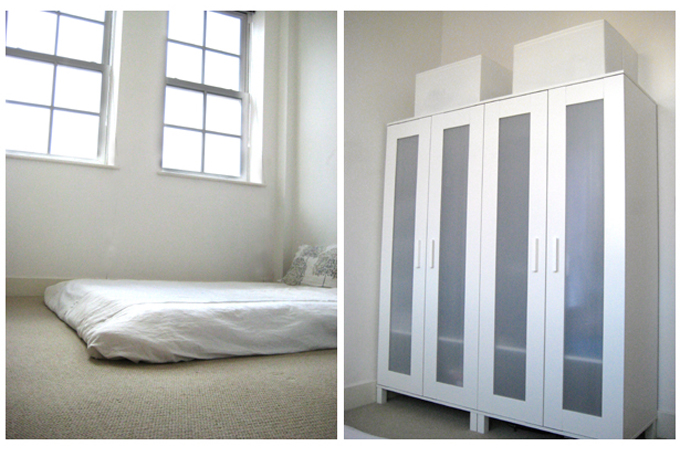
To be honest, there’s really not much to see. It measures only 9.75 x 9.25 feet, for a grand total of 91 square feet. Suffice it to say, photographing it was somewhat of a challenge!

Tiny minimalist bedroom

Tiny minimalist bedroom

A few notes:

* I know a mattress on the floor is not everyone’s cup of tea, but it works for us. It also makes the high ceilings seem even higher. :-)

* We have no built-in closets, so all our clothes are in these two wardrobes (mine on the left, DH’s on the right). Above each wardrobe, we’ve corralled out-of-season items (sweaters, scarves, gloves) and other extras in white nylon Ikea storage cubes. I like the way they blend into the wardrobes and the walls, and give us a little extra storage space.

* I’m not a huge fan of the carpeting, but when you’re in rented accommodations, you learn to live with less-than-ideal finishes. If it were our own place, I’d choose either dark, wide-plank, weathered wooden floors, or white painted wooden floors.

* Yes, there’s a distinct lack of color here; but as most long-term readers know, I *love* white (see my posts Minimalist Home: White Walls and Minimalist Design: White Floors). I particularly like white linens in the summer – so cool, crisp, and refreshing! I’m considering adding a pop of color with a throw pillow; perhaps something in aqua or lavender, with a botanical print. Of course, I welcome suggestions from more décor-savvy readers.

* This bedroom was made for a minimalist – there’s not enough room for a dresser, nightstand, or any other piece of furniture. I love the way it requires one to boil things down to the essentials: a place to sleep, and a place to store clothes.

As I say in my book, I think the bedroom should be the most uncluttered room in the house. It should be a place of peace and serenity, a haven from our hectic lives. But it doesn’t have to be BIG to serve these needs. By keeping things simple, a small space can provide just as wonderful an oasis for our weary souls!

{If you’d like to read more about minimalist living, please consider buying my book, The Joy of Less, A Minimalist Living Guide, or subscribing to my RSS feed.}

Real Life Minimalists: Frugal Babe

Every Monday I post Real Life Minimalists, a profile of one of my readers in their own words. If you’d like to participate, click here for details.

Today, Frugal Babe tells us about her transition from frugality to minimalism, and why she favors a clean, spacious home over one filled with “just in cases.” If you’d like to read more of her thoughts, be sure to visit her blog.

Frugal Babe writes:

I’ve been frugal all my life, but not even close to minimalist. I was a big fan of keeping things “just in case”, even if they had no real value to me. In addition, one of my favorite things has always been shopping at second-hand stores, so I was able to buy all sorts of great stuff for very little money. Easy on the wallet, not so great in terms of how much stuff we accumulated over the years.

Last summer my husband and son and I moved to a new home where we could pursue our dream of growing our own food. Thanks to a snafu at the rental truck company, we ended up with a very small truck instead of the huge moving truck we had reserved. We made four trips to our new home with the small truck and it took us weeks to unpack everything. I knew we had too much stuff, but I was hesitant to start dealing with it all.

A few months ago, I started reading blogs like Becoming Minimalist, Miss Minimalist, and Far Beyond The Stars, and motivation struck. I stopped going to thrift stores unless I was dropping off donations. I used Craigslist to get rid of a dresser and desk that we didn’t need anymore, and the rooms they were in feel big and spacious now instead of cramped. My kitchen cupboards are clean and it’s easy to find everything I need. I realized that although I got killer deals on my saucepans at the thrift store, I only have four burners on my stove, so there was no need to have 15 saucepans. Or six cutting boards.

Once I tackled the easy stuff (extra things that we didn’t need that had no sentimental value), I found that it became a lot easier to deal with the harder stuff… things my mother in law had saved from my husband’s childhood, things from my own childhood, gifts people had given me, etc. Momentum is a powerful thing, and the enjoyment I feel when I fill another box to donate far outweighs any desire I have to hang onto things that are no longer useful to us.

The house feels cleaner and more spacious now, and I don’t have to devote as much time to cleaning as I used to. The closets have lots of empty space in them, which is a far cry from the jumbled mess that they used to be. While we’re not even close to being minimalists when compared with people who only own 100 things, we have a lot less stuff than we used to.

My blog, Frugal Babe, has been my platform for sharing my frugal ideas for the last four years. But I find myself writing more and more about minimalism these days. Getting rid of stuff has become much more fun for me than getting great deals on second-hand stuff.

{If you’d like to read more about minimalist living, please consider buying my book, The Joy of Less, A Minimalist Living Guide, or subscribing to my RSS feed.}

400 Square Feet is the New Black

Last week, I wrote about my Housing Crisis – at the time of the post, my husband and I had four days to vacate our flat and no prospect of new accommodations.

Well, today I have some good news to report: I’m writing this post from our new apartment! With only hours to spare, we found a place, passed the reference check, and signed a lease. I still can’t believe that everything fell into place at the last minute.

What’s even more exciting: our new place will inspire us to continue to live minimally, and provide me with plenty of blog material. Why? It’s less than 400 square feet (390 to be exact).

In one year then, we’ve downsized from a 1000-square-foot 3-bedroom house, to an 800-square-foot 2-bedroom flat, to our current 390-square-foot 1-bedroom flat. Woo-hoo! I’m excited to explore the challenges of living in such a small space.

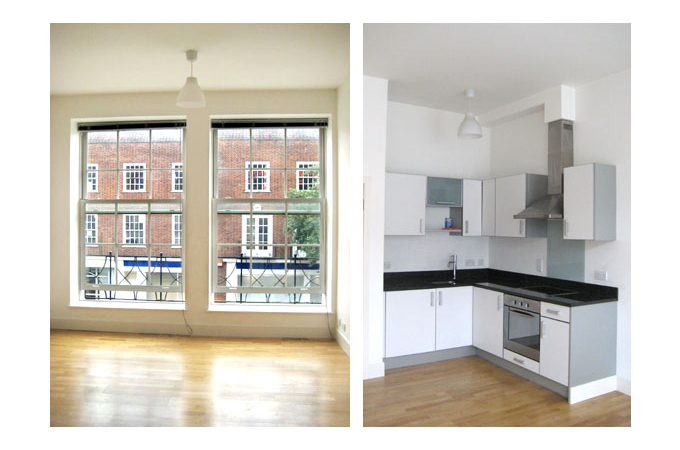
The wonderful thing is, it doesn’t feel small; in fact, it feels more spacious than some of the larger flats we looked at. The reason: it has white walls, ceilings over 10 feet tall, and enormous windows that take up the entire front wall of the flat. It’s amazing what a difference these features can make – the whole place seems so light and airy.

Here’s a few pics (one of the front windows, one of the open-plan kitchen in the corner of the living room):

newflat

Some of the challenges we’ll be facing (and I’ll certainly be writing about):

* the complete lack of storage space. This flat was a conversion, and has no built-in closets. We will have to fit all our stuff into three small wardrobes (I’ll take one, DH will take one, and the third will hold coats, shoes, tools, paperwork, luggage, iron, and all those miscellaneous household supplies that have to go somewhere).

* the tiny refrigerator. Having a small, dorm-sized fridge (with an itsy-bitsy freezer) will be wonderful inspiration to shop often and cook fresh. I plan to write more about our simple, healthy meals in the future.

* no parking. Last year, DH needed the car for work, and we found it convenient for exploring the English countryside. Since this flat does not include parking, we’re ready to go car-free! DH will commute by rail and foot (2 miles walking each day), and we’ll be relying on trains and buses to get out of the city and go on our weekend hikes.

So what’s the meaning of the title, “400 square feet is the new black”? Well, my good friend Tammy Strobel (Rowdy Kittens), her husband, and their 400-square-foot apartment were featured this week in a wonderful New York Times article on living a happy life with less. I’m thrilled to join the ranks of such inspiring, small-space dwellers, and hope to see a trend develop for mindful, “right-sized” living.

My husband and I haven’t lived in this small of a space since college, and we’re excited to come full circle (we always felt the 1000-square-foot house was much too big for us). Fortunately, our lack of stuff has enabled us to move into a lovely space in a great location (if we had more possessions, we’d probably still be looking).

I never expected to live in 400 square feet again, but I’m pretty confident we can make it work. How about you – how low could you go? Let me know in the Comments!

Real Life Minimalists: Miss HK

Every Monday I post Real Life Minimalists, a profile of one of my readers in their own words. If you’d like to participate, click here for details.

This week, I’m pleased to feature Miss HK. She’s been a long-time commenter here, and I’m so glad she’s decided to share her story! If you’d like to read more about her minimalist lifestyle, please be sure to check out her blog.

Miss HK writes:

I can remember when I first discovered minimalism. I was 11 years old, playing with my sister and our Barbie dolls. My sister’s doll had a lavish home and tons of clothing and accessories. Mine lived in a cozy apartment I made from a large shoebox. My doll was an aspiring actress (of course), so she was always moving from place to place, carrying her entire life in her little convertible. It was always this way; my doll never inherited a mansion or went on shopping sprees. At that age, I obviously didn’t know what minimalism was, I just liked the idea of being able to live your life simply and in the moment. You could leave at the drop of a hat, and not worry about lugging years worth of possessions with you.

Now, over fifteen years later, I’ve learned what minimalism is, and I continue to embrace the lifestyle. I am constantly looking for ways to free up my life; whether it’s a weekly shredding of personal documents, donating old clothing, or replacing a book with its electronic twin on my Kindle. I am in college, so I’m still living at home, which certainly makes minimalistic living a breeze. Everything I own is in my bedroom; I have nothing stored in the basement, garage, or spare closet. I have to admit, I fear the day I move into my own place. I don’t want to end up buying tons of things to furnish the place, and then later regret it.

I used to accumulate a lot of things when I was a teenager, but I think cds were my guiltiest pleasure. My boyfriend at the time ran a mix cd store, and so I would get complementary copies of every cd he picked up for his shop. Before I knew it, I had three large cd storage books full. I listened to a handful of them on a daily basis, but otherwise, they just sat in those books, like big, ugly anchors on my bedroom floor.

I finally decided to rip them all to my computer. I can’t tell you how good it felt to finish a cd book off, and then return them to my ex. I also have about a 30 DVDs that I’d like to rip to my computer, but I haven’t gotten to that point yet. I’ve eliminated 98% percent of my books in physical form, and replaced them with electronic versions. I then resold the physical formats to a second hand book shop, or donated to friends or my library. The only books I still keep around are ones that are not available for the Kindle (yet), and my legal school books, which I occasionally reference. I think once I am comfortable in my career someday, I will do away with them.

Becoming a minimalist can be a struggle, but the end result is so rewarding. You have more time for yourself, and spend less time worrying about “stuff” in your life.

{If you’d like to learn more about minimalist living, please consider reading my book, The Joy of Less, A Minimalist Living Guide, or subscribing to my RSS feed.}

Minimalist Makeover: Beth’s Closet and Kitchen

Last week, Beth left the following lovely comment on my post about The Joy of Less:

Thank you! I read your book last week and loved it! There is so much valuable information in it! I started today with my bedroom closet. I kept remembering your words and kept going. I did it and the bedroom (which I am going to use as a yoga room too–don’t have a mattress and box spring–just a futon) is next! My closet looks so good! I can’t believe it but I am only using half of the rods to hang clothes on. I feel like a real minimalist–ok maybe a beginner but I’m into it now. ( :

I was immediately intrigued by her closet makeover (what minimalist wouldn’t be?), and invited her to send me some “before” and “after” photos. I also asked her which advice from my book she found to be most valuable, or inspirational, in her decluttering process. Here was her reply:

What really helped me:

Your advice to take everything out, everything! I didn’t want to do it at first–just as you wrote–there were some things I thought I’d be putting back anyway, why take them out? I did as you suggested though and you know what, many of those items never made it back into the closet!

Also your suggestion about using modules for projects or like items. This really helped me. I make jewelry and knit. Now I have jewelry supply, knitting supply and even technology supply modules instead of having these things all over the table surface or on the closet floor! That box on the shelf with the bike helmet is my jewelry making supply module.

For the kitchen–your strong advice (I love it) to have a place for everything. I realized if my drawers and cabinets were not cluttered then I’d have room for the kitchen items I use but don’t need to have cluttering the counter.

Also–invaluable–your idea of Trash, Treasure or Transfer. This made it fun and easy to do the initial sort through the stuff. I would always get stuck right at the beginning obsessing over items or paperwork and just quitting. This time I just made piles. In trash I had recycle or shred. I’m shredding some of it myself but am going to a community shredding event for the bulk of it. That gave me the idea to post links on my blog to shredding events.

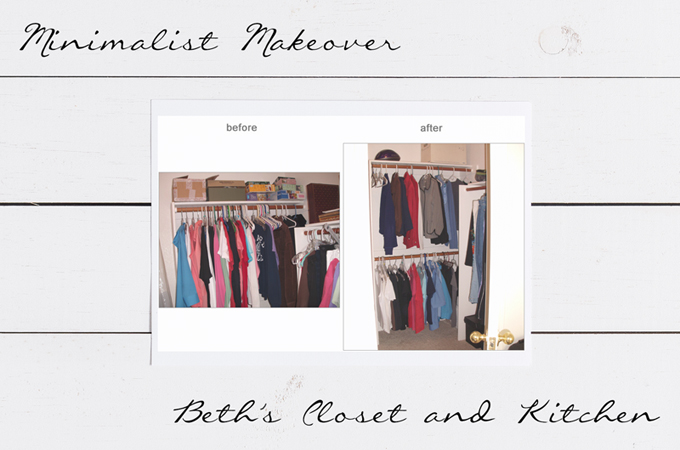
So without further ado, here are the photos of Beth’s closet transformation (before on the left, after on the right):

bethscloset-m

Beth's closet

Notice the clear floor, the nice amount of breathing room between clothes, and the color coding of the bottom rack. She also removed the jumble of boxes from her top shelf, leaving just one box and her bike helmet (what a difference!). I’m sure this serene and streamlined space makes it a pleasure to get dressed each morning!

Beth was also kind enough to send me a snap of her gorgeous, decluttered kitchen:

Beth's kitchen

Beth's kitchen

Those empty countertops are a minimalist’s dream! Keeping all surfaces clear is an important step in my STREAMLINE method (my strategy for achieving, and maintaining, a decluttered home). As I mentioned to Beth, this photo would have made a great illustration for my book. :-)

Many thanks to Beth for sharing these inspirational photos! If you’d like to learn more about her minimalist journey (and see more of her decluttering pics), please visit her blog, Staying True. You can also read her full review of my book while you’re there.

I really enjoyed this, and would love to make “Minimalist Makeovers” a regular feature on the blog. If you have one to share (whether it’s your garage, your living room, or simply your sock drawer), email it to me at:

ct09 AT missminimalist.com (remove the spaces and replace the AT with @, of course!)

Please include a photo of your newly-decluttered space (and a “before” pic, if you have one!). Also, let me know what decluttering advice (from my book, or otherwise) inspired you most.

{If you’d like to read more about minimalist living, please consider buying my book, The Joy of Less, A Minimalist Living Guide, or subscribing to my RSS feed.}