Minimalist Decor: What’s in Your Tokonoma?

a(Photo: TANAKA
Juuyoh
)

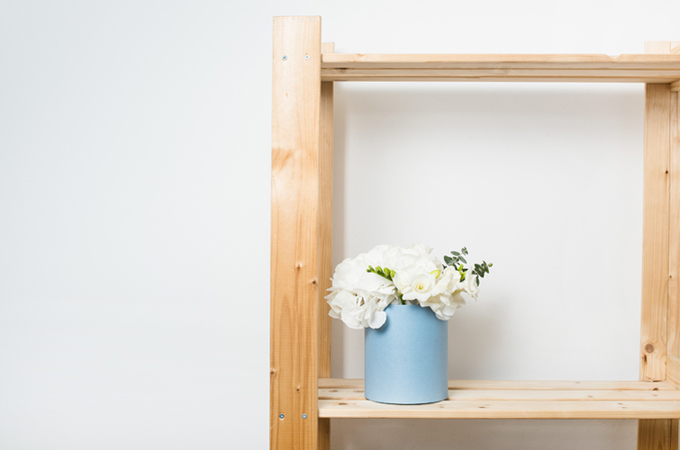
In traditional Japanese households, décor is kept to an absolute minimum. Usually, just one or two artistic items are displayed in a small alcove called a tokonoma.

The tokonoma generally holds a calligraphic scroll or painting, along with a bonsai or simple flower arrangement. The items are appropriate to the season (like fall foliage or spring blossoms), and are meant to evoke an appreciation for both art and nature.

Of course, you don’t need an actual tokonoma to put this concept into practice. In our former house, we had a small console cabinet in the corner of our living room. On it, I displayed various “treasures” from our backyard, such as fresh flowers from our garden or a branch from our cherry tree. Sometimes, I added a small decorative object, like my little kokeshi doll or other souvenir from our travels.

That was the extent of our living room decor – we had nothing on the walls, or the other surfaces in the room.

As a minimalist, I love the tokonoma concept for the following reasons:

* it puts special objects in the spotlight, instead of making them compete for attention with dozens of others

* it’s a wonderful opportunity to celebrate the season and enjoy the gifts of nature

* by limiting the number of items on display, it discourages excess accumulation of decorative objects

* if you rotate your décor, you always have a fresh look

We don’t have a console table, a garden, or decorative items here in the UK, but we’ve created a miniature tokonoma on our windowsill – currently, it holds a handful of interesting rocks and shells we’ve picked up on our walks along the English coast. This small display always makes me smile, and adds a lovely personal touch (and a little bit of nature) to our otherwise minimal home.

So what do you have in your tokonoma?

{If you’d like to read more about minimalist living, please consider buying my book, The Joy of Less, A Minimalist Living Guide, or subscribing to my RSS feed.}

Minimalist Beauty: 11 Ways to Look Gorgeous without Chemicals

Last week’s post on The Story of Cosmetics inspired a lively discussion on natural beauty alternatives. Many thanks to everyone who commented! I’ve decided to gather up the information that was shared, plus a few extras, and consolidate it into a Minimalist Beauty post.

So here you have it: eleven ways to minimize the chemicals in your beauty routine (and still look gorgeous!).

1. Wash your face with honey. Used as a facial wash, honey tightens pores, moisturizes skin, and is believed to help treat and control acne. Simply wet your face with warm water, massage with a tablespoon of raw, unprocessed honey, and rinse well. Or, apply it as a mask, and let it sit 15-20 minutes before washing it off. I’ve been doing this for some time, and have been quite pleased with the results.

2. Use witch hazel as a toner. It’s natural, gentle, and alcohol-free, and won’t dry out skin like chemical-based formulas. Witch hazel refreshes your skin, and removes excess oils and impurities. I tried this a while back, and was perfectly happy with it — just too lazy to keep it up. Although I don’t currently feel the need for this extra step in my beauty routine, I would use witch hazel if I did.

3. Moisturize with olive oil. Other suggestions from the Comments included coconut oil, almond oil, and jojoba oil. I’m a little nervous to try this, as I’m afraid to break out or look greasy; when I work up the courage to give this a whirl, I’ll let you know.

4. Shampoo with baking soda, and rinse with apple cider vinegar. This natural combo is a popular alternative to shampoo. First, dilute a tablespoon of baking soda with enough water to make a loose paste, then massage it into your scalp. After rinsing it out, pour an apple cider vinegar and water solution over the ends. (See Nature Moms No ‘Poo post for complete instructions.)

5. Make a facial with oatmeal. I’m not really a facial kind of gal, but if I ever fancy one, I like the idea of oatmeal. The simplicity of it appeals to me: just mix dry oatmeal and water into a paste and spread it on your face. Let it dry, then rinse with warm water. It’s supposed to have a wonderful calming effect on the skin, reducing irritation and inflammation.

6. Use tea tree oil for blemishes. Tea tree oil is a natural antiseptic that kills bacteria without chemicals – simply dab a bit on the inflamed spot morning and night. It’s a great way to avoid the harsh ingredients in acne creams (which can further irritate skin).

7. Use one natural bar soap for body, hair, and teeth. This tip was mentioned a few times in the Comments; and while I was aware that one could use the same bar soap for hair and body, I would have never considered brushing my teeth with it! Cool idea!

8. DIY. Search the internet, and you’ll find plenty of recipes for making your own soap, lotions, shampoos, facials, and cosmetics from natural (and edible) ingredients. Check out Tammy’s (Rowdy Kittens) recent post on How to Make Your Own Cosmetics.

9. Choose products with natural ingredients. If you don’t want to cook up your own potions, start reading labels more carefully. Dawn Michelle lists chemicals to avoid in this post on her Minimalist Beauty blog, and the Skin Deep cosmetics database provides safety ratings for thousands of personal care products. “Natural” brands recommended in the Comments include Dr. Bronner’s, Fresh Line, Giovanni, Dr. Hauschka, Suki, and Aubrey’s Organics.

10. Drink plenty of water. Drinking eight to ten glasses of water per day hydrates your skin, helps it maintain its elasticity, and gives it a healthy, natural glow. An added bonus: it’s also good for the rest of your body, helping to lubricate joints and flush out toxins and impurities.

11. Get your beauty sleep. Sounds simple, but this can be a tough one for night owls like me (I do my best work at night!). Lately, however, I’ve been making a real effort to get the recommended eight hours of sleep. I’ve noticed that when I do, my skin looks smoother and more radiant. It’s also a great way to avoid dark, under-eye circles (and the concealer or makeup needed to cover them up!).

Keep the tips coming! I’d love to hear more about your natural (and minimal) beauty routines.

Real Life Minimalists: Graduate

Every Monday I post Real Life Minimalists, a profile of one of my readers in their own words. If you’d like to participate, click here for details.

I was delighted to receive the following story from Graduate, and think it’s wonderful that she’s decided to pursue a minimalist lifestyle at such a young age.

Graduate writes:

I grew up in a pack-rat household, bordering on hoarding. We literally had four rooms in my house that were filled floor-to-ceiling with items still in their plastic shopping bags (thanks to my mother’s hobby of trying to own everything in the whole wide world). I was uneasy and always stressed growing up, not understanding how anyone would want to be surrounded by so many things or spending so much of their money on things they did not even value.

When I went off to college, my parents encouraged me to purchase every possible item I would ever need for my new apartment. In my own new space I was drowned out by things I did not want, but felt told were essential to “growing up” and “being an adult”.

It took me a year to realize that “growing up” and “being an adult” were the exact opposite of beginning my own attempt to purchase the entire universe. The way I saw it, to be an adult means to not care what others think of your choices, to own and value exactly what you want, and to stop trying to compete with what your peers had (I tried that in high school, it was nothing but miserable!).

It has been quite the journey in the past three years: I have given away over 70% of my things and never looked back. I am constantly trimming down my belongings even more. I have found that my interests, friends, and hobbies have changed because of it (and I feel for the better!). I no longer go to the mall to buy things with people I do not really feel are true friends…I go on a walk with a real friend and truly listen to her now. I have found friends that value me for the person I am, and not what I own.

I am not a survivalist minimalist, but one that weeds out everything but the essential. I truly feel more alive and more happiness than I ever thought was possible before. When people come to my home they are shocked at how little I own (and how little attachment I have to the few things I still own).

At 18, I had no idea that there was a word for this lifestyle; all I knew was that it was the right thing for me. At 23, I can barely remember the year I was “an adult” and look forward to so many more years of being me; having and doing the things in my life that make me happy. I have gained so much more than I have seemingly “lost”…a sense of self, personal and financial freedom, and confidence in bowing out of the competition.

I want to thank Miss Minimalist and everyone else who contributes to the blog. It is because of all of you that I have found endless inspiration, but more importantly, endless sense of belonging in this lifestyle.

{If you’d like to read more about minimalist living, please consider buying my book, The Joy of Less, A Minimalist Living Guide, or subscribing to my RSS feed.}

The Story of Cosmetics

My main reason for pursuing a minimalist lifestyle is that I enjoy an uncluttered environment. Nothing makes me happier than a sparse, open space with little visual distraction. I also love the freedom that results when you don’t have a lot of stuff to worry about, care for, and move around.

However, I also have a second reason for practicing minimalism: I’m worried about the impact of all that stuff on the world and its people. I’m concerned about how the manufacture and disposal of material goods affect the environment, and how the chemicals contained in them affect our health.

With the latter point in mind, I was thrilled to discover Annie Leonard’s latest addition to her Story of Stuff series: The Story of Cosmetics.

soc

The video was just released yesterday, and is well worth the 5-10 minutes it takes to view it. In a nutshell: it explains that many of the personal care products (creams, lotions, shampoos, cosmetics) we use each day contain toxic ingredients, which are in large part unregulated by the FDA. The chemicals are present in small amounts, but the long term effects of smearing them on our heads, faces, and bodies every day are unknown.

Since I first read about such issues a few years ago, I’ve drastically cut back on the products I use – eliminating things like perfume, nail polish, mascara, and fancy skin creams. I generally stick to a sunscreen/moisturizer combo, lip balm, and minimal makeup (light powder, lipstick, and occasional eyeshadow) when I need to look professional. I’ve also been seeking less-toxic alternatives to my favorite shampoo, body wash, and deodorant, with the help of the Skin Deep cosmetic database.

In the process, I’ve found that being mindful of the products I use has made me even more of a minimalist. Questioning the ingredients in my lotions and potions has not only decreased the chemicals I put on my skin — it’s cleared my bathroom shelves, streamlined my morning routine, and made it that much easier to travel light. :-)

I encourage all of you to take a look at Annie’s illuminating video; and if you’d like to see more regulation of the chemicals in our personal care products, please ask your local representative to support the Safe Cosmetics Act of 2010.

{If you’d like to read more about minimalist living, please consider buying my book, The Joy of Less, A Minimalist Living Guide, or subscribing to my RSS feed.}

Car Sharing 2.0

carshare-150(Photo: cote)

Most of you are familiar with the car share programs run by Zipcar, City CarShare, and the like: when you need a set of wheels, you go online, make a reservation, and pick up the car at its designated location.

Car2Go, a subsidiary of German automaker Daimler, has taken this concept one step further. They’re pioneering a program similar to bike sharing: members have access to any car in the network, without a reservation. Furthermore, the cars can be used for one-way trips, and left in any parking space free of charge (no need to return it to its original location).

In other words: if you walk out of the grocery store with too many bags to handle, you can jump in the nearest Car2Go, drive back to your home, and leave it in a public parking space out on your street (as long as it’s within the operating area).

My first thought: if you drove to the store, a restaurant, your friend’s house, etc., what would keep another member from taking the car while you’re inside and leaving you stranded? I found the answer on Car2Go’s website: you can use the key fob to indicate that you’re making an intermediate stop. This blocks the vehicle from being accessed by another party, and shows its “in use” status by a red blinking signal on the card reader.

The program is currently being tested in Austin, Texas, with a fleet of 200 Smart ForTwo cars. You can read more about it in this article from the Texas Tribune.

I think it’s a great way to practice minsumerism, and would love to see it rolled out to other cities in the near future!

{If you’d like to read more about minimalist living, please consider buying my book, The Joy of Less, A Minimalist Living Guide, or subscribing to my RSS feed.}

Real Life Minimalists: Victoria

Every Monday I post Real Life Minimalists, a profile of one of my readers in their own words. If you’d like to participate, click here for details.

This week, Victoria tells us about the wonderful freedom that minimalist living affords her. To read more of her thoughts, please visit her blog at Ozarks Crescent Mural.

Victoria writes:

Victoria

Victoria

I am a minimalist by nature. I’ve always liked things to be very simple and easy. I noticed this early on when I first moved into my own place. I didn’t like a lot of things and no way was there any excess or clutter. Things were very minimal and I liked that. I certainly didn’t grow up in a house like this though. My mother and her sister have rooms that are just storage only. I couldn’t live this way. I’m more like my father who had very few things.

If something is not in active use, then I take it to a place that gives everything away for free. I figure if I’m giving something away for free then it should in turn be given away for free.

I have moved a lot by having set the goal in my 20s of seeing all of the lower 48 states (accomplished many years ago), and you learn the lesson early on that taking everything from place to place is expensive. Not only that but it becomes tiresome, exhausting, a hassle and you lose respect for what you have because it’s caused so much grief in getting it around. It’s easy to pick up gently-used things in your new town for not much money, a lot less money than you would’ve spent on moving what you had. Plus, it’s fun to get different things.

Now that I work at home, I have the freedom to take it on the road. There’s nothing better than not being tied to an office. This winter I will be staying at a resort in the Ozark Mountains of Arkansas from November through February. It will be just me, my dog and a suitcase. Can’t get much lighter in life than that!

Victoria – Ozarks Crescent Mural

{If you’d like to read more about minimalist living, please consider subscribing to my RSS feed, or signing up to receive new articles by email.}

The Joy of Less, A Minimalist Living Guide

Today I have some exciting news to share with you: my second book has been published!

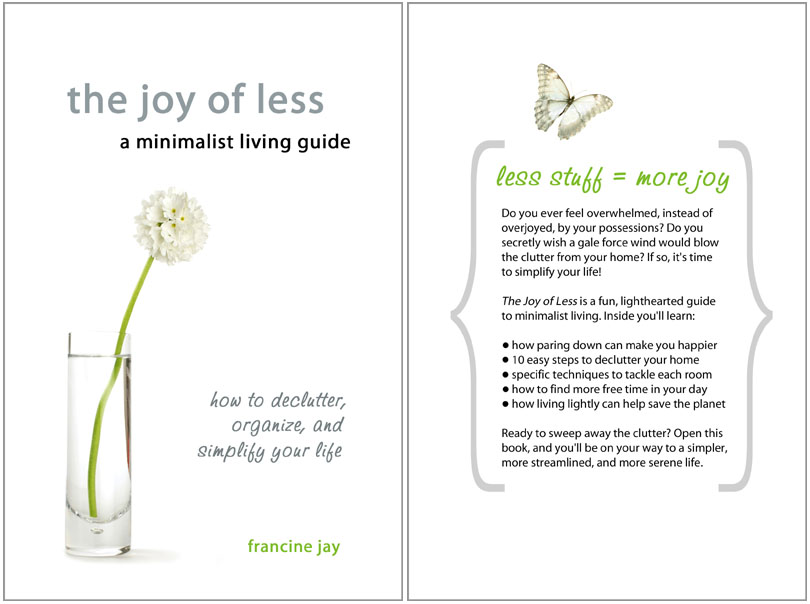
It’s called The Joy of Less, A Minimalist Living Guide: How to Declutter, Organize, and Simplify Your Life.

Here’s a look at the front and back covers:

jol-blogcovers

As most of you know, I started this blog after I moved to the UK—a relocation that involved selling most of my possessions, and starting my minimalist life anew.

Before that, however, I was in the same position as many of you: I had too much stuff, and wanted to pare down. My things weighed on me like hundreds of little anchors, draining me of my time, my money, and my energy.

So one day I made a decision: I stopped buying things, and started to declutter. And to my delight, what I’d expected to be a rather onerous task was absolutely exhilarating! I decluttered in the morning, in the evening, on the weekends, and in my dreams. When I wasn’t actually decluttering, I was planning what I could declutter next.

The entire process was an amazing time in my life: with each passing day, I felt a little bit lighter, a little more serene, a little more free. The less stuff I was burdened with, the more possibilities life seemed to hold.

I began to sing the praises of minimalist living to anyone who would listen, and was surprised at the positive response I received. I discovered that a great many people wanted to declutter their homes and simplify their lives—but for the most part, just didn’t know where to start.

That’s why I wrote The Joy of Less. The book is part philosophy, part pep talk, part practical advice—basically, everything you need to know to purge the clutter from your life.

Part One is all about inspiration. The quotes, stories, and exercises in this section help you develop a minimalist mindset—making it much easier to let your excess stuff go, and keep new stuff from coming in the door.

Part Two outlines the STREAMLINE method: ten sure-fire techniques to rid your house of clutter, and keep it that way. These steps are my “secret weapon” for achieving, and maintaining, a minimalist home—and I’m so thrilled to finally share them!

Part Three shows you how to give each room in your house a minimalist makeover. Each chapter tackles a different room: living room, bedroom, home office, kitchen/dining room, bathroom, and storage spaces (garage, attic, and basement). There’s also a whole chapter on creating a minimalist wardrobe, and another one dealing with gifts, heirlooms, and sentimental items.

Part Four takes this minimalist philosophy beyond the house. In this section, you’ll learn how to declutter your schedule, and reclaim your time as you did your space. You’ll also discover the far-reaching benefits of living lightly and gracefully on the Earth, and see how saving space in your closets can help save the planet.

Want a sneak peek? Click here to read the Table of Contents and the Introduction (or see the Contents below).

.

jol-toc

I assure you that the book is not a collection of blog posts, but rather a comprehensive manual for minimalist living. The vast majority of material has not appeared on the blog, and will provide you with plenty of new reading on the subject!

I’d be so honored, and grateful, if any of you decide to purchase the book. If you’d like to do so, it’s available on Amazon.com:

The Joy of Less, A Minimalist Living Guide: How to Declutter, Organize, and Simplify Your Life

For those of you downsizing your book collections (or outside the US), it’s also available on Kindle:

The Joy of Less, A Minimalist Living Guide: How to Declutter, Organize, and Simplify Your Life (Kindle Edition)

You don’t need to own a Kindle reader; simply download the free software to your PC, Mac, iPhone, iPod Touch, Blackberry, etc.

Thank you so much for letting me share this with you today. I love to write, but I’m somewhat shy when it comes to selling and promoting my work.

However, I’m very excited about the book, as it sums up all of my thoughts, ideas, and experiences with minimalist living. Furthermore, I feel like you’re all my family—and thought that some of you might be upset if I didn’t tell you about it. :-)

I really appreciate your support of my blog, and hope you’ll read my book!

As most of you know, I started this blog after I moved to the UK—a relocation that involved selling most of my possessions, and starting my minimalist life anew.

Real Life Minimalists: Geoff

Every Monday I post Real Life Minimalists, a profile of one of my readers in their own words. If you’d like to participate, click here for details.

Today, Geoff, a university student, shares his story with us. I think it’s wonderful that he’s starting his minimalist journey so early in life! If you’d like to read more of his thoughts, please visit his blog, Happiness & The Fish.

Geoff writes:

I’m a student living 4 hours from home, and that means not many trips home. When I relocate I have to move everything at once. Since I’ve found a place for the next 3 years at school, I decided to move all my stuff with me (not just stuff I need for school, but everything I own: I didn’t want my extra stuff cluttering up my parents’ house). I’ll spare the details, but when we moved all my stuff to the new place, the (fairly large) van was literally packed to the top, with room left for only 3 of 4 family members. This is when I realized that I had far too much junk.

Once I’d settled in (about a month ago), I began to read a lot of minimalist blogs like Miss Minimalist, Far Beyond The Stars, and mnmlst. I started sorting through everything, using the ‘one month’ and ‘one year’ rules. I am donating or selling a lot of things like PC games and gadgets that I haven’t used in years. The more crap I let go of, the easier it gets to part with more and more stuff.

I’m also viewing a lot of the things around me differently: without so much junk I don’t need such a big room (Or I can enjoy more space in a large room). Without a cluttered desk, I can focus on my work much better. Without so much clothes, I don’t need to do as much laundry. The list goes on.

As I’m currently unemployed, I’ve been spending time scanning important papers/books and photographing momentos, so that I can let go of the physical objects. I’ll admit, I’m not quite ready to part with a lot of my stuff just yet, but the next time I move will be a big motivator to crack down on things that I don’t actually need. I’m just starting my minimalist journey, and I know I have a long way to go. But I’m glad I’ve learned early in my life to reject the consumer society that we’ve been immersed in for over 50 years. The 21st century is not going to be easy on us, but I hope that by adopting and spreading the minimalist philosophy, we can greatly reduce our footprint and make the transition easier.

Thanks for providing such an inspiring resource, miss minimalist! It’s helped motivate me to simplify my life, and I will be recommending it to friends and family!

Geoff

{If you’d like to read more about minimalist living, please consider subscribing to my RSS feed, or signing up to receive new articles by email.}

7 Steps to a Minimalist Wardrobe

a(Photo: Mzelle Biscotte)

When I decided to pursue a minimalist lifestyle, one of the first areas I tackled was my closet. I had too many clothes that I didn’t wear, and too little space in which to keep them. I wanted a wardrobe that was simple, elegant, and functional — and I wanted to be able to retrieve the pieces, and put them away, without any pushing, pulling, or wrestling.

Over the course of a few months, I pared down my closet to less than half its original contents. I sold quite a number on eBay, gave some to family and friends, and donated the rest.

The reward: a spacious closet, and a well-edited wardrobe that perfectly suits my needs.

Want to do the same? Just follow these seven easy steps, and you’ll never again have “a closet full of clothes and nothing to wear:”

1. Purge everything that doesn’t fit. Ditch the “fat clothes,” the “skinny clothes,” and anything else that bunches, pulls, stretches, or sags in the wrong places.

2. Purge everything that doesn’t flatter. Get rid of the mom jeans, the baggy sweatshirts, and any other items that make you look or feel frumpy.

3. Purge everything you haven’t worn in the last year. Twelve months’ time is sufficient to cover all the seasons and occasions for which you need apparel. If you didn’t wear something last year, you probably won’t wear it the next.

4. Choose a base color. Pick a neutral like black, brown, navy, or khaki for your “foundation” pieces (like pants, skirts, and suits), and purge the rest.

5. Choose accent colors. Select a handful of shades that flatter you, and limit the rest of your apparel (like shirts and sweaters) accordingly. Choose colors that complement your base and each other, for optimal mixing and matching.

6. Pare down your shoes and purses. If you’ve chosen a base color for your clothes, you no longer need a rainbow of footwear and handbags. (Black shoes and a black bag, for example, go with everything in my closet.)

7. Accessorize. Instead of buying trendy apparel, stick to classic pieces and spice things up with scarves and jewelry. They’re significantly smaller and easier to store.

And remember, don’t put your rejects in a landfill; they may be perfect for someone else! If you don’t want to deal with selling them on eBay or in a consignment shop, be generous and give them away. Here’s a list of organizations that could use your donation:

In the US:
Dress for Success
Goodwill Industries International
Purple Heart Pickup Service

Vietnam Veterans of America
The Salvation Army

In the UK:
British Red Cross
Oxfam
Cancer Research UK

You may be able to take a tax write-off, so obtain a receipt and record the value of donated items.

If you’d like to pursue a more minimalist lifestyle, decluttering your wardrobe is a great place to start. Each item you toss is like a weight lifted off your shoulders—and you’ll no doubt be inspired to tackle the rest of the house!

{If you’d like to read more about minimalist living, please consider subscribing to my RSS feed, or signing up to receive new articles by email.}

Minimalist Lessons from a Tea Ceremony

tea(Photo: Hassan &
Mariko
)

A few years ago, I participated in a Japanese tea ceremony. It’s a beautiful ritual, and—in my opinion—a wonderful analogy to minimalist living.

In a nutshell, chado (or Way of Tea) is the ceremonial preparation and serving of matcha, powdered green tea. Guests enter the teahouse after walking through a small, contemplative garden and symbolically purifying their hands and mouth with water from a stone basin. To enter the tearoom, they must bow their heads to fit through the small door—meaning all are equal in tea, regardless of social status or position.

After the guests are seated, the host cleanses each utensil, and prepares the tea, in a series of precise, choreographed movements. He or she then serves the tea to the first guest, who admires the bowl, drinks some tea, wipes the rim, and passes it to the next guest. Each guest follows the same procedure in turn. After they’ve all taken tea, the host again cleanses the utensils, and offers them to the guests for examination.

What principles of chado can we incorporate into our minimalist lives?

1. Bare essentials – the only implements used in the tea ceremony are those necessary for the activity: tea bowl, tea caddy, tea scoop, tea whisk, and linen cloth.

2. Economy of action – each movement of the tea ceremony has a particular purpose; nothing is superfluous.

3. Mindfulness – the nature of the ceremony focuses attention on each object and action, encouraging participants to be fully present in the moment.

4. Spare décor – the only decoration in the tearoom is a scroll, or flower arrangement, in a small alcove. It is appropriate to the season, and intended to provoke an appreciation of both nature and the occasion.

5. Respect – this is an overarching theme throughout the ceremony, manifested in bows, compliments, and proper etiquette.

6. Appreciation – the deliberate study and admiration of the tea bowl, and each utensil, ensures that no part of the ceremony is taken for granted.

7. Wabi-sabi – this term describes an aesthetic of impermanence, imperfection, and rustic simplicity. The objects used in the ceremony have a quiet and understated beauty, rather than being ostentatious.

The entire ceremony is an exercise in elegance, economy, purity, and tranquility. To me, the essence of the tea ceremony is the same as minimalist living—being mindful of every item, action, and interaction with others, so that in the process we may discover the grace and beauty of life.

{If you’d like to read more about minimalist living, please consider subscribing to my RSS feed, or signing up to receive new articles by email.}