Mars, Venus, and Minimalism

malefemale3Earlier this week, I blogged about an interview with minimalist actor Vincent Kartheiser. One of the comments made by the interviewer, however, struck me as odd. After Vincent described the simplicity of his abode, and how he was making a sink out of a rock, the interviewer said it was “not very woman-friendly.” (You can read the whole interview here.)

Well, I’m a woman, and I think the rock sink—as well as his whole minimalist aesthetic—sounds divine!

It made me wonder, however, if there’s any particular gender bias in minimalist living.

I think (and I could be wrong) that the stereotypical image of a minimalist is generally male—and represented as the bachelor living alone, sleeping on the floor, and cooking his meals with a single pot. I’m not familiar with any media (literature, film, TV shows) featuring a woman living such a lifestyle.

In my own experience, I’ve noticed that when I mention my minimalist lifestyle to people (outside the blogosphere), most men seem to think it’s kind of cool, and most women seem to think it’s kind of strange. Of course, that could say more about the social situations I find myself in than the population at large.

On the other hand, I have more female commenters on my blog than male—and women seem to be more active in discussions on minimalism at SimpleLiving.net.

When it comes to minimalist bloggers, my impression is that we are pretty evenly divided between male and female. Off the top of my head, I can rattle off equal numbers of men and women writing on the topic.

These are simply my observations, but I’m really curious as to everyone else’s thoughts. Do you think minimalism is popularly regarded as a “male thing,” a “female thing,” or gender-neutral? Do you think minimalist living appeals more to men, to women, or equally to both?

{If you’d like to read more about minimalist living, please consider subscribing to my RSS feed, or signing up to receive new articles by email.}

Celebrity Minimalist: Vincent Kartheiser from Mad Men

Let me preface this post by saying I have very little interest in celebrities. I don’t care what they do, what they buy, how they dress, where they live, what they drive, or what they eat, and could never understand pop culture’s obsession with them. (I’d much rather read the bio of a scientist or humanitarian than an actress or professional athlete.)

So you can imagine how puzzled I was when my husband forwarded me this interview with Vincent Kartheiser (the actor who plays Pete Campbell in Mad Men) from the Guardian. “Trust me,” he said, “just read about halfway down.”

I dutifully skimmed the article, and was surprised and delighted to read the following:

Some of the ways that Kartheiser has chosen to do this are unconventional, at least among Hollywood TV stars. He has, for example, in the city of cheap gas and freeways, given up on a car.

“I go on the bus, I walk. A friend left his car recently at my house and I took it out one day just for 15 minutes and it was terrible. You know why? I felt like I was back in LA again. Four or five years ago, when I had a car and I had been out of the city I wouldn’t feel I was back until I got in the car, you know. But now I feel off the grid. I feel that I am not part of the culture. And because I don’t have a car I don’t really go anywhere to buy things. In fact, I have been in a slow process of selling and giving away everything I own.”

He has? Like what?

“Like, I don’t have a toilet at the moment. My house is just a wooden box. I mean I am planning to get a toilet at some point. But for now I have to go to the neighbours. I threw it all out.”

(As he says this, I’m wondering whether this is just another of the parts Kartheiser might be trying on for size, but to prove the point he later takes me back to his house, which really is an empty wooden box, a small one-room bungalow on a nondescript Hollywood street and indeed it has no lavatory.) Is that a Buddhist thing, I wonder, or an early midlife crisis thing?

“It started a couple of years ago,” he says. “It was in response to going to these Golden Globe type events and they just give you stuff. You don’t want it. You don’t use it. And then Mad Men started to become a success on a popular level and people started sending me stuff, just boxes of shit. Gifts for every holiday, clothes. One day, I looked around and thought ‘I don’t want this stuff, I didn’t ask for it’. So I started giving it to friends or charity stores, or if it is still in its box I might sell it for a hundred bucks. I liked it so I didn’t stop.”

How refreshing! Instead of bragging about a garage full of luxury cars, he talks about the joy of not owning one; instead of giving a house tour of a thirty-bedroom mansion, he shows off his one-room bungalow; and instead of accumulating designer clothes and other swag, he sells or gives everything away.

How wonderful would it be if actors like Vincent Kartheiser became Hollywood’s new role models? Instead of impressing the masses with what they own, they could inspire them by what they don’t own. Perhaps conspicuous consumption would fall out of favor, and be replaced by a popular interest in minimalist living… (I can dream!)

I wanted to share this because I suspect that many of you (like me) would never have tripped across this on your own. I think it’s wonderful to have a minimalist in the public spotlight, and hope that it introduces more people to this fabulous lifestyle.

I’d love to hear your thoughts on this — and wonder if anyone knows of other minimalist celebrities?

{If you’d like to read more about minimalist living, please consider subscribing to my RSS feed, or signing up to receive new articles by email.}

Declutter Your Jewelry Box

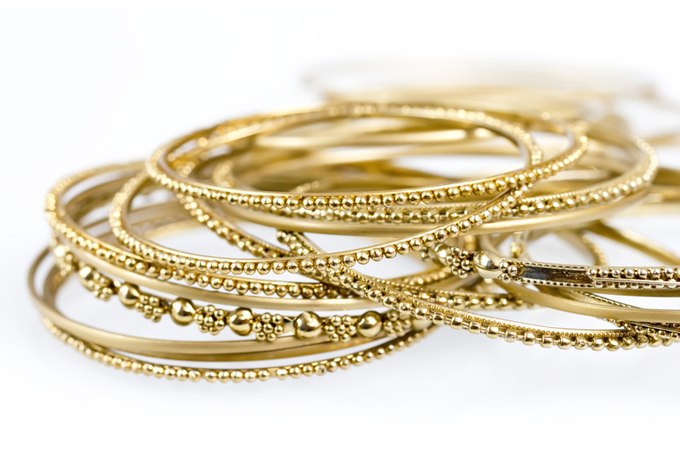
Let’s face it—we all have clutter in our jewelry boxes: broken chains, gifts from old flames, grandma’s wedding ring, an uncle’s old watch. Jewelry, however, can be especially difficult to purge. Unlike most clutter, gold and gemstones have intrinsic value—tossing them in the trash is like throwing money away.

Good news: the price of gold is near its all-time high, and jewelers everywhere are buying it from people like you and me. (It may seem contradictory that jewelers would want to buy gold at such a high price, but they make a profit by selling it to a refiner.)

Here’s how it works: clean out your jewelry box of all the bits and bobs you no longer want. Take the pile down to your local jeweler. The jeweler will separate out the gold from the costume (not gold) pieces. You can facilitate this process by looking for 10K, 14K or 18K stamps on your items; in the absence of such markings, the jeweler will use acid, or an electronic tester, to determine the gold content. The jeweler will then weigh your pieces on a scale, and use a multiplier to calculate the gold (“scrap”) value in dollars.

It’s a great way to get rid of (and get cash for!) broken, common, or unattractive jewelry that has little antique value or artistic merit. Finer pieces, or those with quality diamonds and gemstones, will command a higher price than this “scrap” value, and should be taken to an estate jeweler for evaluation.

And if you don’t need the cash, consider gifting sentimental pieces to someone in the family; Uncle Ed’s pocket watch may not be your cup of tea, but it might be a treasure for a nephew or grandson!

Minimalist Entertainment: Watching Sheep

Lately, I’ve been spending a lot of time watching sheep. I know that sounds strange, so let me explain…

I’ve always been a city girl at heart. I love the people, the buildings, the culture, the vibe; going to bars, cafes, and restaurants; and attending the opera, the orchestra, and the ballet.

Recently, however, my husband and I have discovered a wonderful new pastime: walking the public footpaths of the English countryside. As an American accustomed to fences, private property, and “no trespassing” signs, I was completely taken aback by the concept of the public footpath—in essence, it’s a right-of-way that lets you stroll through the fields, pastures, and meadows that belong to someone else (how amazing is that?).

The paths are so numerous (and extensive) that books and websites feature scores of walking routes on them, in virtually every part of the country. I imagine one could traverse most of England via footpaths, bridleways, and country lanes.

Anyway, back to the sheep…These footpaths often take you through the very pastures where sheep or cows are grazing. Until a few weeks ago, I’d never been on the same side of the fence as a farm animal, so it’s been quite a novelty to “hang out” with them. In fact, until a few weeks ago, I’d never had the opportunity to ramble through farmland, skip through meadows, or lounge in wide, grassy fields enjoying picturesque views over rivers and valleys.

I’m still a city girl, but one who’s falling in love with the peace, quiet, and idyllic atmosphere of the country…

This past weekend, my husband and I drove out to Cornwall in Southwest Britain. We hiked along dramatic seaside cliffs, picnicked in gorgeous spots overlooking the Atlantic, discovered secluded beaches, explored ancient ruins, encountered wild ponies, and yes, spent a good amount of time watching sheep. It’s my new favorite minimalist activity.

ukwalks

{If you’d like to read more about minimalist living, please consider subscribing to my RSS feed, or signing up to receive new articles by email.}

Minimalism of Royal Proportions

In a previous post, I confessed my love of grand, empty spaces (Minimalist Confession: I’m an Empty Space Junkie). Unfortunately, while visiting European castles over the last few months, I’ve discovered that grand spaces are rarely empty. On the contrary, they’re usually stuffed with paintings, tapestries, gold gilt decor, and enough furniture to stock a showroom. Royal families have a unique way of making a football-field sized room feel claustrophobic.

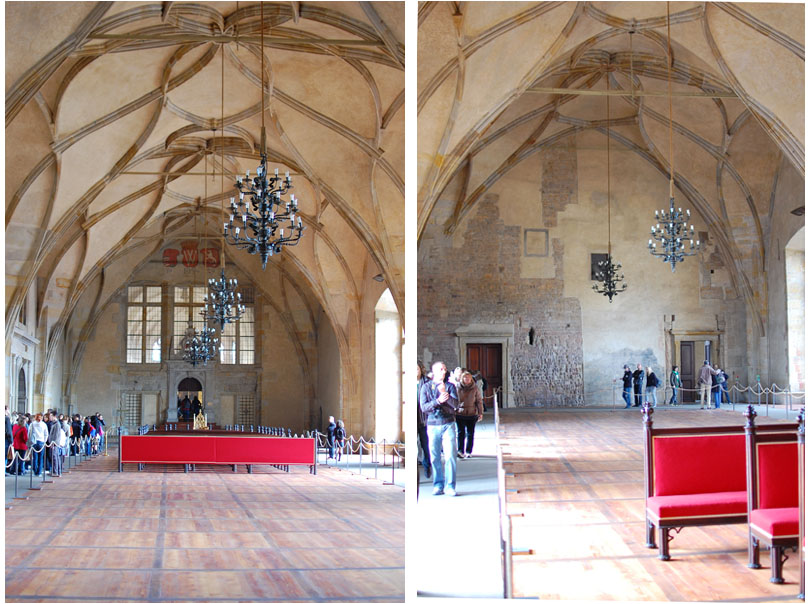
Imagine my delight, then, when I recently stepped into Vladislav Hall in Prague Castle (pictured below). I couldn’t believe my eyes: soaring ceilings, unadorned stone walls, bare floors, and enormous windows. The decor consisted of little more than some rustic chandeliers. It was my minimalist dream come true! While other visitors shuffled quickly through in search of something more “interesting,” I stood there entranced by the emptiness — imagining how it would look when I cleared out those red benches and moved in my futon and coffee table.

I just wanted to share this minimalist eye candy with you, and let you know I’ve found the cavernous space of my dreams. I may not be the wisest, wittiest, or most prolific blogger around, but you can’t say I don’t take you interesting places. ;-)

praguecastle-c

When we visited, the hall was set up with red benches for some kind of event. Here’s a photo from Flickr, showing how gorgeous it is without them:

{If you’d like to read more about minimalist living, please consider subscribing to my RSS feed, or signing up to receive new articles by email.}

The Top Ten Ways to Declutter Heirlooms

I was recently cleaning out some bookmarks (digital decluttering!), and ran across this oldie-but-goodie from the New York Times:

The Tyranny of the Heirloom

In the article, the writer interviews several people who feel compelled to keep the things they’ve inherited — a Victorian settee, an ugly painting, a massive sideboard — despite their dislike for them. Some do it out of guilt, some to hang onto memories, others to preserve their family “history.”

I can relate, as I inherited my grandmother’s twelve place settings of china right after I graduated from college. I dragged them around with me for years, carefully packing and unpacking them during moves across three states. (Perhaps one of the reasons I became a minimalist!) Fortunately, I was finally able to unload them on give them to another family member.

Want to avoid the tyranny of the heirloom? Here’s ten ways to declutter them — with less guilt than simply throwing them away:

1. Be generous, and give them to another family member. (I could never understand why heirs fight over material things — I say, let ‘em take it all!)

2. Donate them to a charitable organization, and let them do some good rather than gathering dust in your basement.

3. Sell them, and donate the money “in memoriam” to your loved one’s favorite charity.

4. Sell them, and use the money for something you really want.

5. Donate historical items to a museum or university.

6. Save a piece of the heirloom (like a swatch of your grandmother’s handmade quilt or wedding dress).

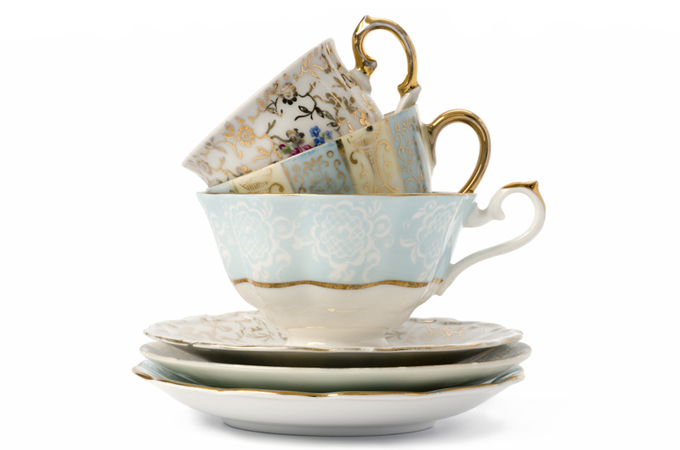
7. Save one item from the collection (like a single plate or tea cup from a set of china).

8. Photograph them, and save the photos (instead of the items) for memories.

9. Re-make the heirloom into something more useful. Have a jeweler set the stones of a gaudy old brooch into a pretty necklace, or use the yarn from your grandpa’s sweater to knit a nice scarf.

10. Avoid them in the first place. Tell family members (gently and politely, of course) that you don’t want them to “save” anything for you, and encourage them to find alternate homes for their treasures.

Has anyone else ever felt “shackled” to an unwanted heirloom? Or does anyone have other creative strategies for getting rid of them?

Minimalist Inspiration: The Story of Stuff

sos4
In the spirit of Minsumerism, I wanted to share with you one of my favorite internet videos: The Story of Stuff, by writer and activist Annie Leonard. It’s a brilliant, 20-minute, stick-figure documentary about the life cycle of material goods.

The video explores the environmental and social issues of our current model of consumption, and calls on us to create a more sustainable economy.

While walking us through the five steps of extraction, production, distribution, consumption, and disposal, Annie provides many thought-provoking statistics, such as:

  • 80% of the planet’s original forests are gone.
  • 40% of waterways in the United States have become undrinkable.
  • People in the United States are targeted with more than 3,000 advertisements a day.
  • People in the United States makes 4.5 pounds of garbage a day.

If you’re not a minimalist already, you may very well become one after watching this!

Want to learn more? Annie has recently released a book version of The Story of Stuff, with more details of the materials economy — including her travels to factories and dumps around the world, to see exactly how the stuff we buy is made and disposed of.

And if that’s not enough, two new videos have been added to the site: The Story of Bottled Water, and The Story of Cap & Trade. I’m looking forward to The Story of Electronics, which is coming in May.

So what inspires your minimalism? Is it a concern for the environment or human rights, or simply a desire for clean closets and a spacious home?

The Minsumer Movement: A Quiet Revolution

Hand with mini bagSomething wonderful happens when you start living a minimalist lifestyle: you begin to really think about what you consume, and question the necessity of every purchase.

How amazing would it be if such mindful consumption became the norm? Not only would we all have more time, more money, and more space in our homes; we’d also have a healthier planet, and more resources for future generations.

In order to promote such an idea, however, we have to define it and give it a name. We have to let others know it’s a viable lifestyle alternative, and provide support to those pursuing it.

To this end, I’ve written the following manifesto to introduce the Minsumer Movement.


“Don’t buy it!” may be an unusual call to arms, but it has the potential to transform our lives, our society and our planet.

Like all revolutions, ours is bred by discontent. We’re sick of being slaves to debt and keeping up with the Joneses. We’re tired of working long hours at jobs we don’t like, to pay for things we don’t need. We’re unhappy with the clutter in our homes, and the commercialization of our holidays. We’re angry that human rights are violated to fill our stores with cheap clothes and plastic gizmos. We’re worried that our children and grandchildren won’t have the clean air and water that should be their birthright.

We are not necessarily anti-consumption. We don’t forage or dumpster dive, and we don’t expect to get anything for free. We like the fact that we can buy things when we need them. We appreciate the ease with which we can obtain basic necessities; unlike our ancestors, we need not devote our days to securing food, clothing, or shelter. However, we believe that once these needs are met, consumption can be put on the backburner. Our time would then be free for friends, family, and community; and for spiritual, philosophical and cultural pursuits. Imagine what we could do with all that newfound time, energy, and capital!

The consumption instinct is rooted in survival, though, and difficult to curb. Savvy marketers exploit this fact and continually manufacture new “needs” to suppress our sense of fulfillment. They try to convince us that our lives are incomplete without the latest electronic gadget; that our houses are outdated and must be “improved;” that our cars should be new, and our clothing should be fashionable.

Well, we declare “Enough!” We refuse to spend the better part of our lives desiring, acquiring and paying for things. We are neither Consumers, nor Anti-Consumers, but Minsumers: we seek to minimize the role of consumption in our lives. Our strategy is simple:

  • To minimize our consumption to what meets our needs
  • To minimize the impact of our consumption on the environment
  • To minimize the effect of our consumption on other people’s lives

To this end, we won’t waste our money, or the resources of our planet, on frivolous goods. We’ll reuse and repurpose what we can, and favor used goods over new. We’ll avoid items made with exploited labor or violations of human rights. We’ll support our local economies, and work to create sustainable communities.

We are not your typical revolutionaries. You won’t see us protesting, boycotting, or blocking the doors to megastores; we’re simply not buying. Our battles are personal, made up of a million little acts of consumer disobedience. We leave convenience foods on the shelf and breeze by impulse items without a glance. We cut up our credit cards, borrow books from the library, and mend our clothes instead of buying new ones. We shop on Craigslist and Freecycle, rather than at the mall.

We are an invisible army, and our offense is our absence: the empty spaces in the parking lot, the shorter checkout lines, the silence at the cash registers. The only bloodshed in our revolution is the red ink on a retailer’s profit statement.

We are under constant bombardment by advertisers, but our defenses are well-honed. We regard with a critical eye their attempts to make us feel unattractive, unsafe, and unsatisfied. We turn off the television, cancel our magazine subscriptions, and use ad-blocker in our web browsers. They develop new weapons to weaken our resistance — greenwashing, viral marketing, zero percent financing — but their arsenal is no match for our resolve.

Our ranks are diverse, and spread out among spiritual, environmental, simple living, and human rights groups, as well as the population at large. But under the banner of Minsumerism, our individual efforts have far-reaching potential. By not buying, we regain our freedom: from debt, from clutter, and from the rat race. By not buying, we have the time and energy to rebuild our communities. By not buying, we reclaim the resources of our planet, and deliver them from the hands of corporations into those of our children.

Most importantly, by not buying, we redefine ourselves: by what we do, what we think, and who we love, rather than what we have. And in the process, we rediscover the meaning in our lives.


Please show your support for the Minsumer Movement by leaving a comment, and spreading the word through Digg, Twitter, or email.

How do you minimize the role of consumption in your life? I’d love to hear your ideas and techniques!