To Live Content with Small Means…This is My Symphony

Today I’d like to share this quote from William Henry Channing:

“To live content with small means; to seek elegance rather than luxury, and refinement rather than fashion; to be worthy, not respectable, and wealthy, not, rich; to listen to stars and birds, babes and sages, with open heart; to study hard; to think quietly, act frankly, talk gently, await occasions, hurry never; in a word, to let the spiritual, unbidden and unconscious, grow up through the common–this is my symphony.”

I think it’s a beautiful, and refreshing, take on creative expression.

Advertisers encourage us to “express ourselves” through the things we buy. They tell us that by “styling” our lives — with sleek cars, designer dresses, or modernist housewares — we can show our creativity. (Of course, we all know this is just a clever marketing scam.)

More appropriately, we can express our creative genius through the things we make. We can draw, paint, sculpt, knit, make pottery, compose music, or cook fabulous gourmet meals.

I have degrees in both art and science. My brain is logical and analytical, but my soul is purely creative. It’s a frustrating combination; while my soul yearns to paint giant, abstract canvases, my brain enumerates the impracticalities of such a pursuit.

For years, then, I’ve struggled with the issue of creative expression. I don’t particularly like to buy things, and my uber-practical brain has prevented me from mastering any particular art or craft.

That’s why I love Channing’s quote — because he suggests that we can express our ourselves creatively through how we live. That living contentedly within our means, and harmoniously with others and our planet, is a work of art in itself.

With that in mind, I think I’ll stop worrying about finding my artistic calling in tubes of paint, balls of yarn, or globs of clay; for now, I’ll let my minimalist lifestyle be my symphony.

So tell me…what’s your symphony?

(FYI: Just wanted to let you all know I’ll be traveling next week, and will resume posting after the Easter holiday!)

{If you’d like to read more about minimalist living, please consider subscribing to my RSS feed, or signing up to receive new articles by email.}

Spring Decluttering

mm-sakura-200

So it’s finally here…spring. And you know what that means, don’t you? It’s time for some major decluttering!

I’ve always loved this time of year. The cherry trees will soon be in bloom, as well as the Bradford pears, magnolias, and dogwoods. The whole world seems fresh, new, and beautiful—and I want my home to be just as lovely!

After my major declutter for our UK move, I have significantly less to do this year. Instead of tackling a three bedroom house with a basement, attic, and garage, I’ll only be dealing with a two bedroom flat. Surprisingly enough, though—as minimally as we live—there’s still some work to be done.

Here’s my to-do list:

* Try on everything in my closet. Eliminate anything that’s worn out, doesn’t fit, or I’ve just grown tired of.

* Go through all the paperwork that’s accumulated in the last several months. Scan what needs to be scanned, shred what needs to be shredded, file what needs to be kept.

* Clean out the bathroom cabinet. Dispose of cold medications from winter, and any products that aren’t being used or are past their prime.

* Take everything out of the kitchen cupboards. Scrub down the cabinets, and put back only the food that we intend to eat (I say this because I know there are still two Christmas puddings in there! FYI to American readers: these are not what you think of as “pudding,” but rather small, highly-preserved cakes).

* Purge any books we’ve accumulated since our move. (These consist mainly of travel guides for countries we’ve already visited, and a few novels purchased for long train and plane rides.)

* Clean, clean, clean! I’m usually not particularly domestic, but springtime brings out the household diva in me. After everything’s sparkling, I’ll reward myself with a bouquet of fresh flowers for the windowsill.

Since I don’t have an attic, basement, or garage to work on this year, it’ll be a piece of cake—leaving me plenty of time to spend outdoors, watching the world come into bloom. If anyone can tell me where the best hanami (cherry blossom viewing) spots are in London, I’d be very appreciative!

Anyone else in the mood for some spring decluttering? What’s on your list?

Minimalist Seeks Survivalist

I just finished reading a novel about the aftermath of an EMP (electromagnetic pulse) attack, and it has me thinking about survivalist issues.

As an urban-dwelling minimalist, let’s just say I’d be up the creek if the SHTF. I have three days of food and water at best, and nothing to speak of in terms of tools or other supplies. (I’m certainly not bragging about this, and in fact am a little embarrassed to admit it.)

Although I know it’s prudent, every fiber of my being is against the notion of stocking up. However, I think when it comes to emergency preparedness, I’ll have to fight against my minimalist instincts. Although my city isn’t prone to natural disasters, terrorism and pandemic diseases are a concern.

But here’s my dilemma: I would imagine if a BIG catastrophic event occurred, a period of lawlessness would follow. (In the book, roving gangs of looters ransacked the houses of those who were “prepared.”) I’ll likely never own a gun, and certainly wouldn’t be able to shoot someone stealing from my vegetable garden or pantry. Therefore, even if I did have adequate supplies, I would fail miserably at “defending” my property.

I’d be more inclined to strap on a backpack, get out of Dodge, and hope for the best. To that end, I should probably be learning how to boil chickweed, purify water, hunt small game, and catch and clean fish (none of which are likely to happen, either).

In general, my philosophy is to take each day as it comes, and not worry about the future. What will be, will be. However, I’m starting to wonder if that attitude is too irresponsible in this context.

At this point, I think my best option is to befriend someone who lives on a defendable, self-sufficient property, or knows how to survive in the wild. So if any such person reads this blog, and would like to see it continue after a worldwide meltdown, please consider taking me in. Living within walking distance of London would be a big plus. I’ll organize your closets, and dispense inspirational minimalist quotes, in exchange for food and shelter. ;-)

I’d love to know how everyone else plans for potential emergencies. Have you stocked up on food, water, and supplies? Can you be self-sufficient if necessary? Or would you hit the road, and put your fate in the hands of Providence?

On another note: I’ve run out of Real Life Minimalists! Would anyone like to be featured on Monday?

{If you’d like to read more about minimalist living, please consider subscribing to my RSS feed, or signing up to receive new articles by email.}

Minimalist Philosophy: Wise Words from a Reader

Enlightenment

Enlightenment

One of the reasons I love writing this blog are the comments I get from my readers. They’re a wonderful source of inspiration, and a great opportunity to learn how others incorporate minimalist principles into their lives.

Yesterday, I was thrilled to receive an incredibly insightful comment on one of my older posts. I know that many of you do not receive the RSS Comments feed (you can subscribe by clicking this link), and would likely never see it. Therefore, I’ve decided to highlight it in today’s post, as I want to make sure that nobody misses it.

I think this comment beautifully expresses the essence of minimalist living, and can serve as inspiration to us all.

Jason Edwards writes:

Dear Miss Minimalist,

I have found your site interesting and it is excellent that you are spreading the message of simplicity, which is an important message to pass on to others. By living simply we have a positive effect on the planet. Having few possessions and only accumulating what is necessary saves the planets resources.

I can carry everything I own. I have a few changes of clothing, laptop, two pots, bowl, spork, futon and flask. I like sitting on the floor to eat and eating fruits, nuts, vegetables, and rice (vegan diet) .I like to eat food as it is, so I can taste the varying flavours without smothering food with sauces, spices, and manufactured sugars. I am not concerned with eating something different everyday and can quite happily eat oats in the morning, rice and chickpeas for lunch and a big bowl of vegetables in the evening for months. Many indigenous tribes in the Amazon eat the same staple foods on a daily bases and before air travel most people in the world ate local staples. I think people have become used to having so many choices be it food or possessions, that it distracts them from the simple things and experiences like tasting the flavour of a nut without covering it with salt.

The nice thing about a bare room is that you begin to notice the space around you in a physical sense and you begin to notice other things like the changing sunlight during the day. Your window becomes like a landscape painting where you notice the changing colours of the flora. Many possessions tend to tie one down mentally and physically- seeing to much permanence in inanimate objects rather than being aware of the vitality of the outside world of nature. I think it also tends to make people more detached from nature and they forget how dependant we are on nature for our survival. They forget to make the connection between a table and a tree or a piece of metal with the hard work of mining it and the resultant effect it may have on ecology. Things are taken for granted and it is assumed that nature has an endless supply of resources. When you own just a few things these things are valued and have more meaning.

Every time we go out and buy something new we take from nature. If we live simply with few things and don’t accumulate anything we do not need it saves time, money, stress, and the planet without having to do very much.

Industrialization has taught many to seek experience through objectifying experience. A simple example is photography, a useful medium in one sense but a burden in another. Photography is a good medium for communicating an idea or recording an important event, however it can also stop us from experiencing events fully because we are so caught up in objectifying an experience through a photo rather than using our other senses like smell or our ability to transfer an experience to others orally by telling a story.

We in developed countries can make the choice to live simply to help others in developing countries so they can also have the choice to decide how to shape their lives. This website is excellent and I will also spread the word by creating further links to create and encourage a larger community of people to live simply who I hope will do the same.

P.S Don’t feel to burdened by aesthetics. I had the same problem while I was at art school.I would spend a great deal of time looking for the perfect second hand minimalist table or lamp shade, but then I realized the most elegant thing is to own nothing.

Jason, thank you so much for taking the time to write such a thought-provoking comment! It made my day, and reminded me of how wonderful it is to follow a minimalist path. As you point out, minimalism not only helps us live more mindfully; it also helps us conserve the resources of our planet, and protects the interests of those in developing countries. It brings to mind the famous quote by Gandhi: “Live simply so that others may simply live.”

I particularly love the final line: “…I realized the most elegant thing is to own nothing.” What a beautiful summary of minimalist philosophy!

{If you’d like to read more about minimalist living, please consider subscribing to my RSS feed, or signing up to receive new articles by email. Also, if you don’t want to miss wonderful comments like this one, be sure to subscribe to the RSS Comments Feed.}

Real Life Minimalists: Jenna Ann

Every Monday I post Real Life Minimalists, a profile of one of my readers in their own words. If you’d like to participate, click here for details.

I don’t have anyone scheduled after today’s post, so I’d love to receive more stories. I know there are more Real Life Minimalists out there — don’t be shy! :-)

Today, Jenna Ann shares with us her thoughts on minimalism, voluntary simplicity, and homemaking; please visit her blog to read more!

Jenna Ann writes:

Jenna Ann

Jenna Ann

My husband and I both grew up on the low to middle side of “Middle Class”. Our married lives were more in the “Lower Class” as we struggled to make ends meet, raise our kids and have some of the luxuries of life. We both worked, we lived paycheck to paycheck and we were dissatisfied with the way things were going. Eventually we opted for me to stay home and take care of the kids and the house. Money got even tighter. We didn’t buy as much but we still had the consumer appetite. He worked hard at work and I raised the kids, home-schooled them and kept house. He was depressed because no matter how hard he worked at his job, money was still in short supply. I was depressed because no matter how hard I worked at home, I wasn’t earning a paycheck. We were equating happiness with money but no matter how much or how little was coming in, it all went out just as fast.

Fast forward…our oldest was graduated, married and involved in a great career. Our second child is entering college and the “baby” had opted to go to public school for high school. Wow…all that time now free….what to do? I didn’t want to go back to suffering from “housewife syndrome” like I had in my early days of being a stay at home Mom. I wanted to feel fulfilled, challenged and like I was contributing something valuable to the family. I was also feeling very hemmed in by clutter. So began my crusade to purge our home…which I did by at least 60%. We ALL felt so much lighter after that whirlwind.

Around the same time I began reading about minimalism and voluntary simplicity. It was simple…choose your priorities/passions and get rid of everything else. I had to decide on passions? Ok…I can do that. But most minimalist did it to help free up their lives for mobility. I didn’t want travel. I love being at home! Still, I liked having a lighter load. I also still felt like I wasn’t truly contributing despite all I did to maintain our home. In walked Shannon Hayes with her book Radical Homemakers: Reclaiming Domesticity From A Consumer Culture. Ahhh…now here is me. Here is MY passion! She managed to marry the concepts of simplicty, minimalism and the homemaker and being damned proud of it! For me, nothing embodies minimalism more than attending to the basic needs of life and getting the direct benefit of doing it with my own hands instead of earning a wage and paying someone else to do it for me.

Finally, I’ve found my place!

{If you’d like to read more about minimalist living, please consider subscribing to my RSS feed, or signing up to receive new articles by email.}

Minimalist Flooring: Carpet Tiles

carpettiles3(Photo: FLOR)

I love a bare floor as much as the next minimalist. However, sometimes an area rug is desirable — to delineate a section of a room, add a touch of color, or simply provide some warmth underfoot.

Anything larger than 6’ x 9’, however, can be awkward, heavy, and difficult to move.

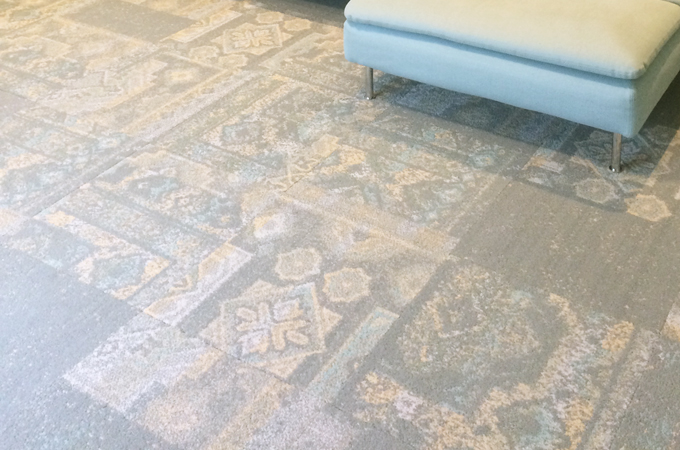
In our former house, we found a great solution: carpet tiles, such as those made by FLOR. They’re 20” squares that come in a wide variety of colors, textures, and patterns that you can mix and match.

Here’s why they fit with our minimalist lifestyle:

They’re portable. Frequent movers will love them for this reason alone. Just stack them up, pack them in a box, and you’re ready to go!

They’re non-permanent. There’s no glue or nails involved; small adhesive “dots” connect the tiles to one another and keep them from slipping. Unlike wall-to-wall carpeting, they don’t require a carpet pad and can be easily removed.

They’re flexible. If you get tired of them in your living room, you can pick up the squares and rearrange them in your bedroom, bathroom, or anywhere else in the house. You can easily change the size or shape of the “rug” by adding or subtracting squares.

They’re interchangeable. If you can’t get that wine or coffee stain out, you don’t have to ditch the whole thing; just replace the square that’s damaged!

They’re stylish. We minimalists have good taste, and appreciate a sleek, well-designed product. :-)

They’re recyclable. You can send your old FLOR tiles back to the company to be recycled into new product.

Unfortunately, we left ours behind when we moved to the UK (as most of you know, we moved with only two duffel bags). I wish we could find them here — they’d be perfect for our current flat!

What’s your opinion on carpeting? Do you prefer bare, covered, or a mix of both?

{If you’d like to read more about minimalist living, please consider subscribing to my RSS feed, or signing up to receive new articles by email.}

Study: Experiences Bring More Happiness Than Stuff

ocean(Photo: mikebaird)

If you asked me to name my favorite “purchases,” I’d be much more likely to rattle off vacations I’ve taken, operas and ballets I’ve seen, and nice dinners I’ve had — rather than any things that I’ve bought.

Well, it seems I’m not the only one. A new study shows that experience-related purchases, rather than material ones, bring more happiness to the consumer:

“The results show that people’s satisfaction with their life-experience purchases – anything from seeing a movie to going on a vacation – tends to start out high and go up over time. On the other hand, although they might be initially happy with that shiny new iPhone or the latest in fashion, their satisfaction with these items wanes with time.” Click here to read the entire article…

In short, the study explains that material purchases are easy to compare, and therefore more likely to lead to second-guessing and dissatisfaction. For example, we may worry that we didn’t get a good deal on our new car, or feel it isn’t up to par with our neighbor’s.

However, we tend to regard experiences on their own terms, instead of making comparisons. We’re unlikely (or unable) to judge our trip to Hawaii versus our neighbor’s trip, and therefore experience more satisfaction from it.

The results of the study confirm previous research on the topic, and were published in the January issue of the Journal of Personality and Social Psychology.

I’ve discussed this matter with people in the past, and some have made the argument that when you purchase an experience (such as a European vacation), you have nothing to “show for it” afterwards; whereas a diamond ring, on the other hand, you can keep forever.

I’ve never been comfortable with that reasoning, and feel that memories of an experience are just as significant as a tangible object. I also feel that material purchases bring on a slew of other worries and responsibilities, such as cleaning, maintaining, insuring, repairing, and storing the item in question. Therefore, I’d take the European vacation over the diamond ring any day!

What do you think? Do you get more pleasure from material purchases, or experiential ones?

Real Life Minimalists: Aspiring Minimalist

Every Monday I post Real Life Minimalists, a profile of one of my readers in their own words. If you’d like to participate, click here for details.

I don’t have anyone scheduled after today’s post, so I’d love to receive more stories. I know there are more Real Life Minimalists out there — don’t be shy! :-)

Today, Aspiring Minimalist shares her story with us, and explains why she has chosen to pursue a minimalist lifestyle; check out her blog to learn more!

Aspiring Minimalist writes:

Growing up, my family has always been frugal. My parents immigrated from Hong Kong in their late twenties, to start a new and better life in Canada. My two sisters and I were fortunate to have been born in Toronto, and given the opportunity that my parents didn’t have growing up.

We grew up poor, with only my dad working outside the house – he worked at various factory jobs in order to provide for my family. My mom stayed home and took care of us. She also ran a home daycare for up to 5 other kids at times (she is a super woman!).

My sisters and I never had fancy toys or clothes growing up, but we always had shelter, warm clothes and lots of good, healthy food to eat. We grew up happy and oblivious to the materialistic society we were in. We had one (real) Barbie, but I think we were most happy making soup concoctions from the leaves and grass, catching grasshoppers and playing tag in our backyard!

I want to share a story early in my life that still affects me to this day about materialism:
In grade five, I got new sneakers and I wore them (very proudly) to gym class. One of my classmates came up to me to check them out – Jonathon. He looks at them and smirks, “Those are no name brand running shoes. Hahaha. She’s wearing no name brand running shoes!” He runs off to tell his friends.

I was confused. I thought they nice sneakers with nice shoelaces (I only had velcro before these babies!). Not to mention they were Venture brand, not “no name”. I didn’t understand why the other kids laughed, as well. Because I was perfectly happy with my new sneakers until that moment.

I went home and told my parents. They explained to me that some people have brand name clothing, and they might think that makes them better than other people. But as long as our clothing keeps us warm, and comfortable, that’s really all we need.

I guess the moral of this story is that material things have a different meaning and purpose to everyone. How we use those things and how we view them is what’s important and can dictate our happiness. The way that I approach my minimalist lifestyle is simple – I want to be happy.

I want to make changes in my life to make my life more fulfilling, happy and simple. I will make the changes for myself, not because of what someone else thinks or believes. The choices I make, are my steps to freedom and happiness.

Growing up, I’ve had a few brushes with a more minimalistic lifestyle. In my college days, I alternated working full time (apprenticeships) and school every four months, so I had to move very often. I got so good at packing and moving, that I could pack up my life in about 5 or 6 Rubbermaid boxes in about 2 hours!

I also did a fair bit of traveling in my college days and backpacked across South East Asia, Europe, and Egypt in a 50L pack. It’s very exhilarating to be carrying all that need for the next few weeks (or months) in one pack. I was like a big snail with a mobile “home,” I began to realize that I really didn’t need much to be happy. Hence, a minimalist was born.

My passions in life are food and travel. I explore these topics on a daily basis, and sometimes through lifestyle changes (small and big), general thoughts and musing, and a bit of personal finance. Please join me as I embark on my journey to a minimalistic lifestyle.

{If you’d like to read more about minimalist living, please consider subscribing to my RSS feed, or signing up to receive new articles by email.}

Minimalist Home: Naked Windows

a(Photo: *clairity*)

When it comes to home décor, there are few things I love more than naked windows. In my book, they’re right up there with empty walls. :-)

Of course, I recognize that window treatments can be quite practical—and in many cases, quite necessary! We live in the city, in view of our neighbors across the street; therefore, leaving our bedroom windows bare is out of the question. Our living room, however, is on a corner; and even though it has large, floor-to-ceiling windows, it’s less directly “exposed” to nearby buildings. Furthermore, a large tree right next to it provides privacy three seasons of the year.

Therefore, we choose to leave our living room windows naked. It’s the best we can do in our urban environment. If we lived in the middle of nowhere (or with plenty of trees to shield the view), we wouldn’t have a single curtain, blind, or shade in the house.

Our situation was quite different in our former house, where our neighbors (and their windows) were just a few feet away on each side. Even then, however, we decided to forgo curtains, and opted instead for the simplest option we could find: translucent, white fabric shades that let in plenty of light and blended in to the white walls around them.

The loft apartment we lived in before that was ideal. There, we had an entire wall of factory windows; and since the building was in an industrial section of the city, across the street from an empty lot, we had no need to cover them. It was minimalist window heaven!

Sure, the argument can be made that window treatments are valuable for climate control—like blocking cold air in winter and sunshine in summer. However, I’ve been in plenty of homes where the curtains don’t seem to be providing any climate or privacy functions whatsoever; their raison d’etre is solely decorative. And if that’s the case, why have them at all?

Lest you think this matter too trivial to discuss, no less than Thoreau himself weighed in on it in Walden:

“I would observe, by the way, that it costs me nothing for curtains, for I have no gazers to shut out but the sun and moon, and I am willing that they should look in. The moon will not sour milk nor taint meat of mine, nor will the sun injure my furniture or fade my carpet; and if he is sometimes too warm a friend, I find it still better economy to retreat behind some curtain which nature has provided, than to add a single item to the details of housekeeping.”

So, how do you feel about naked windows? Do you leave yours bare, or cover them up?

{If you’d like to read more about minimalist living, please consider subscribing to my RSS feed, or signing up to receive new articles by email.}

Minimalist Philosophy: To Walk Away, Empty-Handed

onpath-mToday I’d like to share one of my favorite quotes, from Henry Thoreau’s Walden:

“It is desirable that a man […] live in all respects so compactly and preparedly that, if an enemy take the town, he can, like the old philosopher, walk out the gate empty-handed without anxiety.”

I’ve often wondered, if the place I live was suddenly struck by political unrest or natural disaster, could I walk out the door and leave everything behind?

Ten years ago, I might have found this difficult. I was in a more “accumulative” phase of my life, building a household as a young adult. I put a great deal of thought into each purchase, expressing my identity, in some respects, through my choice of clothing, housewares, furniture, and décor. I appreciated aesthetics and good design, and hunted down unique and one-of-a-kind “treasures” to own. Walking away from it all would have been at least mildly distressing.

After a decade of decluttering, purging, and practicing a minimalist lifestyle, I’ve become significantly less attached to my possessions. I own very little, and actually take pains to avoid acquiring anything too expensive, precious, or sentimental. I still appreciate art and design, but I’d rather meet my needs with things that are “good enough,” than invest in pieces I’ll feel obligated to keep the rest of my life.

I’m often reminded of this quote when I hear news reports of forced evacuations due to hurricanes or forest fires. There are often those who stay behind to “defend” or “protect” their homesteads, risking their own lives in order to do so. I, on the other hand, would be the first one out of there and headed to safety!

I wouldn’t give a second thought to most of the stuff I own, and the only possession I’d have difficulty leaving behind is my laptop. However, my distress would be caused by losing the information, not the device itself. Therefore, I back up essential data to both physical media and the cloud, so that the information exists independent of the hardware. Because everything with “memories” is digitized — photographs, letters, postcards, etc. — I don’t have photo albums or sentimental items that would be heartbreaking to lose.

In general, all the “things” in my life can be replaced; and in some cases, I may not even bother to replace them.

I’ve been on my minimalist journey for awhile, some years making more progress than others, but generally continuing on the same path. My latest move (from the US to the UK) was immensely valuable in “releasing” me from my stuff, both physically and mentally.

I’ve pondered the above quote from Walden for years, holding it up as an ideal to which to aspire. I’m thrilled to finally be able to say, and know in my heart to be true, YES, if the circumstances warranted, I could now walk out the gate, empty-handed without anxiety.

What about you? Could you leave it all behind? Is there anything in particular you couldn’t bear to lose?

{If you’d like to read more about minimalist living, please consider subscribing to my RSS feed, or signing up to receive new articles by email.}