Wisdom Path, Hong Kong
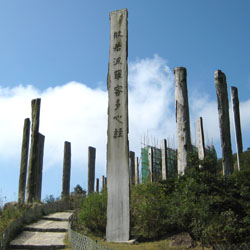
On my recent trip to Hong Kong, I visited the Wisdom Path on Lantau Island. This outdoor “sculpture” consists of thirty-eight wooden columns inscribed with the Heart Sutra, a text treasured by Confucians, Buddhists, and Taoists.
The columns, each about 10 meters (~30 feet) in height, are arranged in a figure-eight infinity symbol; they stand on a steep hill, in a serene, natural setting overlooking Lantau Peak.
In short, the Heart Sutra espouses the doctrine of “emptiness.” One of its famous lines teaches that “Form is emptiness, emptiness is form.”
Such emptiness is not to be interpreted in a nihilistic, nothing-exists sense. Rather, it means that nothing is absolute—everything is relative and impermanent, and in a constant state of change. Therefore, there is no point in becoming irrationally attached to things.
I couldn’t help but think how beautifully this coincides with minimalism, and living as non-attached to material things as possible. I feel that embracing “emptiness,” rather than clinging to the material aspects of existence, opens us to a more direct, genuine, and fulfilling experience of life.
Although I haven’t taken any Buddhist vows, I agree with (and live according to) many aspects of Zen philosophy. I don’t know whether my minimalism has led me to embrace Zen Buddhism, or vice versa—but the two seem to complement each other very well.
Does anyone else feel a tie between their spiritual beliefs and minimalist lifestyle?
{If you’d like to read more about minimalist living, please consider subscribing to my RSS feed, or signing up to receive new articles by email.}
I would say I definitely feel more at peace and more in line with life. I don’t feel rushed, chaotic or out of sync. I think my life now gives me the time to think bigger and deeper…whether it be in my goals, family life or on my spiritual path. I take time to notice the smaller details in life and appreciate them more. I do think there is a connection on some level. : )
Very well said, Heather!
Thanks for the link in this post, I had been looking for a good book about zen. I really enjoy your blog especially how you relate zen and minimalism together.
Thanks, Karl! I plan to do further reading on Zen Buddhism as well, and will likely post more on it in the future.
Karl and Miss Minimalist,
I am in the middle of Daisetz Suzuki’s book “Zen and Japanese Culture.” Truly a great read and very helpful for this Westerner to try to understand what Zen is through aspects of Japanese culture like swordplay, haiku, tea, and so on. It’s a dense and delightful read, albeit slightly dated. Do check it out.
Absolutely. Buddhists and other Eastern religions find beauty in the natural world, and they astutely realized how much of nature is empty space. I recommend “Zen 24/7”, by Philip T. Sudo if you chance upon it at the library. It makes everyday activities mindful, which is awesome. The Tao te Ching also nicely sums up a lot of ‘live in the now’ philosophy with simple, minimalist beauty.
I guess the real link between minimalism and Buddhism is to live in the present moment and enjoy what you have that is right here. So much of non-minimalism consumption is saving or hoarding things from another time or for a future project. Once you strip that away and recognize the beauty in a single flower or the shape in a single cloud, your mind has become an empty cup and serenity enters.
Wow, that’s beautiful, Meg! You’re right: minimalism absolutely helps you live in the present. I appreciate the book recommendation; I’ll definitely check it out. As for the Tao Te Ching, I’ve been reading a passage each morning for years. :-)
There is an absolute connection for me-summed up in this Bible verse: Luke 12:15 (New International Version)
15Then he said to them, “Watch out! Be on your guard against all kinds of greed; a man’s life does not consist in the abundance of his possessions.”
Great quote, TrishB! I have a feeling there are probably many references in the Bible to simple living. :-)
I am a Christian who has long been bothered by my level of “stuff”. In the Old Testament the Israelites were taught to share with the less fortunate. In the New Testament Jesus taught that life doesn’t consist in the things one possesses. He also taught the principle of sharing and at one point, He told his immediate followers to sell all they had, give to the poor and follow Him. A life of service to people is much better and more rewarding than a life of service to things.
Thanks for this wonderful comment, Carla! I read the Bible when I was younger, and remember many of the points you mention. I think it’s time for another read through it, with a new perspective as an adult.
I am also a follower of Christ, and I believe that simplicity is one of the spiritual disciplines that is most forgotten. Not only are there the Biblical examples that Carla mentioned (and more), but in church history there are many people (St. Francis of Assisi, for instance) who believed and practiced a life of simplicity/minimalism.
So, yes, it greatly affects my simplicity/minimalism.
Hi Luke! I was raised Catholic, and St. Francis of Assisi was my favorite saint. :-) I’m very interested in learning more about the emphasis on simplicity in different faiths.
No, not spiritualism or spiritual beliefs, but a minimalist lifestyle fits with my own belief system or Eupraxsophy
Gordon, thanks for the link! I have an academic background in science, and this appeals to my rational side. I particularly like how a eupraxsophy emphasizes “the importance of living an ethical and exuberant life.” :-)
I am a catholic and I feel my relationship is better with items, people and Christ. A better relationship with items since I am more careful with those I use , with people since I focus on their good sides and with Christ since I am on a way towards harmony. Lent are very special days to focus ont this subject.
Thank you for the link, it is inspiring.
Thanks for sharing this, nicole 86. What inspiring words–I love hearing that you are “on a way towards harmony.” :-)
I absolutely agree with you. I never usually plug my own posts but I actually wrote about this exact subject (http://bit.ly/bN0VkC), it’s one of my most popular posts, I think the connection between Zen and minimalism is extremely strong and evident in such things as that statue or even monastic life. Absolutely great post, I find your blog simply inspirational, please keep it up!
Love your post, Minimal Student — thanks for sharing the link!
What a very interesting post. I certainly feel that my desire for simplicity stems from my Christian faith, and in particular the fact that I am a member of the Franciscan lay order. There is so much in the Gospels about not valuing things over a spiritual life and how the love for them and the attachment they invoke can interfere with one’s spiritual journey. St Francis was among the few to take this literally and how I wish I could do the same! His life story is incredibly inspiring. I also find the writings of Thomas Merton very inspiring. He was a Catholic monk, who towards the end of his life got very interested in Zen Buddhism and how this connects to Western spiritualism.
Frances, I think it’s wonderful how you (and others) live by the example of St. Francis. I also appreciate the info on Thomas Merton, and will check out his writings.
Its so funny that I have read this post tonight as I have just started studying this year to be a Yoga Teacher. Through this study I believe that I am finding my way to minimalism. We have been studying the Yoga Yamas and the Niyamas, which are outward and inward behaviours. I have been so surprised that this ancient wisdom is so applicable.
Also, as I am so busy studying and doing yoga, I just dont have the time to waste it at strolling around the stores. All the hours count.
So I am just enjoying what I have in my life. Its lovely.
Sara xx
I’m so glad to hear this, Sara! Yoga imparts such a wonderful perspective on life. :-)
From the Tao Te Ching, Chapter 11:
Thirty spokes join in one hub
In its emptiness, there is the function of a vehicle
Mix clay to create a container
In its emptiness, there is the function of a container
Cut open doors and windows to create a room
In its emptiness, there is the function of a room
Therefore, that which exists is used to create benefit
That which is empty is used to create functionality
I’m a Buddhist not a Taoist, but I think this verse is important. My personal aversion to acquiring ‘stuff’ is definitely an result of Buddhist practice.
Thanks for sharing this, Paul! I read a passage from the Tao every morning, and this is one of my favorites. :-)
I have read a lot on religion and self realization, buddhism and hinduism –
and have come back to Christianity. I was raised a Christian but went on to search that something that was missing.. I think I have found it. Christianity is definitely advocating simplicity, inner contemplation, and living in the present moment. I wish these things were brought up more. I think I got lost somewhere in “sin and judgement” and only now have found the sanctity and beauty of life on Earth, and even mysticism in Christian tradition. I feel like I no longer have to look for it in the trendy Eastern religious traditions.
That’s fascinating, Cat’s Meow — I’d like to do some reading on Christianity and simplicity.
a min life is a focussed life.
Many good posts regarding Christianity and minimalism. As a disciple of the Lord Jesus Christ, I am convinced that I should find my comfort in Him, and not how much stuff I can shove into my apartment. In Philippians 4, the Apostle Paul speaks of contentment. To me, stripping down my “stuff” is heavily rooted in being content. Paul had clothes on his back, and food to eat, and he was content. So many people today have an abundance, and lack any sense of being content.
This quote from Fen-yang nicely brings together the themes of religion and minimalism: “When you are deluded and full of doubt, even a thousand books of scripture are not enough. When you have realized understanding, even one word is too much.”
Precious Mother Teresa once spoke about how we can spend so much of our time taking care of our things that we don’t have much left for God and others. She is a beautiful example of living a minimalist life out of a heart full of love.
I greatly enjoyed reading your inspiring e-book and what came to my mind when you shared that funny story about the thief was just what Jesus said in Matthew 6:19 “Do not store up for yourselves treasures on earth, where moth and rust destroy, and where thieves break in and steal.”
Thank you and God bless you for helping people like me break free from the god of consumerism.
Yes, for me its also Zen, Franciscan & Benedictine paths unified. Also I love hearing God in silence & seeing God in nature. :)
Christianity was deeply rooted in simplicity before the great divide between the Liberal and Fundamentalist Churches.
John in one of his letters summarizing what he had learned from his life as Jesus best friend wrote
Do not love the world or the things in the world. If anyone loves the world, the love of the Father is not in him. For all that is in the world the desires of the flesh and the desires of the eyes and pride of life is not from the Father but is from the world. The world is passing away along with its desires, but whoever does the will of God abides forever. 1 john 2 15 and following
From a Christian perspective Richard Fosters classic, A Celebration of the Disciplines has a great chapter on the discipline of simplicity.
Celebration of Discipline. Copyright 1978 by Richard J. Foster.
thanks.i’ve been to this place too, two and a half years ago. would you know exactly the teachings inscribed on those posts, or at least some links? tolle, by the way, has some practical take on zen teachings. :)
My favorite biblical verse is Matthew 25:34 where Jesus says (paraphrased) “Come into heaven because when I was hungry you feed me, thirsty and you gave me drink, naked and you covered me, in prison, sick or a stranger and you took me in.” The blessed respond “When did you do that? He replied “When you did it to the least of your brothers.” How can I perform prison ministry, care for orphans, etc if I am concerned with acquiring and caring for stuff? Answer: I can’t.
Thanks for writing the book which i read with avid interest and this blog. I have been practicing minimalism for a while…i know it’s a constant process of choice and evaluating what is truly important in ones’ life. I do agree that it relates to spirituality. I am personally not affiliated with any religious organization but I do find many similarities between Buddhism and Christianity. In particular…i feel that minimalism is similar to charity…you are donating things you no longer need…this frees you of greed which i one of the 7 deadly sins. You are more aware and conscious and you walk lighter on this one and only planet we have.
Thanks so much! Peace, love always!!!
If you have to talk, read about, compare, analyse and all the other clutter you bring to zen and minimalism, it defeats the object. Forget the bible, mother Theresa, Saint Francis, eastern philosophy, Joe Shmo’ yadadada. That just adds overhead. There is nothing to understand which is why most intellectuals don’t get it. Just be still, its really that simple.
(JUST) (BE) (STILL)
Don’t go searching, let the magic come to you.
PS
Being broke is excelent minimalism when you accept it.
Wicca too celebrates simplicity, valuing the earth so do not overuse, and doing/ believing what you want as long as it harms none.
Until recent times, only the very rich could afford to have many material things. Go to any historical site that isn’t a castle or the home of a very rich person and you will see how few things they had. There was no middle class until about the 1500’s in Europe. Only the rich and the very poor.
I choose to live with less because it is better for the environment, clutter and waste make me nervous because I grew up with a hoarder. I gave some magazines I got free to my daughter to pass to her friends, her friends pass their magazines to me. We clean the house with rags, wash them and use them again. No paper towels.
Just finished a book called zen Christian by Kent Merritt I would highly recommend it. It is a very encouraging book melding our spiritual hunger and meditation with the one true God. Meditation is such a wonderful bridge between us and God. Minimalism helps clear our souls of unnecessary clutter. I have felt much more free and unburdened as I continue on this journey. Just be still and know that He is God. His peace passes all understanding
By grabbing and using far more than our share of the world’s bounty, we are not doing what we can to share with the poor. We can keep our homes a little emptier, a little smaller, turn the thermostat down in the winter and up in the summer and there will be more for everyone. We have not been the stewards of nature we should be.