Minimalist Philosophy: Doing Less

roseStop and smell the roses. (Photo: Kai Hendry)

A few years ago, I was involved in a group conversation about work and careers. One of the men, in his mid-late twenties, was asked what he did. He simply smiled and said, “Not much,” offering no further explanation. (It later came to my knowledge that he worked part-time helping disabled children.)

At the time, I was somewhat of a workaholic, clocking in sixty-hour weeks. I, and several of the other young professionals in our group, were taken aback by his casual remark. We were all what you’d consider “upwardly mobile,” and it was difficult for us to understand someone else’s deliberate rejection of such a lifestyle.

However, those two words have stayed with me—not as something to disdain, but as something to which to aspire. When it comes to work, I too would like to someday do “not much”—saving my time and energy instead for activities and causes that are important to me.

I lead a much more balanced lifestyle these days, but still find it hard to escape my workaholic tendencies (and it doesn’t help that DH is the same!). While we don’t have debt, or buy expensive “toys,” we’re still trying to maximize our income in the interest of future financial freedom. At the same time, however, we’re realizing that as we get older, life seems to go by faster—and that we need to take more time to enjoy it now, as well as plan for later. With that in mind, we’ve vowed to make travel and sightseeing a priority while we’re living abroad (instead of working weekends and skipping vacations!).

By the same token, I’m making a conscious effort to keep my schedule as light and flexible as possible, minimizing commitments and planned-in-advance activities.

So has anyone else decided to do “not much”—or at least less than you used to?

The Minimalist Wallet – Seven Ways to Slim It Down

wallet-mI try to keep my wallet as light and streamlined as possible (no Costanza wallet for me!). To this end, I’ve found the following strategies to be particularly useful:

1. Carry one credit card. In fact, own as few as possible; signing up for every store card, or offer that comes in the mail, only complicates life. Who wants to deal with all that paperwork? (And worse yet, all that potential debt!) I typically keep two credit cards at a time: one with a high credit limit, for travel and big-ticket items; and one with a low limit for online shopping (to lessen the hassle if the numbers are stolen). The low limit one stays at home, the higher limit one in my wallet.

2. Carry one debit/ATM card. This not only reduces the bulk of your wallet, it helps you consolidate spending onto one bank statement.

3. Carry cash. Okay, from a strictly minimalist standpoint, you might say that cash adds unnecessary bulk. However, I much prefer to carry a few bills, rather than review a bank statement that has a zillion little purchases on it. In fact, I use cash as much as possible, particularly for minor expenditures like food, household supplies, drugstore items, books, magazines, and most clothing. I simply don’t want to be bothered with keeping the receipts, and matching them up to a bank statement every month.

4. Don’t carry a checkbook. It takes up too much space, and makes you that person that nobody wants to be in line behind.

5. Don’t use your wallet as a filing cabinet. I empty all the receipts from my wallet as soon as I get home, trashing the insignificant ones and filing those that I might need later (for warranties, returns, tax purposes, etc.).

6. Don’t use your wallet as a Rolodex or photo album. Leave your business cards and photos at home (or convert them to digital format and put them on your smartphone or PDA, if you carry one).

7. Be selective with “loyalty cards.” Don’t accept them for places where you don’t shop frequently; or if you do, only bring them along when you’re going to that particular store. I only have one at the moment, for the store where I do most of my grocery shopping. If I had more, however, I’d seriously consider using a service like JustOneClubCard to consolidate them.

When it comes to your wallet (and financial transactions), how do you keep things simple? I’d love to hear more tips!

Real Life Minimalists: Janet

spotlight2-m2-100
Every Monday I post Real Life Minimalists, a profile of one of my readers in their own words. If you’d like to participate, click here for details.

This week, we have a wonderful contribution from Janet, who shares her story (with photos!) of leading a simpler life.

Janet writes:

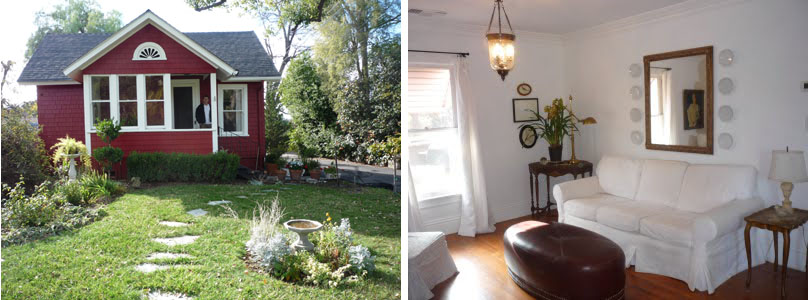
Mine is not as much a minimalist story as a quest for simple living. Two years ago as the last of our 3 boys left home we decided to scale back, slow down and try to recapture the time in our life before kids. We were young and didn’t have much but were quite content. This was our vision. So this is what we did…

We traded a big tract home with all the bells and whistles for a tiny, old cottage that is located in a historical park in our town. The cottage required a complete renovation but the location was perfect. We now have 2 very small bedrooms, 1 closet in the entire house, no garage. We do have a tv that is rarely turned on, but no cable. No cell phones (only a landline.) No gardener or pool service (both of which we had before.) We have a small push mower that I love because I’m able to do the gardening by myself if I want to. Our utility bills are a fraction of what they used to be. We have no credit card debt or car payments. My husband works from home and I can walk to work. We maintain a vegan diet for compassion and health. This life we have recreated was not easy but has been so worth it. We still have stress but it is not the nagging, persisent kind that we used to live with on a daily basis.

Friends and family could not understand why we would voluntarily give up so much. But we had a vision and we stuck with it. While I strive to continually pare down, I do love the things we have kept because they hold so many memories. I am always inspired by reading other stories regarding this topic. If you are interested you can see the progress we have made at my blog – www.thegardenerscottage.blogspot.com

The one last thing I’m struggling with is the internet. I’m finding that I’m spending too much time on it and have been thinking about giving it up too. Not quite sure how that will turn out.

Thanks for reading my story.

~janet

aPhotos by Janet

Minimalist Home: White Walls

It may come as no surprise that I *love* white walls (and white floors…and white textiles…and white décor…).

So I was happy to see this Apartment Therapy feature on white bedrooms. How gorgeous! I think the monochromatic color scheme gives the spaces a serene, minimalist look, even when they have a little more “stuff” in them.

They’re also a great example of how “minimalist” doesn’t have to mean “modern.” Now I love streamlined furniture and glossy surfaces as much as the next minimalist, but my favorite bedroom of the lot (pictured below) is actually quite the opposite:

Seeing this space actually made me miss our old 1920s bungalow in the States. DH and I had painted every single wall, ceiling, door, window, and piece of trim a uniform white. Not a creamy white, or an eggshell white, or any other kind of decorator, hint-of-color white. We used the “bright white” that you pick up in giant cans straight from the home improvement center’s shelves—the kind that doesn’t have to be carefully mixed into some pretty shade at the counter.

The monochromatic paint job took significant time and effort (in one room, we were painting over a brilliant emerald green) but the results were amazing. It gave an ethereal, airy feeling to the space, making the rooms look larger, and the walls as if they were floating; the effect made me smile every morning when I opened my eyes to it.

It wasn’t the first time we’d covered every inch of a place in a beautiful, stark white. In fact, we’d done something similar to almost every apartment we’d lived in.

I’m writing this as I sit in our new UK flat, with warm, cream-colored (almost light yellow) walls. We won’t be trekking down to the paint store anytime soon, as our lease prohibits us from making cosmetic changes. It’s strange, though; my husband and I have moved around a lot, and always settled in quickly to any new living space. This place, though lovely, has never felt quite like “home” to us; it feels more like an extended-stay apartment than “our” space. Originally, I’d chalked it up to living in a foreign country. But you know what? I think it’s the walls.

My Minimalist Wedding Dress

dress-cropI recently received an email from a reader named Elise, who wrote: “You mentioned that you are married. I’d love to know what you have done with your wedding dress and other keepsakes.”

Great question, Elise! After the big day, many women struggle with how to store the “dress of their dreams”—as well as all the other stuff they accumulated from the ceremony and celebration.

Fortunately, I was a minimalist before I got married—and knew I could never manage to drag around a big, bulky, and delicate garment for the rest of my life. My husband and I also wanted little to do with the usual marriage accoutrements (favors, invitations, albums, cake, presents, and the like.)

Therefore, instead of a traditional wedding, we eloped and got married in Iceland. Now, as many of you know, I’m an inveterate carry-on traveler—and I was not about to make an exception for this occasion (especially considering the dilemma I’d have if my luggage was lost!) Getting married abroad, therefore, presented a unique packing challenge: how to transport a dress, shoes, and other accessories in my carry-on bag.

An over-the-top, white satin “princess” dress, complete with veil and train, were obviously out of the question (and not really my style anyway). To top it off, I had little shopping time; we had only a month to do all the requisite paperwork, and get ourselves together, before departure. (As you may have surmised, my husband and I are pretty spontaneous and not particularly adept at long-term planning).

I had one requirement for a wedding dress: that it fit in a standard-size ziplock bag, for easy, no-worry transport. Fortunately, I found just such a garment: a cocktail-length lace dress in pale blue and gold (see photo above). It folded down to practically nothing, and the fabric showed no wrinkles. I accessorized it with a long white cardigan (it’s cold in Iceland!), and some kitten heels that were slim enough to fit in my toiletry bag.

After a short and sweet ceremony, we sent out postcards of Reykjavik (the capital of Iceland, and city in which we were married) to announce our wedded bliss. In lieu of a reception, we went for a nighttime dip in the Blue Lagoon. By keeping things simple, we deftly sidestepped the barrage of gifts that usually accompanies such an event: china, flatware, fondue sets, linens, small appliances, etc. (We already had a furnished household, and certainly didn’t need any more stuff!) Friends and family were content to treat us to dinner, and bottles of wine and champagne, after we returned home.

Therefore, the only “keepsake” we have to store is our marriage certificate. Our photos are all digital, and my dress is now part of my regular wardrobe. We have no “wedding china,” “wedding linens,” or other sentimental “wedding things” that we’ll feel obligated to keep for the rest of our lives.

My advice to single minimalists: if you take the plunge, keep it simple. Otherwise, you may accumulate a lifetime’s worth of stuff in just one day!

I’d love to hear how others have dealt with wedding dresses, gifts, and other keepsakes!

Real Life Minimalists: Sunny

spotlight2-m2-100
Every Monday I post Real Life Minimalists, a profile of one of my readers in their own words. If you’d like to participate, click here for details.

This week, we’ll get to know a little more about Sunny, and her motivation for choosing a minimalist lifestyle.

Sunny writes:

I’m a minimalist. I own two pieces of furniture. My closets are empty and my cupboards are bare. There’s space everywhere in my life, and I’ve never been happier.

Once upon a time, I was very complicated. I wore stilettos, carried designer handbags (stuffed with receipts, chewing gum, extra socks, a dozen lips glosses, and sticky unidentifiable objects), and spent an inordinate time organizing/dusting/reorganizing my overwhelming burden of belongings.

My first glimpse into what minimalist design looked like occurred at the Denver Art Museum, in this picture I’ve included. “Wow,” I thought. “Imagine how easier life would be if THAT were my living room!”

Despite my admiration for minimalism, in all its forms, I became a minimalist by accident. When I received an unexpected medical bill, I choose to sell my furniture instead of go back into debt. With my apartment suddenly bare, I wondered why I didn’t feel like a failure for having released all of the things that signified my adulthood. Like my kitchen mixer, which I never used, but having it signified that I was “grown-up”.

Then I remembered that simple corner at the art museum, the one I liked so much I’d been compelled to take a picture. If it’s good enough for a museum, I figured it was good enough for me.

After living an unfurnished life for a few weeks, I felt brand new. I began reading about other minimalists. Reading blogs, like this one, encouraged me to release even more stuff. I sold everything, piece by piece, until only the necessities were left.

It’s amazing what happens when you empty a drawer. A slice of freedom comes along with it. What would you do differently if you weren’t tied down to your stuff? Maybe you aren’t the type to move to Brazil and live a vagabond beach life, but would you live your everyday life differently?

For me, my minimalist quest became a release of the mental clutter, as well as the physical clutter. Instead of dusting, I began thinking. Without shopping, I had time to read books, and have lunch with good friends. The important things became clear.

Seduced by the absence of stuff, I’ve fallen in love with a new kind of life (which I’ve started to write about on my own blog, Simplicity by Sunny). I want to travel, experience different cultures, live out of a suitcase, develop more relationships. Most of all, I want to experience life, not stuff.

So, I’m off – pockets light, mind open – to enjoy another Sunny minimalist day!

aPhoto by Sunny

Why I Love Ebooks, Part 2

aiPod with Kindle app

In Part 1 of this topic, I talked about how moving overseas (and being separated from my favorite tomes) made me a huge fan of ebooks.

Even before I moved, however, I was growing weary of physical books. I didn’t like how everything I read seemed to stick around on my bookshelf. Consequently, I committed to get rid of (resell, pass on, or donate) books directly after I’d finished them. I’m a fast reader, though, so in many cases books would leave my house just a day or two after I purchased them! That didn’t feel quite right either.

To compound the problem, the town I lived in (before moving to the UK) was NOT part of the county’s library system (!). Therefore, borrowing a book from the library involved borrowing a friend or relative’s library card, and going to their town to browse the stacks. (And being particularly diligent about returning books on time, lest they incur late fees!) Oftentimes, it seemed more trouble than it was worth.

Unfortunately, these two factors greatly curtailed my reading. There were plenty of new, nonfiction titles I wanted to read, but instead I made do with what I could read online at Project Gutenberg. I simply didn’t want to own any more books, or go through the hassle of acquiring, then reselling or donating them.

Therefore, I was thrilled when Amazon released the Kindle-for-PC reader last fall. I downloaded it the day it came out, purchased a few titles I’d been longing to read, and felt like I was in touch with the literary world again!

Mostly, however, I wanted to be able to read ebooks while traveling. I often take long flights and train rides, and relish those hours of uninterrupted reading time. But I travel carryon only, so the weight and volume of books always presented a problem. The titles I took on a trip would be determined by page count and font density (in an effort to find the longest, yet lightest-weight book), rather than what I really wanted to read. (Although, as a result, I became quite well-read in Russian classics!)

I considered purchasing a Kindle or Sony Reader, but didn’t want to carry yet another electronic device. I always take my iPod on the road, so decided to replace my Nano with a Touch—that way, I could have just one device for both music and books. I downloaded the apps for Kindle, Barnes and Noble, and general reading, and it’s worked out beautifully; I can read on the Touch for hours with no problem, and it’s much smaller and lighter than a dedicated ereader. Better yet, it’s always with me: so I can read on the bus, on the subway, while waiting for appointments, etc. I even curl up in bed with it at night!

Going forth, my goal is to purchase as few physical books as possible. I plan to use a combination of the library (to which I now have access!) and ebooks for all my literary needs. In the future, I’d love to see the following:

1. Lower prices on ebooks, given the absence of manufacturing and distribution costs.

2. The ability to borrow ebooks from the library.

3. A secondhand (“used”) market for ebooks, which would allow me to sell my “ownership” of one to someone else, at a reduced price.

4. The ability to share or trade the ebooks I own with friends and family.

5. Ereaders that can display color photographs and pictures, so that art, architecture, and other graphic-intensive books can be read digitally.

That doesn’t sound like too much to ask, does it? ;-)

Anyway, I love how technology is making it easier (and more fun!) to be a minimalist—and I’m looking forward to what the future holds!

Why I Love Ebooks, Part 1


In response to my post on Printing to PDF, Stuart brought up the subject of ebooks. Oh Stuart, you had to get me started… I know this is a controversial topic here, and some of you fundamentally disagree with my opinion. But it’s an issue near and dear to my heart, and I just can’t refrain from pontificating on it. :-)

I have a love/hate relationship with books. I love the content, but I hate the physical format. It’s not that I don’t like to hold a book in my hands while reading it; I don’t mind that at all, and in fact, sometimes relish the tactile experience of diving into its pages.

However, that same physicality (the covers, the binding, the hundreds of pages—and the resulting weight) is what’s currently separating me from my collection! The fact that I can’t enjoy my favorite books, because they’re too heavy, unwieldy, and expensive to ship, is what gets my knickers in a twist.

Before I moved overseas, I culled my library to roughly thirty books. These are the tomes with which I’m loath to part. They’re primarily non-fiction, covering topics like art, architecture, philosophy, travel, history, cultural studies, and writing. I wish I could invoke my minimalist superpowers and simply let them go; but for the most part, they would be difficult, if not impossible (some are out of print), to obtain again if I so desired.

Now, I’d have no problem giving them up, if I could simply nip down to the library when I had the need to consult one. But unfortunately, only two were available from my local library system (one through Interlibrary Loan) the last time I checked.

(Fortunately, fiction does not pose such a problem for me. What I read generally falls in the Great Classics of Literature category, and many of my favorites are in the public domain. They’re readily available in libraries, from bookstores, and on the internet. Therefore, I don’t feel the need to own them in order to secure future access to them.)

So, out of my thirty books, only four currently reside with me (the most I could fit in my duffel bag when I moved). I’d intended to have the rest shipped over once we were settled. But I’ve come to realize that when living abroad on a visa, you’re never really settled (and for the record, I don’t consider that a bad thing). However, I’m reluctant to pay big bucks to transport them over here (the Post Office no longer offers the cost-effective International Media Mail), only to have to drag them around the next time we move.

Ebooks, then, are the answer to my minimalist prayers—well, theoretically. If I could replace every book in my “permanent” collection with a digital version, I’d do it in a heartbeat. Unfortunately, however, only a handful are currently available in electronic form. Amazon has an “I’d like to read this on Kindle” button on each book’s product page, that sends the request to the publisher. I’ve been clicking that link like mad for the books in question, with the hope that someday I’ll be (digitally) reunited with my beloved volumes.

Wow–this post is getting too long, and I’ve barely begun to wax poetic on the wonders of ebooks and how they’ve changed my reading habits. I think I’ll call this Part 1, and continue my discourse (I told you not to get me started!) in my next post…

As always, comments (both for and against ebooks) are welcome. This is one of my favorite topics, and I love hearing everyone’s opinions!

Real Life Minimalists: Frances

spotlight2-m2-100
Now that you all know my story, I’d love to hear yours! Every Monday I plan to post Real Life Minimalists, a profile of one of my readers in their own words. If you’d like to participate, click here for details.

I’m thrilled to inaugurate the feature with this wonderful contribution from Frances.

Frances writes:

I think I have always had minimalist tendencies but for a long time I never had much stuff anyway so it never occurred to me that I was one! About 15 years ago I was living in London and very dissatisfied with my life and my job. I really, really wanted to move to the country and I knew I would be earning much less by doing so. So I decided to downsize and it has gone on from there.

Once I had moved (about 11 years ago) I wanted to fund a few months where I didn’t have to work so I looked at all my expenditure and do without things I didn’t really want or need. So, for example, I keep a very spare purse with just one debit card and one credit card. No store cards, no so called “loyalty cards” and I don’t carry the credit card around with me either. I gradually took down the amount of cosmetics I wore and now, apart from face creams, the only cosmetic item I wear is lipstick and I rather resent using that sometimes! I decided not to dye my hair as I didn’t want to spend money on yet more chemicals leaching their way into our water systems. On the same basis I decided not to buy clothing that needed dry cleaning – same reasoning! I wasn’t wild about jewellery and selling what I had funded a bit more freedom. Now I don’t have to worry about losing it or having it stolen. I don’t use a mobile phone – if I do get one I will do without the landline.

Television was beginning to irritate me hugely, both in terms of the amount of space it took up, together with all the add ons I had acquired of set top box, video, DVD player, cabling, remotes and having to keep a piece of furniture I disliked just to accommodate it all. In the UK we have to pay a license fee before we even switch on and that began to niggle me as I wasn’t watching it much anyway. I finally took the plunge and got rid of the lot. I eventually replaced it all with a DVD player I can keep in a drawer and just get out when I want to use it. I decided on a fairly minimal wardrobe as well, mostly wearing trousers and tops and that saves money on having to buy tights and have umpteen pairs of shoes to go with different items. Lots and lots of other things as well but this is probably already too long a piece for your purposes.

A while ago I watched a programme where a very attractive and well known actress was lamenting the fact that when she was young it took her 20 minutes tops to get ready and leave the house in the morning and now it took her at least 40 minutes. Well, I am delighted to report that I find the complete opposite. When I was young, I had to put on all the make-up, sort out my contact lenses, get my tights hauled on praying that they wouldn’t ladder or twist and dress before I could get out of the house. Now, no make up to put on, I have a pair of sweet little spectacles to pop on my nose and I wear socks with my trousers. Out of the house in 20 minutes flat!

Minimizing Paperwork: Print to PDF

stackpapers(Photo: FeatheredTar)

Like many people, I make the majority of my financial transactions online: from shopping to paying bills, from retrieving statements to managing bank accounts.

In the past, I used to print off a paper confirmation of each one. For some reason, I thought I needed physical “proof” every time money changed hands—be it a deposit into a savings account, or a receipt for a sweater ordered over the internet. So although I was conducting the majority of my business electronically, my files were still bulging.

Then I discovered the three magic words that eliminated 90% of my paperwork: “print to PDF.”

Oh, how I love this option! It gives me the satisfaction of documentation, without the clutter.

No longer do I have a stack of receipts from online purchases I’ve made or bills I’ve paid. Yet if I ever find the need for a paper copy, I can easily print one off. (Recently, however, I’ve found electronic documents to be more valuable in resolving issues than printed ones!)

Similarly, when I come across an interesting article on the web, I no longer feel compelled to print it out and squirrel it away–just in case the web page or content disappears in the future. Instead, I print it to PDF, and voila!—I have a virtual library of “research” on my laptop.

To “print to PDF,” all you need is software such as CutePDF or pdf995. Both are free, and easy to install.

Once it’s installed, it’s a snap to use. To “print” the current page in your browser window, do the following: select “File,” then “Print,” and choose the PDF program from the dropdown box next to “Printer Name.” Click on the “OK” button, navigate to the folder in which you’d like to store the document, and name your file.

Of course, you don’t want to make your computer a digital dumping ground! Be selective with your “printing,” and set up folders (such as “Receipts” or “Articles,” for example) to organize the documentation you generate. Most importantly, make regular backups of your files in case of data loss.

My goal is to live as paperless a life as possible—and this simple feature has gone a long way towards helping me accomplish that. This year, I have more incentive than ever to avoid accumulating paperwork—I have no idea where I’ll be living this time next year, and don’t relish the thought of dragging a stack of documents around.

Therefore, I’ll be attempting a zero net gain of paperwork in 2010. Would anyone like to join me?