I’m Dreaming of a Minimalist Christmas

a(Photo: ceanandjen)

From the time I was young, I’ve had mixed feelings about the holidays. While I love the excitement, the festivity, and the gatherings with family and friends, I’ve always dreaded the “stuff” that seems to come along with it.

When I was a child, I couldn’t articulate just what it was that made me so uncomfortable about Christmas. I enjoyed the anticipation, and how the spirit of the season made the everyday world seem more magical (I’ve always had a thing for fairy lights.) But the day after opening my mountain of presents, I’d tuck them away as quickly as possible, unsure of how to handle the sudden barrage of new possessions.

I began to understand my problem as a young adult. Immediately after Thanksgiving, I’d go into defensive mode. I knew stuff would soon be flying at me from all directions (from family, relatives, friends, colleagues). I’d try my best to get out of gift exchanges, and dodged social calls that might involve presents (“let’s get together after the holidays instead”), but I felt like I was fighting a losing battle. In the end, I’d graciously accept what was given to me, and then return, regift, or donate what I could.

Fortunately, as my minimalist lifestyle became more understood and accepted, things changed. At first, people despaired about what to get me. “You’re so hard to shop for!” was a common refrain. Eventually, though, there came a point where I could rest easy; the vast majority of gifts I received were of a consumable nature (food, wine, homemade cookies). Better yet, many friends were happy to get together for a holiday lunch or dinner in lieu of exchanging presents.

In fact, as awkward as the topic often was to address, it seemed that the end of a gift exchange brought a sense of relief all around. I honestly think that a lot fewer presents would change hands if people had an easy way to say “Let’s stop.” While I’ve never personally used one, I like the idea of a gift exemption certificate, as shown here and here.

If you’d like to join me in making this holiday a minimalist one, here are some ideas to consider:

Gifts. Try to limit gift exchanges as much as possible. Propose alternatives (like a get-together instead of presents) to friends and family. At the very least, express a preference for consumables; it’ll dramatically decrease your post-Christmas clutter. For those with children, consider following Heather’s example in her comment to my Born Minimalist? post. She gives her young son four gifts for Christmas, and asks him to donate one to Toys for Tots. (I just love this idea!)

Cards. The vast majority of holiday cards wind up in the trash by January, so consider emailing a holiday greeting instead. You’ll save time, money, and the environment. If you feel you must send a card, consider recycling an old one—cut off the picture on the front, and send as a postcard.

Decorations. Give yourself permission to enjoy other people’s decorations, instead of feeling obligated to display your own. I haven’t had a Christmas tree, or decorated my home with lights, in years; I much prefer walking around neighborhoods and downtown streets, and admiring everyone else’s efforts. :-) If anything, opt for natural décor (greenery, berries, and pine cones) instead of mass-produced, store-bought items.

Just because you’re a minimalist doesn’t mean you can’t enjoy the holidays. In fact, you may even enjoy them more! The key is focusing on the experience of the holidays, rather than the stuff.

Even though my husband and I won’t be sending cards, exchanging gifts, or putting up any decorations, we’re looking forward to the season with the same anticipation we had as children. We love seeing the streets of London turn into Dickensian scenes of twinkling lights. We’ve also booked a trip to the Christmas markets in Cologne, Germany—not to buy anything, but rather to nibble stollen and sip hot chocolate while taking in the festive atmosphere around us.

I’d love to hear how others plan to celebrate the holidays. Are you taking any steps to simplify your Christmas (or Hanukkah, Kwanzaa, winter solstice, etc.)?

Celebrate Your Minimalist Lifestyle – Thanksgiving and Buy Nothing Day

bndI’d just like to wish all my American readers a very Happy Thanksgiving. I’ve always loved this holiday, because it encourages us to focus on, and be grateful for, what we have. And when we stop to think about it, most of us truly have enough.

Furthermore, it makes us stop and realize that material goods are not the source of happiness—far from it, in fact. Friends, family, love, and good health—these are the things that make our lives truly rich. We really don’t need much beyond that.

When my friends and I were in our early twenties, before we had families of our own, we all used to meet up on the Wednesday night before Thanksgiving. Fresh off trains and planes, we would gather in a bar for a few hours before going home to parents’ and relatives’ houses.

In terms of possessions and money, we had little to none; in fact, for some of us, scraping up the train or plane fare home was a major undertaking. Yet we couldn’t be happier; we were heady with freedom, and the world was full of possibility.

It’s this sense of liberation that minimalist living has allowed me to recapture. And since we don’t have friends or family to celebrate with in the UK, my husband and I plan to spend our Thanksgiving evening relaxing in a pub–being grateful for the amazing opportunity to live here, and the chance to explore how little we need (in terms of stuff) to truly be happy.

On another note, I hope you’ll join me in supporting Buy Nothing Day (this Friday, Nov 27 in the US, and Saturday, Nov 28 in the rest of the world). For those unfamiliar with it, Buy Nothing Day is a 24-hour moratorium on consumer spending, conveniently timed in the US to coincide with Black Friday, the biggest shopping day of the year.

You can participate simply by staying out of shops and malls for the day; the more activist-minded can join anti-consumer demonstrations and protests. For events in your area, see the Buy Nothing Day page on Adbusters.com.

It’s a wonderful way to express your minimalism—and send a message to the corporate and marketing world that “We have enough!”

What’s in a Minimalist Kitchen?

When we sold our house and purged almost everything we had (see My Minimalist Story, Part 1: A Clean Slate), we discovered that the majority of our “stuff” came out of the kitchen. We had never realized just how many plates, pots, pans, glasses, utensils, and other cooking implements we had accumulated over the years.

After ridding ourselves of all the excess, we thoroughly enjoyed having an ultra-minimalist “kitchen” during our six weeks of transition from the US to the UK: nothing more than our sporks, titanium cups, and a tea kettle (and the occasional hotel microwave). Of course, we relied heavily upon restaurants and prepared foods from grocery stores—not exactly a long-term solution.

Now that we’re “rebuilding” our kitchen, we’re determined to keep things to a minimum. We only want to own those culinary items we use on a regular basis.

Sure, we could have a super-minimalist kitchen if we didn’t cook very often (or ate mostly frozen dinners or convenience foods). However, my husband and I enjoy preparing meals together, and try to base our (vegetarian + fish) diet on whole, unprocessed foods. Therefore, we’ve deemed a functional kitchen one of our necessities.

After an initial run to Ikea for the absolute basics, we’ve been taking it slow when it comes to culinary apparatus—and acquiring things strictly on an as-needed basis. Our main criteria: we must use something at least once a week for it to earn a place in our kitchen. So far, we’ve been getting by quite nicely with the following items:

Pots and pans: large skillet, saucepan, pasta pot, baking pan

Small appliances: tea kettle, rice cooker, French press (instead of coffee maker)

Other: chef’s knife, bread knife, paring knife, colander, steamer, cutting board, measuring cup, spatula, serving spoon, whisk, can opener, corkscrew, stainless steel mixing bowl, water filtration pitcher

For utensils, we purchased an inexpensive, four-place setting (after looking high and low for open stock or single settings, to no avail). It seems excessive to have extra forks and spoons on an everyday basis, but I suppose they’ll come in handy if we have guests for dinner. We also bought four plates, two bowls, two coffee mugs, and a set of four small glasses (to be used for all liquids other than coffee and tea).

[In general, I’m not a fan of owning extra stuff for the handful of times we entertain; when we hosted Thanksgiving dinner last year, I had no problem borrowing extra plates and utensils for the evening. That might be a bit harder here in the UK, though, without friends and family who understand our minimalist lifestyle!]

Plenty of websites and cookbooks offer lists of kitchen essentials; more than a few, however, seem intent on making sure you’ll be able to cook anything at any time. In that sense, having a minimalist kitchen requires some minor adjustments in priorities and lifestyle. I wouldn’t be able to bake cupcakes tonight on a whim, for example—but I’m okay with that. In fact, we’ve decided to forego bakeware almost entirely; instead of making our own sweets, we save those calories for when we travel—and sample the baked goods of the countries we visit. :-)

Of course, everyone’s list of essentials will be different; ours simply suits what we like to cook, and eat (mainly pasta, rice, soups, salads, and sautéed and steamed vegetables).

I’d love to hear what everyone else finds necessary… Leave a comment, and let me know what’s in your minimalist kitchen!

Minimalist Furniture: The Bare Essentials

We’ve been in our flat for over two months now, and I think it’s about as “furnished” as it’s going to get. Therefore, I thought I’d devote this post to recapping what we found to be the bare essentials, furniture-wise.

We ended up with a grand total of four pieces, as follows:

1. Mattress on the floor. We haven’t found any reason to invest in a bed frame, and actually quite enjoy sleeping on the ground. Our bedroom’s floor-to-ceiling window lends itself nicely to low (or non-existent) furnishing. Furthermore, our building has radiant ceiling heat, so our floor is warmed by the flat below. :-)

2. Coffee table. This multi-purpose item serves as a coffee table, a dining table, and occasionally a desk. It’s very lightweight, and can easily be picked up and moved around the flat when needed.

3 & 4. Two Ikea Poang chairs. As I mentioned in my last post, my husband and I opted for two of these lounge chairs in place of a couch. While I would have been fine with a floor cushion, I have to admit that they’re quite comfortable for reading, surfing the net, or kicking back with a cup of tea or glass of wine. Since we were determined to keep our furnishings to a minimum, these chairs offer us greater seating flexibility than a sofa.

That leaves us with one completely unfurnished room: the second (guest) bedroom. My guess is that it will stay unfurnished until the week before someone comes to stay with us—at which point we’ll have to come up with some sort of sleeping arrangement post-haste. I have my eye on the foldable Cube Bed from the Futon Company. I like the way it can be folded into a side table or seat when not in use. For now, however, that serene, empty space will be my yoga room. :-)

So how did we choose these particular pieces? In order to stick to our minimalist living goals, we based our decisions on the following principles:

Necessity. After a week of sleeping on the floor, for example, we decided a mattress was necessary. Things like a bed frame, dining table, and printer stand we knew we could live without.

Multi-functionality. As a minimalist, I love pieces that do double or triple duty (like our coffee table). I’d like to be able to meet all our needs with as few things as possible.

Mobility. It’s important to us to be able to transport our furniture easily—should we decide, for example, to move to a different flat in a few months (six-month leases are common in the UK, versus the standard one-year in the US). Therefore, we chose the most lightweight and mobile furnishings possible. (What I wouldn’t give for the Casulo furniture I blogged about last month!)

Flexibility. We chose pieces that could work in a variety of configurations, and that we could move around the flat if necessary.

Non-attachment. This became a significant guiding principle for us. We really wanted (replica) Barcelona chairs, and thought a pair of them in ivory would look fantastic in the flat. And we came *this close* to purchasing them. However, we reasoned that we’d hate to leave them behind if we left the UK; they’d cost a fortune to ship somewhere else; and we’d be unlikely to recover even half the cost if we resold them. In the end, we decided we’d rather have furniture to which we didn’t have much attachment—and chose the less expensive, and more easily resaleable, Ikea chairs.

chairs-m

Four pieces of furniture is far less than what we had in our last house—but so far, we’ve found them to be perfectly adequate. Time will tell if we need anything more (and, of course, I’ll blog about it here!).

So, when it comes to furnishings, how low can you go? Even if you currently have more than you want/need (like we did four months ago!), what would your minimalist dream home contain?

Minimalist Living: Questioning the Couch

a(Photo: Knoll)

Have you ever been in a house without a couch?

I don’t think I have. I’ve thought about my friends’ houses, my relatives’ houses, and my neighbors’ houses. I’ve thought about all the places in which I’ve lived, from childhood until now. I’ve thought about the homes I’ve seen on TV, in movies, and in magazines.

From modest studios to million-dollar McMansions, from inner cities to suburbs to out-in-the-sticks, you’d be hard-pressed to find a living room without a couch.

In considering the subject, I realized that our sofa has always been the key piece of our décor. When we looked for houses or apartments, we’d wonder how the layout would accommodate it. After we moved in, we’d spend time experimenting with its optimum orientation (against the wall? at an angle? facing the window or TV?) In some cases, we even bought a new one because the old one didn’t suit the style or size of our new digs.

So naturally, after we found a flat in the UK, one of the first issues to arise was that of a couch. We’d lived without a single piece of furniture for two weeks (minimalist heaven!), but our backsides were growing a bit numb from sitting on the wood floors.

Personally, I would have purchased a couple of floor cushions and called it a day. No matter how comfortably a room is furnished, I usually end up on the floor anyway. I simply feel more relaxed on the ground—and whether I’m eating, reading, or surfing the net, that’s where you’ll usually find me.

It seemed unfair, however, to deny my husband (and potential guests) more proper seating—and so our hunt for a couch began. We spent a weekend searching online, and visiting furniture stores, to find the perfect sofa for our new flat. We looked at every type imaginable—from futons to loveseats to sectionals—and tried to imagine how they’d look in our open-plan living room.

We had just about settled on one with a mid-century modern design, when my husband suddenly asked, “Do we really need a couch?” (Whoa. Is it any wonder I love him so?)

Do we really need a couch? Hmm. Good question. We took a break from shopping, and talked it over. We didn’t have a TV, so we weren’t sure what our couch would face. Furthermore, we’d always have to sit side-by-side, instead of face-to-face—unless, of course, we bought some additional chairs. The more we thought about it, the less appealing a couch seemed to be. Not to mention that it would likely require more pieces of furniture to balance it out.

We concluded that not only didn’t we need a couch; we didn’t even want one.

But would that be weird? We wondered what our landlord, guests, or family would think when they came to visit, and found an empty space where the sofa should be. But then we reasoned: we were already considered somewhat eccentric for quitting good jobs, getting rid of everything we owned, and moving to a foreign country. Why not go for broke and confirm our (already-suspected) quirkiness? Why not live in a house without a couch?

So instead of arranging delivery on a heavy, expensive sofa (the resale of which we would someday have to orchestrate), we decided on a more lightweight, mobile, and versatile option: we threw two Ikea Poang chairs and a coffee table into our Mini, and were on our way. And thus we completed the task of furnishing our flat.

I’m certainly not suggesting that minimalists can’t have couches. My point, rather, is that we should think about why we own what we do. We should make our possessions fit our lifestyle, instead of the other way around. We shouldn’t feel pressured to own things just because it’s expected, or because everyone else has one. We should feel free to own only those things that meet our needs (no matter how strange that may seem to anyone else!).

In our case, a sofa doesn’t meet our needs at this particular place, and at this particular time, so we’ve simply decided not to own one.

So what items have you decided you don’t need to own? I’d love to hear about them!

Minimalist Living: Life Without a TV

tvFor years, my husband and I talked about giving up our TV. We hadn’t had cable in a decade, hardly watched anything other than the news, and didn’t like the way it was the focal point of our living room.

But for some reason we could never take the crucial step of getting rid of the darn thing. Worse yet: when a lightning storm conveniently destroyed it for us, what did we do? We went out and bought another one. {sigh}

Our recent overseas move, however, provided us with another chance to be TV-free. And this time, I’m happy to report, we took it.

Shipping our television to the UK was out of the question—not only would it have been prohibitively expensive, it was unlikely to work here anyway. So we finally bit the bullet, and sold it on Craigslist a few days before our closing.

After we’d crossed the pond and found a flat, the question soon arose as to whether or not to replace it. Luckily, the British government made our decision much easier; as soon as we found out about their annual TV tax of 142.50 GBP (about $237 USD), we had all the incentive we needed to embrace the no-TV life.

I have to admit, I wasn’t too concerned about giving up the physical television because I thought we could watch the few shows we liked (ie. The Office) online. Unfortunately, we discovered that our foreign IP address prevents us from viewing American programming—so we’ve really gone cold turkey. (But if you’re in the US, you could certainly ease into the TV-free life with judicious use of the internet.)

We’ve been without a television for over two months now—and to be honest, we hardly notice its absence. In fact, our home, and lives, seem much more serene without it.

Better yet, I’ve found that our lack of a television has made it easier for us to live a minimalist lifestyle. Here’s how:

1. No commercials. The fewer things we see advertised, the less stuff we “need” or want—hence, the less likely we are to fill our home with junk. We also escape the feelings of deprivation such marketing messages are designed to invoke.

2. No “Joneses” to keep up with. We have no idea how celebrities, reality stars, or TV characters dress or decorate their homes, so we have no motivation to purchase similar items. We’re also blissfully unaware of popular culture and trends, so they have no influence on our consumer decisions.

3. Less furniture. We don’t need a TV stand or entertainment center. We’ve also been able to rethink the layout, and necessity, of other living room furniture (I’ll write more about this in a future post).

4. Fewer accessories. We’ve eliminated the need for a DVD player, sound system, speakers, and remote controls.

5. Less repetition. Between morning, dinnertime, and evening, we used to watch about two hours of news each day—and see the same stories repeated ad nauseum. Now we simply read the news online, and receive the same information in a much more efficient manner.

6. Less “junk” news. We’re no longer subject to frivolous “news” stories on celebrities, sports figures, and entertainers. (Remember CNN’s round-the-clock coverage of Paris Hilton’s jail term?)

7. More time. Now that watching television isn’t an option, we suddenly have a lot more leisure time. We’ve found that reading, talking, taking long walks, and trying new hobbies are much more satisfying than vegging in front of the tube. It actually feels like we have extra hours in the day!

When creating a minimalist lifestyle, we typically think about paring down our possessions. Just as important, however, is paring down distractions. Whether it’s television, magazine subscriptions, unfulfilling relationships, or commitments, anything that steals too much of our time and attention should be a candidate for elimination.

When we live minimally, we live more mindfully. By eliminating the extraneous, we gain the space, time, and energy to focus on what’s truly important to us.

I know many people may find it extreme to live without a television—and as I’ve mentioned, it took nothing short of an overseas move for us to give up ours. But if you’re striving for a minimalist lifestyle, the prospect is certainly worth considering.

Ask yourself if your TV enhances, or detracts, from your well-being. If the news makes you anxious, commercials make you acquisitive, or the “noise” makes you feel overwhelmed, distracted, or depressed, try pulling the plug (at least temporarily)—you may find yourself much happier without it!

My Minimalist Story, Part 5: Starting Over

livingroom-m-500

A fresh start.

Don’t get me wrong, apartment hunting in a foreign country was an exciting experience—in fact, it’s something we’d always fantasized about on our travels. Unfortunately, however, it marked the end of our blissfully minimalist, hotel life.

It had been my long-time dream to live in hotels, with nothing more than a single suitcase; and I was fortunate enough to realize it, for six weeks, while we moved from the US to the UK (see My Minimalist Story, Part 3: My Life in a Duffel Bag).

For minimalists with deep pockets, it’s a great way to live. But for those of us with more limited budgets, it can’t go on forever. The weekly rate at our last hotel was just shy of what we’d pay for a month’s rent in an apartment.

Our challenge then, was to continue living as minimally as possible in a place of our own.

First, we had to decide whether to look for a furnished or unfurnished flat. We were surprised to find that furnished flats are more prevalent than unfurnished ones here in the UK (the opposite of our experience in the US). The concept was tempting: we’d have all the stuff we’d need, without actually having to own it.

The problem: our minimalist aesthetics. Most of the apartments seemed over-furnished, with more chairs, dressers, tables, etc. than we’d ever really need (or want). While such a life might technically be minimalist, it certainly wouldn’t look (or feel) that way.

Plus, we wanted to explore living life with just the bare minimum. Starting with an empty slate seemed necessary to truly determine the essentials.

So the day our lease started, we moved our duffel bags into our empty flat—and promptly realized we were going to need some of those things we’d taken for granted in the hotels! We made an emergency trip to Tesco (the UK equivalent of a Target or Walmart), and came back with towels, pillows, sheets, and a kettle—the very first possessions of our new life.

That night, we once again slept on the floor, just as we had the night before our closing. But this time, we were at the end of the ultra-minimalist part of our journey. From here on out, we’d be acquiring rather than purging, buying rather than selling, getting rather than giving. I dreaded the idea of having to re-purchase so many of the things we’d just gotten rid of.

At the same time, however, I was thrilled to have been given a “do-over.” I regarded this new beginning as a chance to determine, and acquire, only those things that met our needs—and nothing more. Finally, I had the opportunity to discover that elusive point of just enough.

My Minimalist Story, Part 4: Our Dirty Secret

From the time we decided to move overseas, my husband and I fantasized about owning nothing more than we could carry with us. We were determined to get rid of all of our possessions, and pare down our lives to a single suitcase each.

We almost achieved our goal. But in our final week of purging, we were weakened by the uncertainty of our plans. My husband had a job offer in the UK, but it was contingent upon us receiving our visas—which, given strict new immigration laws, was not guaranteed. (We did finally receive them, two weeks after moving out of our house.)

Furthermore, we had no idea how long we’d stay. What if we didn’t like England? What if my husband wasn’t happy with his job? What if he was transferred after 6 months or a year?

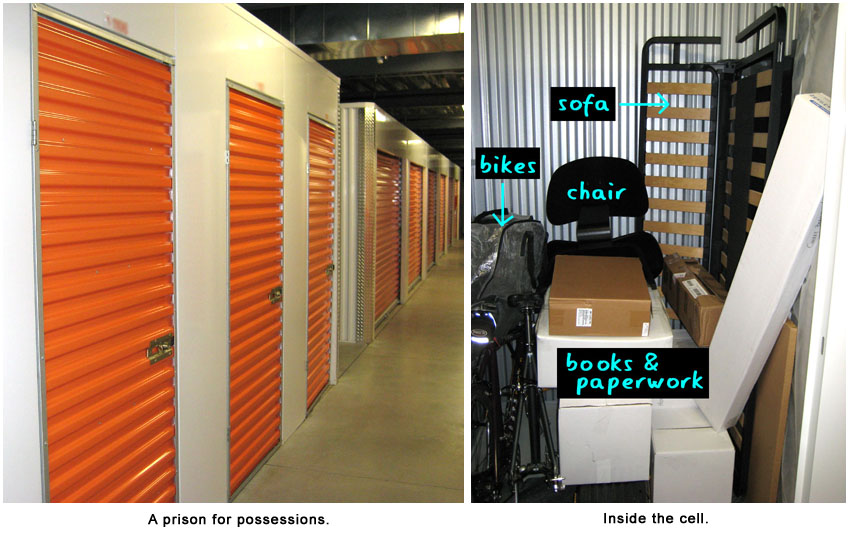
So that’s how we ended up with our dirty little secret: a 5 foot by 5 foot storage unit.

Though no bigger than a small closet, it may as well be an entire warehouse for the grief it causes me. Just the fact that it exists makes me feel like I’m not as minimalist as I could be.

The contents of that closet are things we deemed irreplaceable, or too expensive to re-purchase: an Eames chair, a Danish design sofa (now discontinued), a few boxes of books and paperwork, and a couple of items from our travels. We also included our bikes, since we had the space.

If we decide to stay in the UK, we’ll have them shipped over here. If we return to the US, we’ll bring them back into our lives. But for now they sit in limbo, things without a home.

The day we moved our stuff was the first time I’d ever been in a public storage building. What an eerie place! It was unnervingly quiet, with nothing but the sound of our footsteps echoing through the halls. Lights would turn on automatically as we approached each section, and go dark again after we passed by.

The hallways were completely empty, but we knew that behind the blank, uniform doors sat thousands upon thousands of things—silent, waiting, and in some cases, probably forgotten. The air was heavy with their presence. It reminded me of a jail—a prison for people’s stuff. I felt sorry for our things as we turned the key and locked them away.

We don’t speak of it very often, and the monthly charge is debited automatically from our bank account. It’s easy to pretend it doesn’t exist, but in the back of our minds, we know we’ll have to deal with the contents on our next trip back to the States—whether to dispose of them, or accept the expense of shipping them over.

So, the question is, how little must one have to be truly “minimalist?” Only what you can carry on your back? In your car? In a van? Should the items be such that you could dispose of them without regret each time you move? Should you have no attachment to individual things, no matter how irreplaceable or costly they may be? Or is there room for a few, well-loved pieces that follow (or wait for) you wherever you go?

These are the issues I’m considering now, as we “rebuild” our lives in the UK—because, above all, we don’t want to be burdened by another set of things when (and if) we decide to move on.

Left: a prison for possessions. Right: inside the cell.

Left: a prison for possessions. Right: inside the cell.

My Minimalist Story, Part 3: My Life in a Duffel Bag

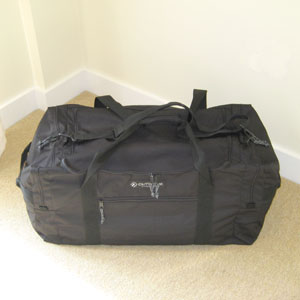
duffelbag-mFor six weeks this summer, I lived my minimalist dream—residing in hotels, with all my possessions in a single duffel bag.

My husband and I purged almost all of our stuff, and sold our house at the end of July (see My Minimalist Story, Part 2: The Great Unraveling). However, we still had to wait several weeks for our visas to be processed before we could move to the UK. In the meantime, we “lived” in a series of hotels, as we wrapped up our old life and prepared for the new.

We each had pared down our things into one (large) duffel bag. Normally, we wouldn’t carry such unwieldy luggage, but it was the most cost-efficient way to transport our stuff across the ocean. The airline would carry our bags for free under our checked baggage allowance, whereas shipping the equivalent amount by post would have cost several hundred dollars.

[Now, I have to admit, I originally had packed a larger bag, in order to take full advantage of this free transport. The problem: I could barely lift it, let alone lug it any further than a few feet. It’s a humbling experience to have to physically carry everything you own; only then can you truly feel how much your belongings weigh on you. In the end, I had to purge some additional items, and trade down to a smaller, more manageable bag.]

In my bag, I’d arranged my possessions in packing cubes—one for pants, one for shirts, one for underwear, etc. I had an “office” cube that contained essential papers for work, our visas, and our move; a “kitchen” cube with my spork, titanium cup, tea bags, and power bars; and a “pharmacy” cube with toiletries, medicine, and other supplies. I arranged the packing cubes in stacks in my duffel bag, so that I could retrieve the appropriate one as easily as opening a drawer.

What a wonderful way to live! I had never before reached this level of organization—a place for everything, and everything in its place. It’s a principle I’d always tried to live by; but our house had too many nooks and crannies for things to hide. Some restless items always seemed to sneak out of their spots and roam around. Here, they stayed still by necessity—if they tried to make a break for it, they could very well be left behind. :-)

The afternoon of our closing, we moved into a highway EconoLodge. The tiny room was almost entirely bed, with only two feet on either side. Space was so tight, we had to stack our duffel bags on top of one another, just to leave a path to walk. It was certainly an abrupt change from the spacious, three bedroom house we had just left! But when you don’t have a lot of stuff, you don’t need a lot of space. We qualified for the hotel’s “long term” rate (7 days+), and actually got quite a kick out of imagining it our permanent residence.

It’s interesting how your perspective of “home” changes when you’re without one. We stayed in four different hotels during our transition, never remaining in any one longer than two weeks. And yet it was amazing how quickly we’d “settle in” to each new spot. Just a day or two after checking in, my husband and I would find ourselves saying things like “meet you at home later” or “are we staying home tonight?” Our home was simply wherever our stuff happened to be at the moment.

It made me think about our past apartments and houses—we’d never considered any of them permanent (even the one we’d just sold). In fact, prior to our previous house, we’d never lived anywhere longer than two years. In essence, they were all just temporary places where we’d kept our stuff, and met up at the end of the day. Places that provided shelter from the weather, and someplace safe to sleep at night. Was that the definition of home? And if you carried all your stuff with you, could you be at home anywhere?

After the Econolodge, we moved onto an Extended Stay efficiency, then flew to England, where we stayed in two more hotels while looking for a flat. I loved our mobility, and got a particular thrill every time we changed hotels. On the morning of checkout, we’d have everything packed and ready to go in a matter of minutes (versus the month it took us to move out of our house!). We never felt like we were stuck anywhere, and always had something “new” to look forward to.

At the airport, our luggage seemed equivalent to that of people going on a long holiday. Nobody would have guessed we were moving our worldly possessions across the globe—for all they knew, we were two tourists setting out on a nice vacation. Which, actually, is very much how we felt—because when you’re not loaded down with a houseful of stuff, life can feel like an extended vacation. :-)