My Minimalist Story, Part 2: The Great Unraveling

unravel-m-b(Photo: ejhogbin)

Most of us spend our lives in a constant state of accumulation.

It all starts when we leave our parents’ homes, and start acquiring the “stuff” to lead independent lives. What begins with a couple of plates, milk crates, and linens in college evolves into furniture, cookware, tableware, and decorative items when we get our first apartments. From then on, it’s a continual process of adding and upgrading as our abodes grow larger, and our lives more complex.

What’s more, we’re cheered on along the way. Our acquisitions are encouraged by advertisers, and celebrated by family and friends. We’re given housewarming parties and shower gifts, and congratulated when we purchase a new TV or living room set. It’s almost as if our stuff becomes the measure of our lives, with “more and better” meaning we’re moving in the right direction.

Which makes it all the more interesting when you decide to do the opposite.

Before my husband and I moved overseas, we decided to get rid of our stuff, rather than move or store it (see My Minimalist Story, Part 1: A Clean Slate). We’d been living together since college, so our possessions represented our entire history together, from our first apartment to our current house.

What had taken over a decade to accumulate, we had one month to purge. Things we had coveted, pondered over, saved up for, shopped for, and excitedly brought home. Things that reflected our interests, tastes, travels, and activities. Things we’d bought to celebrate holidays, birthdays, and anniversaries. We’d slowly woven this tapestry of stuff, telling the story of our lives, and now we had to unravel it.

When we told others what we were doing, it was clear we’d upset the natural order of things. Though we had the support of our closest friends and family, many people couldn’t comprehend why we’d want to get rid of the things “we’d worked a lifetime for” (we’re not that old). Others wrote us off as flighty, eccentric, or a little crazy.

No matter—my husband and I dove into the project with enthusiasm. We split the Craigslist duties, and hardly needed to consult each other on individual items. We knew instinctively the very few things that were special to us; everything else could go without regrets. If one of us wavered, the other would chant, “non-attachment, non-attachment.” The experience was nothing short of cathartic.

Here’s the room-by-room breakdown of our Great Unraveling:

Kitchen. We purged everything, save for our sporks, titanium travel cups, a corkscrew, my husband’s favorite knife, and two masu (sake cups) from Japan. We donated, or gave away, every plate, pot, pan, appliance, and utensil—they were simply too heavy and unwieldy to be worth shipping.

Bathroom. We disposed of everything, except the toiletries we decided to take with us. No sense in shipping towels or shower caddies!

Living room. We gave away decorative items, and sold our TV, stereo system, and all furniture except for two pieces—one impossible, the other too costly, to replace. (If you’re curious, the survivors were the sofa and chair in the photo that accompanies Farewell to My Minimalist House.) This was a tough decision—we didn’t really want to keep anything, but we knew we’d regret disposing of them.

Office. We sold our desks, chairs, and bookshelves, as well as all computer equipment except our laptops and a backup hard drive. We gave away (or otherwise disposed of) every last pen, paper clip, rubber band, envelope, file folder, and miscellaneous item in our overflowing stationery supply box. (In hindsight, we should have saved a handful of essential office supplies, to avoid having to buy mass quantities of them here.) We digitized our photos, and scanned and/or shredded the majority of our paperwork. We kept two boxes of important documents (taxes, real estate, financial), and allowed ourselves one box each of books.

Bedroom. We disassembled and disposed of our homemade platform bed, donated the bedding, and left the armoire with the house. We ruthlessly purged our closets, editing our wardrobes down to our favorite, most versatile, and most often worn pieces. It was liberating to suddenly have “permission” to get rid of all those things that weren’t quite right. No longer was I obligated to keep stuff that might someday fit again, come back into style, or be used for “dirty work” around the house!

Guest room. We sold the furniture (futon and small table), and donated the bedding.

Basement. We sold, gave away, or left for the new owner all the lawn and garden equipment, tools, and household supplies. We kept only our bikes (mainly because DH’s would be more costly to replace than store/ship).

Those weeks were full of chaos and activity, with a constant stream of friends, family, neighbors, and strangers parading through our house and carting away our possessions. It was like a strange dream. Between purging our stuff, preparing for settlement, packing, and wrapping up things at our jobs, we had little opportunity to consider exactly what was happening.

It wasn’t until the night before closing that the full impact of what we were doing finally hit us. As our voices echoed through the empty rooms, we realized that almost everything we’d ever owned was really gone. No longer would we be coming back to our familiar house, with our familiar furniture, and our familiar stuff. For the next six weeks, we’d be living in highway motels, awaiting our visas—then starting a brand new life in a foreign country. Fortunately, any nervousness we might have felt was drowned out by the excitement, and sheer extraordinariness, of the situation.

We slept on the living room floor that night, our two duffel bags lined up at the door, ready to start our adventure in minimalist living.

My Minimalist Story, Part 1: A Clean Slate

a(Photo: jurek
d.
)

I think every minimalist fantasizes about starting over with a clean slate—it seems a heck of a lot easier than the slow (and sometimes painful) process of decluttering the stuff you’ve accumulated over a lifetime. I for one had been decluttering for years, and still seemed nowhere near my goal of living with just the essentials.

But short of a fire, natural disaster, or other tragedy (which nobody wants to experience), there are few circumstances that would suddenly separate you from the bulk of your possessions.

Recently, I received my unique (and possibly once-in-a-lifetime) opportunity for a clean slate: an overseas move.

My husband and I were thrilled about the prospect; for years, we’d dreamt of experiencing life in another country. But reality quickly set in: what on earth would we do with all our stuff?

We had no desire to take all our possessions with us; in fact, the cost of moving them probably would have exceeded their value. Furthermore, we had no address (we’d be looking for a place to live upon arrival), no idea of how long we’d be there, and the thought of dragging hundreds of tidbits across the sea seemed ridiculously burdensome.

Our other option was to put everything into a public storage unit, to be dealt with later. However, that almost seemed like cheating (or at least procrastinating). How could we start a new life, when all the trappings of our old one were bundled up in a warehouse, waiting for us to come “home?” We knew if we kept it, our stuff would continue to weigh on us from across the ocean.

So from the time our house went under contract, we had one month to empty its entire contents. And for an aspiring minimalist like myself, what a euphoric month that was!

Don’t get me wrong, selling things on Craigslist is no walk in the park. It takes a lot of effort to photograph your stuff, describe it, and answer an unending stream of emails about it. Not to mention sell it at a price far less than what you paid. But it was worth every bit of the hassle. That continual parade of buyers lifted the burden of our possessions from us, one-by-one, giving us the freedom (and a little extra cash) to embark on our new adventure.

In the end, my husband and I were each left with one bag (to carry with us), two boxes of books and clothes (to be shipped later), and a handful of items in long-term storage (more on those later).

I only wish I’d had the time to provide a post-by-post account of the experience—but as it turns out, there was little time for blogging (or much of anything else) with precious few weeks to purge, pack, and plan a life in a foreign country. But that’s okay; I’m not sure I could have effectively expressed the utter joy of seeing our bar stools, coffee table, or weed whacker walk out the door for the last time—at least in a way that wouldn’t get me institutionalized. ;-)

So over the next few weeks, I’ll provide my post-mortem account of what it was like to get rid of everything, and live my minimalist dream—residing in hotels, with all my possessions in a single duffel bag. That’ll catch you up to where I am now. Stay tuned.

The Top Ten Benefits of Being a Minimalist

a(Photo: Carmela
Nava
)

A lot of people think being a minimalist is akin to being a monk—living a sort of ascetic lifestyle in which you deprive yourself of “wordly” things simply for the sake of it.

Others regard minimalists with polite curiosity (why ever would you WANT to have an empty house?), or write us off as a bit quirky (since when is it quirky to count how many socks you have? ;-) ).

What gets lost in most considerations of minimalism is the true joy that can be found in the lifestyle. I think that’s the number one reason most of us adopt it: to make ourselves happy.

To this end, I’ve decided to wax philosophical today on the top ten benefits of being a minimalist.

1. Less stuff = less stress. The fewer possessions you have, the less you need to worry about maintaining, repairing, insuring, protecting, and paying for them.

2. Less stuff = more freedom. Possessions are like anchors, tethering us to our houses (to store them), and our jobs (to pay for them). When you don’t have a houseful of stuff, you’re much more mobile and able to take advantage of opportunities as they arise.

3. Less stuff = more time. It takes time to plan for, research, and acquire a purchase (from driving around to stores, to surfing the web for consumer reviews). And it takes time to clean, maintain, and keep stuff in order once you own it. The less stuff you buy, the more time you have for other (more pleasurable) pursuits.

4. Less stuff = more money. The less you buy, the more you save. And who wouldn’t be happier with a little more money in their bank account?

5. Less stuff = less pressure to keep up with the Joneses. When people know you’re a minimalist, they don’t expect you to have the latest and greatest toys and status symbols. In fact, they don’t expect you to have anything at all. (Actually, I’d love to see the Joneses become minimalist, and the competitive non-consumption that results.) :-)

6. Less stuff = less to clean. I prefer not to spend my weekends dusting around tchotchkes, and corralling wayward items into drawers, bins, and closets (and I suspect I’m not the only one!) What’s more: when you’re a minimalist, your house is more likely to look halfway decent when someone drops by unexpectedly.

7. Less stuff = more opportunity to be creative and resourceful. I love the challenge of meeting a need, or completing a task, without purchasing something “extra.”

8. Less stuff = a greener planet. The fewer things you buy, the better for the environment. Rampant consumption is a terrible waste of the Earth’s natural resources.

9. Less stuff for me = more for others. The resources of our planet are finite. When we over-consume, we take more than our fair share—leaving less for others, and future generations. A minimalist lifestyle helps restore the balance.

10. Less stuff = more joy. The fewer possessions you have to fuss over, the more time you have for friends, family, flowers, sunsets, and the beautiful things in life. And that—more than any consumer item—is the source of true happiness.

Minimalist Travel: What’s in My Suitcase

In response to my Traveling Light post last week, I received several requests that I list the contents of my carry-on. I’m happy to oblige, as I think we’d all be happier travelers with much less stuff. :-)

Furthermore, my minimalist packing system is no secret—in fact, there’s a certain security official at London Heathrow who could have written this post for me, given the 20 minutes he spent unpacking and inspecting the entire contents while I was trying to make a connecting flight to Venice. (Note: if you don’t want to treat airport security, and dozens of strangers, to an intimate look inside your perfectly packed bag, don’t bring a spork on an international flight.)

The list below covers what I pack for a trip of about 10-14 days (the typical length of my overseas travel). However, I’d pack the exact same stuff if I were traveling for 3 months (I’d just wash more often). For shorter trips and domestic travel, I pack less; and for overnight or two-day trips, I often take nothing more than a large purse.

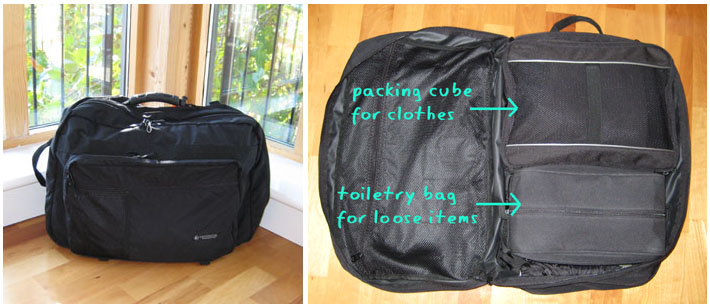
Because I don’t like to have loose items in my suitcase, I pack almost everything into two “holders”: clothes in a packing cube, and toiletries and miscellaneous items in a large rectangular toiletry bag:

My suitcase: the Outdoor Products Essential Carryon

My suitcase: the Outdoor Products Essential Carryon

So here you have it—the contents of my minimalist suitcase:

What I’m wearing on flight/travel day:
Black pants (lightweight, straight leg pair that can be dressed up or down)
Lightweight top
Lightweight silk cardigan
Underwear
Bra
Socks
Shoes
(This is all I need for an overnight trip, along with some toiletries in my purse—I have no qualms about wearing the same thing the next day.)

In the packing cube:
Black pants (so that makes two pairs total, counting the ones I’m wearing)
Black nylon skirt (long or short, depending on season and itinerary—I’ll often skip this if we’re unlikely to go to a “fancy” restaurant during the trip)
Two or three tops in different colors (in lightweight, packable materials)
Lightweight pajamas
5 pairs of underwear
1 bra
2 pairs of socks
lightweight silk scarf (this folds to practically nothing, and dresses up any outfit)

For winter travel/colder climates: If I’m going somewhere cold, I’ll also include silk long johns—they’re extremely lightweight, take up next to no space, and eliminate the need for bulkier clothing. I’ll also pack one heavier sweater or jacket, and either wear it or lay it across the top of my packing cube and toiletry bag.

A note on shoes: Most of the time I travel with only the shoes I’m wearing (my pair of choice is comfortable for walking, but also appropriate for a nice restaurant). But if I’m bringing a skirt (which means a more formal dinner or activity is on the agenda), I’ll slip in a little pair of ballet flats or dressy sandals.

In toiletry bag:
Travel toothbrush
Small toothpaste
Small plastic bottle of facial cleanser
Moisturizer (with SPF)
Powder compact
Lip balm/lipstick
Tiny tube of blush
Small travel brush
Comb
Travel-size pump hairspray
Razor
One or two travel packets of laundry detergent (the key to traveling light!)
Travel clothesline
Lightweight, super-absorbent towel
A handful of band-aids
A few ziplock bags
For foreign travel: Small packs/bottles of Immodium, Pepto Bismol (caplets), and Advil (you can’t buy ibuprofen off the shelf in some countries). Though they take up some space, I find it’s easier to have these things on hand than try to request them from a foreign pharmacy, or decipher labels in a foreign language.
Titanium cup (not every hotel provides mugs for coffee/tea)
A couple of tea bags
Spork (great for picnics and eating grocery store fare) (Warning: for domestic flights only—my last one was confiscated by the above-mentioned security official.)

Note: I don’t travel with soap, shampoo, or conditioner; I use whatever’s provided at the hotels in which I’m staying. First, because I *hate* worrying about liquids spilling in my bag, and second, because the hotel provisions are usually more luxurious than whatever I would bring. :-)

Other stuff:
Travel umbrella
Paper confirmations of flight, hotel, train, museum reservations (better to have them than not—my husband spent a morning in Rome looking for somewhere to print off our Vatican reservations)
Photocopy of passport (for foreign travel)
Lightweight nylon purse (used as a day bag), holding the following:
A couple of power bars
Small hand sanitizer or wipes
Small foldable rain poncho (for unexpected downpours)
Passport, drivers license, credit card, debit card, cash
Money belt (for foreign travel)
Book (for long flights or train rides)
Ipod and earbuds (for long flights or train rides)
Cell phone
Camera and extra battery
Maps and *pages* (I tear them out) of guidebooks that relate to where I’m going

You can see from my clothes list that I’ll wear the same outfit multiple times during the trip. Of course, nobody knows (or notices) this other than my husband—and it’s perfectly fine with him.

Everyone has different needs and preferences—this is simply what works for me. I wouldn’t call this ultra-minimalist, as I could certainly get by with less. I’ve included some things that would be considered luxuries or “just-in-cases” (like medicines, titanium cup, iPod, etc). But from my experience, this is the stuff that meets all my anticipated needs, and provides me with a nice level of comfort during my trip.

I’d love to hear your thoughts and comments!

The Minimalist Wardrobe: Choose a Base Color

a(Photo: absolutwade)

Once upon a time, the clothes in my closet ran the gamut of colors—I had warm hues, cool hues, neutrals, pastels, jewel tones, etc. What’s more, I had a variety of accessories to “match” this rainbow of apparel.

No more. In my quest for a minimalist closet, I found the secret to a well-edited wardrobe: choosing a base color.

Ideally, your base color should be a neutral like black, brown, navy, or khaki. I chose black—mainly because it’s flattering on me, travels well, and hides stains (if I splash something on myself at lunch, I can still make it through the day without looking a mess!).

This strategy has transformed my look, my closet, and my shopping habits. For the most part, I stick to black for bottoms (like pants and skirts) and add color with tops. Almost anything goes with black, but my wardrobe consists mainly of grays, burgundies, purples, and blues. I also have gray pants, and a gray skirt, that I can wear with either black or colored tops.

Furthermore, I’ve been able to significantly pare down my accessories. I no longer have the need for footwear or handbags in varying shades of brown or navy. A black purse, or pair of shoes, goes with everything in my closet—which means I can get by (and still look put-together) with far fewer purses and pairs of shoes.

The surprising part: although my wardrobe is a fraction of the size it used to be, I never feel I have “nothing to wear.” In fact, I find that I look (and feel) more well-dressed than when I had two closets full of clothes. Building a wardrobe around a base color ensures that everything goes with everything else—even if I dressed in pitch darkness (or by pulling out pieces at random), I’d end up with a matching ensemble. It doesn’t get any better than that!

The Minimalist Mailbox

a(Photo: jchatoff)

The key to being a minimalist is controlling the stuff that flows into your life. In most cases, this power lies in your hands: you can refrain from shopping, refuse freebies, and ask friends and family to stop giving you gifts.

You can, in effect, shut the door on stuff.

The problem: in that door lies a mail slot. And through that slot will pour all kinds of useless, unwanted, and uninvited clutter, almost every single day.

Short of boarding it up, here’s what you can do to limit the postal deluge:

1. Put a freeze on your credit report, or sign up with optoutprescreen.com. Companies will no longer be able to run credit checks on your name, and send you pre-approved credit offers. This one step eliminated the bulk of my junk mail.

2. Sign up for online bank and credit card statements. Paper statements usually come stuffed with a handful of advertisements and offers. Retrieve them online instead, and print them to a PDF file.

3. Sign up for online billing. Your desk will stay much neater if you get your gas, electric, water, sewer, telephone, internet, insurance, and cell phone bills by email instead of snail mail. In many cases, you can choose to have the amount you owe automatically debited from your bank account.

4. Don’t give out your name and address to retailers. Don’t sign up for in-store rewards programs; your contact information, and buying habits, will be used to send you targeted mailings. If asked for your contact information at a checkout register, decline to give it.

5. Don’t participate in surveys, sweepstakes and giveaways. More often than not, this is a sneaky way for marketers to get your contact information (and sell it to other companies).

6. Stop the catalogs. I use the brute force method—calling the customer service number on every catalog that appears in my mailbox, and asking them to remove my name from their mailing list. If you prefer, you can sign up with catalogchoice.org; they’ll contact mail order merchants, and express your mailing preference, on your behalf.

7. Don’t subscribe to magazines. They become clutter when they pile up, because you don’t have time to read them. Worse yet, your contact information is often shared with other magazines and companies—creating even more incoming clutter. Go to your favorite magazine’s website, and read the same articles online instead.

8. Stop the newspaper subscription. Personally, I’ve never been a big fan of physical newspapers. They’re awkward to read, they leave ink on your hands, and the bazillion sections make a big mess. I prefer to save some trees, and read the news online.

9. Don’t send in product registration and warranty cards. They’re usually seeking demographic information, which is then sold (along with your name and address) to other companies. Your receipt is usually sufficient proof of purchase to obtain warranty service.

10. Review Privacy Policies, and opt-out of communications. Don’t throw away those Privacy Policy notices that come with your bank and credit card statements. Take the time to call the appropriate number, and tell them you DON’T want to receive marketing offers from them or their partner companies.

11. Make sure you’re not listed in the phone book. Keeping your name and address out of your local phone book will go a long way towards eliminating the mass mailings (and unsolicited phone calls) you receive.

12. Don’t fill out U.S. Postal Service change of address forms. When you fill one out, you’re authorizing the USPS to share your contact information with partner companies—and guaranteeing that your junk mail will follow you to your new home. Contact the people and companies you do business with directly, and provide them with your new address.

13. Stop the direct mail. You can contact the Direct Marketing Association (DMA) to opt out of direct mail from their member companies. Your name will be put in their “Do Not Mail” database. In the spirit of full disclosure, I have NOT done this—mainly because the credit freeze stopped the majority of my junk mail, and I’m extremely cautious about adding my name to ANY database.

14. Visit junkbusters.com. You’ll find more information on how to opt out from list vendors (companies who profit by selling your name and address), as well as sample letters with which to do so.

Mail takes up our time (and desk space) on a daily basis. But if you take these steps to minimize the contents of your mailbox, you can significantly reduce the clutter that comes into your home—and your life!

Traveling Light

a(Photo: stacy michelle)

Sometime in my twenties I was bitten by the travel bug—I’m not sure exactly when or where it happened, but I realized that being in airports, train stations, hotels, and unfamiliar cities made me extraordinarily happy.

Interestingly, this passion developed during what I’d call an “accumulation phase” in my life. After graduating from college, my now-husband and I went through the typical process of “setting up house.” In fact, decorating our apartment became a creative outlet for us. Since we had little money, we scoured antique shops and flea markets for hidden treasures—and hauled a good deal of “junque” back to our abode.

I think in some sense travel became an escape from my increasingly-cluttered environment (though at the time, I never consciously regarded it as such). I loved the opportunity (and challenge) of editing my possessions down to a single suitcase. I’d start making a packing list weeks in advance, and select the contents as thoughtfully as if I were curating an art exhibition. (Thankfully, no one was privy to my intense internal debates about whether to include hand cream, or an extra pair of socks; they would have thought I’d lost my mind!)

Why the enormous effort in packing for a week’s vacation? As a teenager, I had over-packed for my senior class trip to Florida (thinking, in typical teenage fashion, that I needed a new outfit for every day of the trip). I suffered the misery of dragging around a heavy suitcase, half the contents of which I never even used. I remember wondering how anyone could enjoy traveling when they had to cart around their stuff like a pack mule.

That was the last time I checked in a suitcase at the airport. In the following years, I realized that travel didn’t have to be so burdensome. On my first trip to Europe, I took nothing more than a small carry-on bag (swapping my wardrobe of clothes for a packet of laundry detergent). I knew every ounce would weigh on me like a little anchor, so I was determined not to include a single item that was unnecessary or superfluous.

The experience was exhilarating—while others trouped to the baggage carousel, I hit the ground running. I was mobile, flexible, and fancy free—and never once struggled to maneuver my bag on buses, subways, or long flights of stairs. Furthermore, my sightseeing schedule was unaffected by hotel check-in and check-out times; I could carry my little bag to museums and tourist sites, and stash it in a locker when need be.

I had never felt so free! I was heady with the notion that I could go ANYWHERE when all my stuff was in one little bag. When I returned from a trip, I would count the days until my next vacation. Half the excitement was the opportunity to explore other cultures; the other half was the chance to recreate that feeling of unbridled freedom. I looked forward to those precious weeks when one bag sufficed to meet my needs.

Eventually, the idea of living with just the essentials expanded beyond the days of my twice-yearly vacations. Traveling light became a metaphor for how I wanted to live my life. I began to edit the contents of my surroundings with the same fervor as I had my suitcase. As I slowly ditched the extra “baggage,” I could feel the weight lifted from my shoulders.

My passion for minimalist living now equals my passion for travel. In it, I’ve discovered a way to practice the art of traveling light 365 days a year. And in the process, life has become an easier, more exciting, and infinitely more interesting journey!

Born Minimalist?

Little Miss Minimalist: "Just one, please!"

Little Miss Minimalist: "Just one, please!"

The A&E show “Hoarders” has prompted many a debate over whether the inclination to hoard is something people are born with, or something they learn.

I’ve often wondered the same about minimalism—and mainly because it’s been part of my psyche for as long as I can remember.

I’ve been told that in my early years, I found it upsetting to have toys, clothes, and other things scattered around me. Apparently, nothing made me happier than putting things “away.” My parents assumed they had an extraordinarily tidy toddler. Looking back, however, I’m not sure it’s neatness that motivated me (I had little interest in dusting or vacuuming), but rather an innate aversion to the distraction of too much stuff. To my young mind, hiding it in drawers, chests, or closets made it disappear.

My earliest recollections of being uncomfortable with “things” center around Christmas. Although I’d be just as excited as the next kid to open presents, the thrill would wear off shortly after they were all unwrapped. Or, more precisely, when I had to remove them from under the tree and take them to my room.

I remember being distraught about where to put everything, and simply shoving the whole pile into the back of my closet—I didn’t even want to see the things I’d been so excited to receive. I’d unearth things one by one if I had the desire for them at a later date; but, I’m embarrassed to say, some of those items would stay out of sight (and out of mind) until the following holiday.

When I grew older, this compulsion to “hide” such gifts turned into a penchant to return, regift, or otherwise discreetly dispose of them. (It’s no wonder that my friends and family now give me nothing but consumables.)

My minimalism took on more concrete form when I became old enough to have a say in my room’s decor. Until that point, I’d had a well-appointed little princess’s room: a beautiful canopy bed, floral duvet and curtains, and entire suite of vanity, dressers, and bookcases. Of course, I wanted none of it. Around my early teen years, I had everything removed save for a dresser, bookcase, and simple bed (just box spring and mattress). I was exhilarated at the transformation, and for the first time regarded my room as someplace I could “breathe.”

I don’t know why I’ve always felt “stifled” by stuff. My parents are neither hoarders nor minimalists, and the household in which I grew up was neat, well-maintained, and had what I’d call a “normal” number of possessions. My behavior certainly wasn’t influenced by any extreme experience or environment.

But while my number of belongings has ebbed and waned with the circumstances of my life, I’ve always felt happiest when I’ve had the least amount of stuff. And disposing of unnecessary items never fails to provide me with a natural high.

So, should I call A&E and pitch a companion series called “Purgers?” (You heard it hear first!) Would anyone want to watch a group of minimalists obsessively cleaning out their closets? Unfortunately, I’m afraid that no matter what dramatic camera angles are used, shots of spare, uncluttered spaces simply won’t have the same shock value. (Although interventions in which well-meaning relatives try to add throw pillows to their sofas might be entertaining!)

I’d love to hear from anyone else who thinks they may have been “born minimalist.” Please leave a comment and let me know I’m not alone! :-)

Minimalist Living: One In, One Out

a(Photo: Moe_)

One in, one out: it’s a simple rule that works wonders in keeping clutter under control.

When trying to lead a minimalist lifestyle, it’s important to monitor the “stuff level” in your home. Imagine it as a bucket full of water. Your decluttering efforts are a hole in the bottom…drip…drip…drip…as you slowly rid your household of unwanted things. But if you continue to pour water in the top, it’ll never empty—and may, in fact, overflow!

To keep your stuff level from rising, live by the following rule: every time a new item comes into your home, a similar item must leave. For every drip into the bucket, there must be one drip out; this ensures that your household won’t flood, and threaten the progress you’re making.

For best results, pair like-with-like items. For example: for every new shirt that goes in the closet, an old one comes out; new handbag in, old handbag out; new pair of shoes in, old pair of shoes out. If you need to rebalance, you can mix it up; for example, if you have too many pants and not enough shirts, feel free to decrease the former, while increasing the latter. But no fair tossing a pair of socks for a new coat!

The system takes a lot of discipline; it’s tempting to cheat, and tell yourself you’ll get rid of something “later.” In fact, it’s essential to commit to “one out” immediately, or it’ll likely never happen. I’ve gone so far as to keep new items, still packaged, in the trunk of my car until I was able to purge something similar.

When you start the process of minimizing your stuff, “one in, one out” is a good stopgap measure. It puts a lid on your number of possessions, and ensures you don’t accumulate more than you purge.

But to really make progress, the flow out the bottom has to exceed the flow in the top. In other words, it’s necessary to increase the decluttering “drips” from a trickle to a steady flow–while “shutting off the tap” to prevent new things from coming into your home (mainly by buying much, much less).

You’ll then see a significant, and rewarding, drop in the water/stuff level–which you can maintain by continuing to practice “one in, one out.”

Ditch the Prints – Digital Photos are More Fun!

photothumbnailsTo be honest, I’ve never really enjoyed spending hours looking through someone else’s family photo albums—and I get the feeling I’m not the only one! On the other hand, receiving a snapshot by email always makes me smile. :-)

I stopped printing digital photos many years ago, and I recently paid a service to scan my shoeboxes of old pictures. Not only has this eliminated a lot of clutter from my life, but I actually look at my photos much more often. I can access them more easily, and more quickly, now that they’re on my laptop. If on a whim I want to view pics of my trip to Paris, the office Christmas party, or even my high school prom, they’re right there at my fingertips; if I had to dig through a closet or shoebox to find them, I likely wouldn’t bother.

Furthermore, in this day and age, digital photos are a lot easier to share than paper ones. Most of us don’t get to see our friends and relatives as often as we’d like—so when we finally visit, we may end up browsing through prints from months (or years!) ago. It’s much more fun to receive a recent pic of a friend’s new baby or relative’s vacation by email, than to slog through a pile of outdated photos later on.

Another point to consider: paper photos can easily be destroyed in a fire, flood, or other disaster (or slowly deteriorate with age). Since digital photos can be “stored” in multiple ways (on a hard drive, online, and on DVDs in different locations), you’re much less likely to suffer a loss of your irreplaceable images.

So kick the print habit, and if you have albums or shoeboxes stuffed with old photos, consider scanning them (or paying a service to do so). You can share your snaps with friends and family by creating online albums through services like Flickr and Shutterfly. Be sure, of course, to burn backup copies of your digital photos onto archival DVDs.

Going digital not only frees up space, and eliminates the need to store, move, and worry about physical photographs; it also enables you (and your loved ones) to derive much more enjoyment from them!